

- Thread starter
- #1
As long as I can remember I have been a portal fan. Primarily when it comes to Unimogs and Hummers. So in the last few years when bolt-on versions became popular, the timing seemed perfect as wifey was starting to wheel and wanted to build up her Bronco. As a result, we ordered a set. We ran with those portals on all four corners for 1.5 years, making adjustments to accommodate the portal shortcomings we discovered along the way. We have since changed to a completely different setup, going with a different manufacturer and only running portals in the front to see if we can try to find a good balance. The following write-up isn’t specifically about one brand or another, it’s about portals in general as they apply in bolt on applications.

An introduction to portals
These accessories are marketed to mount on OEM components and utilize factory ABS sensors, maintaining all the electronics without creating a Christmas tree dashboard. No modifications to the suspension, axles, or steering needed! Sounds pretty great! You may hear influencers touting portals as “the ultimate bolt on accessory” with a focus on all of the benefits (some stretched significantly on reality) and zero drawbacks. Nothing is free, as the saying goes, but unfortunately many people believe the hype, and portal manufacturers seem to rely heavily on internet personalities to push their products. I was slightly more fortunate to have a modicum of skepticism, recognizing that this was not as simple as bolting on a set of knuckles due to the associated forces from the leverage and weight of the units. When planning the original build, strength to support the addition of the portals was a primary focus. Upper control arms were replaced and the mounting bolts double sheared. Lower control arm tabs were reinforced. The rear upper arm mounts were boxed in with 1/4” plate. The diff housing on the stock axle was welded to the tubes and a truss installed. The M210 front drive unit was replaced with a 32 spline Dana Ultimate 44. You get the idea.

While it’s obvious that portals won’t provide any kind of articulation increase, part of the allure is that, despite the previously mentioned modifications, you’ll still be able to use many OEM parts that are easily sourced if broken. Sticking with OEM means extended CV’s and tierods aren’t needed, but you are limited in CV angle. We chose to run Rock Krawler coilovers on the build to try to maximize the travel available within the constraints of the OEM mounting points, with adjustable preload to try to keep the ride height down due to the increase of center of gravity. That brings us to the first topic of discussion.
Edit-including brief information of steering and suspension
This write-up originally started as an explanation for why we sought out to experiment with the rear portal delete. For this reason, I didn’t include a discussion on steering and suspension tuning as those weren’t changing between the two builds. But the original post grew into a being more informative on portals themselves, so I’m inserting that information here.
Steering and Scrub Radius
From a simplistic perspective , think of the portals as expensive wheel spacers. Four inches wide. When you push the portals away from the king pin axis, you are creating a bigger arc that the tires will make when turning. A pattern similar to a windshield wiper. The further away from the pivot point, the larger the arc created by the tires. And portals create a very large arc. The steering is heavier, bumps in the road are more noticeable, and the performance of the steering rack is reduced. More stress is also seen by the steering components due to the additional leverage applied to the tires trying to toe out with acceleration, and toe in under braking. Higher offset wheels will help, but each portal manufacturer has their limits on what wheel options will work. When planning our build, I reached out to a manufacturer to see what offset would be possible with 20” wheels and their portals. The owner had no interest in sharing this information, saying no difference would be noticed, and instead suggested the best option is to buy their 17” wheels with +45mm offset. The performance of their customers build was less important than selling another $4000 in wheels…this theme of deceiving marketing seems to persist within the portal industrial complex…
Suspension tuning
With the added width of the portals, you are going to need to adjust your spring rate on the coilovers used on the independent suspension. You’re also significantly increasing your unsprung mass. You will absolutely want custom tuning done to account for all these changes associated with the portals. My good friend on Tibus portals ran with coilovers tuned for a conventional bronco for over a year before taking the plunge on custom units. He couldn’t believe how much better it was, as the violent diving under braking or hard lifting with acceleration was gone. The vehicle felt much more stable and controlled. You will also want to add limit straps, as not all coilovers are created equally and some will not hold up to the abuse of being used as a limiting device.
Center Of Gravity Realities-
When it comes to the center of gravity (COG) the portal manufacturers claim it’s a non-issue as you are increasing the width by the same height of lift. This isn’t exactly accurate. The nature of the axle-lift and the clearance provided lifts everything above the hub centerline. An axle lift compared to a conventional lift is a small, but meaningful difference. The next big change is of course, tires. And then, because you’re still limited on travel, aftermarket coilovers are added-all of which further lift the vehicle. The following is information put together by @87-Z28 . He provides a brief explanation, then provides numbers based on OEM data and some math to provide support to the information.
Stability Angle as a reference to COG, simply put - if track width stays the same and CG height increases, then stability angle increases. It gets steeper/easier to tip over. A very simple geometric metric. Dropping CG and keeping track width the same always decreases angle. Dropping CG is good for stability.
As the stability angle increases you get closer to the static tipping point, when angle is exactly 90 degrees.
Of course this is all only static and dynamic forces dominate, for example lateral G’s. But nonetheless, stability angle helps compare two different rigs. The lower the stability angle the greater rotation required to reach tipping point.
Sasquatch : distance from rear axle center line to CG is 13.5. So on 35s the CG= 13.5+17.5=31 and track width 66” so about 43 degrees.
OEM on 37s with 3” suspension lift, a common build. CG=13.5+18.5+3=35 and track width 33, so 47 degrees. About 4 degrees worse than SAS.
Aluminum portal Bronco on 40s with 2” suspension lift (coilovers). CG= 13.5+20+2+4=39.5 and track width goes to 74. So 47 degrees. 4 degrees worse than SAS. Steeper than SAS and less stable.
At first thought when comparing these numbers, it looks like the portals are the better option, but it’s important to keep in mind that the lifted OEM on 37’s is still using the stock width suspension. If you were to replace the arms and axles to get a width similar to that of portals, not only will the stability angle be improved, but you’ll have significantly more travel. And less clearance, of course.
Keep in mind, these numbers only reflect a basic lift, and do not account for additional changes that would reflect an axle lift.
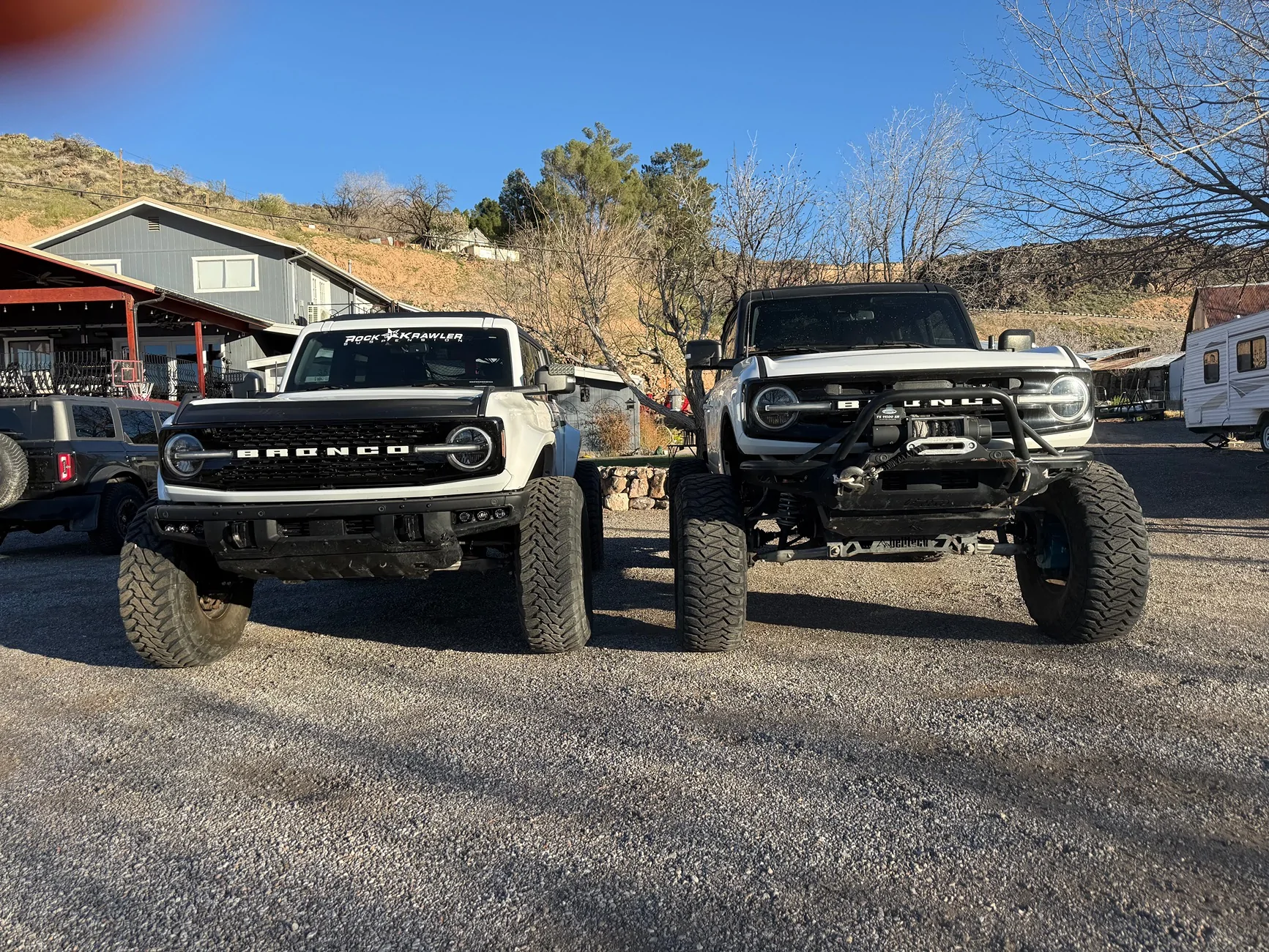
Ours on the left, with 5.5” of portal lift. On the right, 4” of portal lift with a Belltech diff drop. Both rigs running the same 8” Rock Krawler coilovers up front.

On the first version of our portal build, with coilovers set properly (roughly mid-stroke as the normal ride height) right away we noticed the COG increase with the portals while on the shakedown run. We reduced the preload to lower the ride height, but then we were bottoming out the coilovers on the smallest of bumps. This started our plans to lower the ride height via taller shock towers. And if we were doing that, we might as well run longer coilovers as well and maximize the available travel. The OEM towers were cut off and we built our own units that are 3.75” taller, allowing the use of 8” coilovers while also reducing ride height by two inches. Lowering the rig was no small feat, and most people are not terribly interested in cutting apart the structure of their new car. But it made a significant difference in stability and was a very welcome change when running portals. The change up front also required the rear suspension to be modified. That said, more needed addressed on the back than simply lowering the ride height. That brings us to the next topic-axle wrap aka the portal bounce.

Portal-Induced Axle wrap
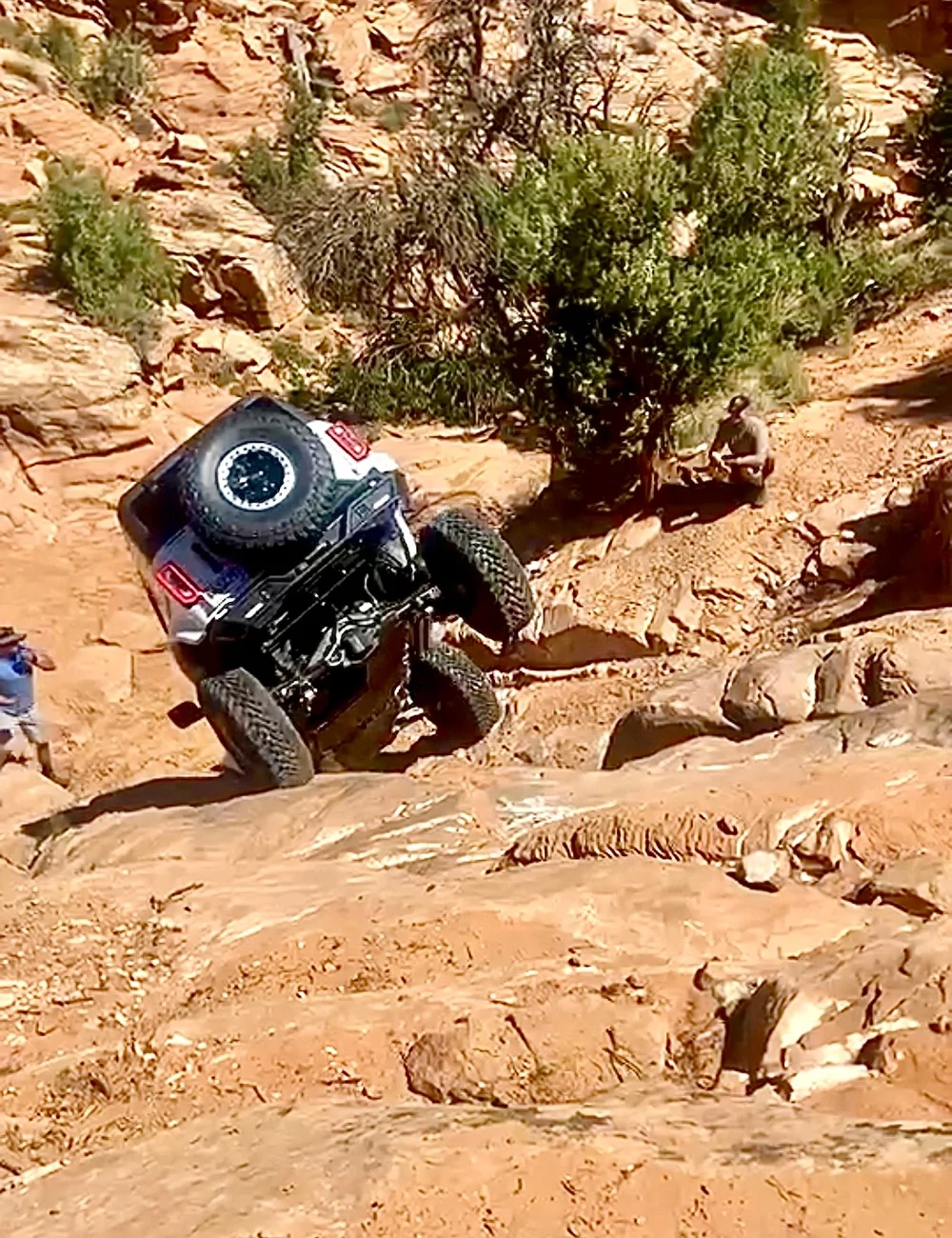
The “portal bounce” is in reference to the bouncing all vehicles sometimes experience when climbing or accelerating due to axle wrap. I never really thought too much about our bronco bouncing when other rigs didn’t, as we primarily wheeled with Jeeps up until UBB last year. It’s difficult to use different vehicles as a basis of comparison. Then we had the opportunity to wheel with similarly equipped broncos, with and without portals. The portal rigs on the same obstacles, regardless of portal brand, consistently bounced when the conventionally equipped bronco’s did not.
What is axle wrap?
When wishing to move forward, anytime you apply the throttle and the tires have traction, your axle will try to rotate backwards. The axle moves forward before the vehicle and the suspension links are placed under tension. Depending on the forces created and the suspension kinematics, the vehicle will start moving forward smoothly or, in more demanding cases, the friction on the tire is overcome and the axle snaps back to the normal positioning under the car. This is called axle wrap. To illustrate what axle wrap is, let’s use a leaf sprung vehicle as an example. With spring under the axle, you have the least amount of potential axle wrap, or twisting the spring as the axle tries to rotate. But you also lose clearance. Easy solution-slap the springs on top of the axle. Quick three inch lift and more clearance at the leafs. (Not diff) But! Now the torque is under the leafs, applying more leverage against the long plies of metal, trying to twist the layers into an S shape. As the leafs twist, energy is built to the point of overcoming the traction of the tires, and the tires snap rearward back into position. Despite this phenomena occurring, some owners still want even more lift without spending cash on new leaf packs, so they put even taller blocks between the leaf and axle. The blocks create a huge leverage increase, just like using a cheater bar to break a stubborn nut loose. The additional leverage deforms the springs more easily. Further deformation of the spring allows the axle to travel forward even further before snapping back, resulting in preposterous axle wrap. You’ll see these trucks hopping like crazy just accelerating on pavement. Now ask that rig to climb a steep rock, transferring the weight to the rear axle. The bouncing that occurs is next level, and broken parts are inbound. Next they buy traction bars that run from the frame to a pivot point under the axle to try to gain some control over the axle rotation. Bonus points because those bars look cool running from the middle of the frame to the axle. It’s basically a trophy truck now. If I did a good job explaining what axle wrap is, you should easily be able to understand how putting portals onto a leaf-sprung vehicle would be a terrible idea. Yet, you’ll see portal manufacturers or retailers installing portals onto a Toyota Tacoma then proudly announcing to the world how it is now an ultimate build. If my explanation wasn’t clear, I do apologize for failing you. Please do a search on the internet for videos of axle wrap to get an explanation and visual that helps make sense of all this.
Enter modern suspension with upper/lower links that help control rotation and keep the axle in place. The lower link is typically below the axle and the uppers are above it. Throttle is applied and the axle still has a need to rotate, but that rotation is much more controlled. The bushings within the link ends, like most OEM designs, are set up to find the optimum balance between comfort, longevity, and deflection. As such, they are on the softer side and it’s possible to get 1-2 degrees of rotation in the axle due to the 1/16”-1/8” deflection in the bushings. Then we add portals. We have now moved the output under the lower links, gave it a lever, and multiplied the torque with the gear reduction. (Bigger tires also increase leverage) Basically a very expensive lift block with many more failure points. The OEM suspension isn’t set up for these forces and any small amount of axle rotation is exaggerated by whatever length of lever you have-aka your portal lift. If you have a 4” lever attached to a 3” circle (5.5” lever overall) that 1/8” of rotation at the axle comes out to the portal itself rotating forward almost a half inch. It’s not as extreme as the 2-4” you might realistically see with a leaf spring suspension, but it does indeed make a difference, and as a result-portal rigs utilizing OEM suspension mounting locations bounce more.
To address the axle wrap in our portal build, we went the “traction bar” route by getting trailing arms that mounted UNDER the output of the portal. We also went higher above the diff for our upper mounts. The goal being an increase in link separation to gain more control over the axle rotation. Deflection was also decreased by sacrificing ride comfort by using heim joints at the axle. Polyurethane anti-wobbles are still used at the frame. In the limited testing we did with another 4-Door bronco on the same portals and smaller 38” tires (less leverage) our changes made a very noticeable difference when it came to the portal-equipped rear axle induced bounce. Of course, in lowering the lower link attachment point, we lost clearance at the trailing arms, but it was an acceptable tradeoff. We also adjusted the arm mounting location and moved it outside the frame, putting the arm next to the tire to help reduce how often it was getting snagged. (There are other benefits to this as well) We did the front shock tower modification and rear suspension changes at the same time, lowering the ride height to improve COG while also bottoming out less, and we were quite pleased with the results. Other portal owners seeing the changes in action were impressed as well.


We’re in the process putting the long travel bronco together, and I needed a better way of explaining the different link suspensions to wifey. French fries and straw wrappers at a local restaurant wasn’t cutting it. Found this series and this guy does a phenomenal job.
How is this relevant to the portal conversation? In the linked video, he talks about bushing deflection, and has a great example showing pinion angle change from bushing deflection. He also shows how link separation can make a difference in the angle change, based solely on the same bushing deflection. When we increased our link separation, the only real consideration was to counteract the portal leverage and control axle rotation. Didn’t even think to consider that there would be an appreciable difference in how the bushing deflection might change things. And while we do have heims at the axle end, all the anti-wobble bushings are indeed polyurethane. With links next to the axle-you have more rotation from bushing deflection. Increased link separation will decrease rotation.
Edit to include more explanation from @87-Z28 from another thread
Link to post with pictures
The distinction between loading and response is necessary. For the scenario of interest, body rotations in the for-aft and up-down plane must be considered. So pitch motions.
The loading occurs from traction forces at the tire/ground interface generated by torque at the wheel hub. That torque is multiplied by the portal gear ratio. The torque from the portal box also adds a moment at the axle shaft due to the moment arm (leverage). This doesn’t exist in non portal configuration. First plot shows a free body diagram. Second plot shows the increased reaction forces at the lower link due to portals. Link forces in non portal rig are fairly symmetric. Lower link forces for portal rig can double.
Now the response to this loading. If instant center for rear links is located on 100% anti squat line then the links will take all of the load and the springs will not be loaded. This is however not the case with the Bronco platform with oem link hard point locations. Plots 3, 4, & 5 show the “effective” anti squat for oem on 35s (sas), oem on 38s with a 3” suspension lift, and portals on 40s. Notice instant center moves further away from 100% anti squat. Hence the springs will need to respond to applied loading.
Springs are only slightly more engaged for portal build (as compared to a typical non portal build on 38s), but applied loading is more severe in portal rig. This will begin to engage pitch motions and thus portal bounce. The applied loading is the cause.
Effects of the portal on a trailing live axle
Continuing the build with a rear portal delete-On one of our trips to the Rubicon last year, we snapped a rear axle shaft. Okay, no big deal. Axle shafts break. Pull the sucker out, cut it off after the tone ring, and let’s go, right? There was a Jeep out with us that also had a broken axle, and this was very much the case with them. On portals? Well…maybe not so much.
Perhaps always having lockers we never really noticed it, but with an unpowered rear corner and portals (the portal itself wasn’t damaged. It spun freely) it seemed that whenever you had a ledge to climb while going uphill the dead corner would act like an anchor. Certainly the problem is exacerbated going uphill due to the weight transfer and the other side spinning when using the locker, effectively giving you a trail turn assist dialed up to eleven. But even being pulled or winched, the portals on the solid rear axle and OEM suspension link placement seemed to resist moving forward and would instead start trying to twist the axle, even with the tire aired up to street pressure. Initially I thought our suspension setup might have exaggerated this problem, as it was semi triangulated upper links with parallel lowers and a panhard delete, but it does seem to be an issue with conventional five links as well. The way the portal acts as a moment arm seems to have a deleterious effect on a suspension not designed for those forces. I’ve made offers to other portal owners to borrow the stub that plugs into the portal to seal it, then go wheeling to confirm that this is not an isolated incident. Seems that the idea of pulling the portal, removing the axle, placing the plug, then taking it out to wheel with a certain loss of performance isn’t how most people want to spend their day wheeling, and no one has accepted the offer. There are videos on the internet showing this same issue on other portal-equipped rigs, so there does seem to be some legitimacy to the issue not being an isolated event.
The axle seals
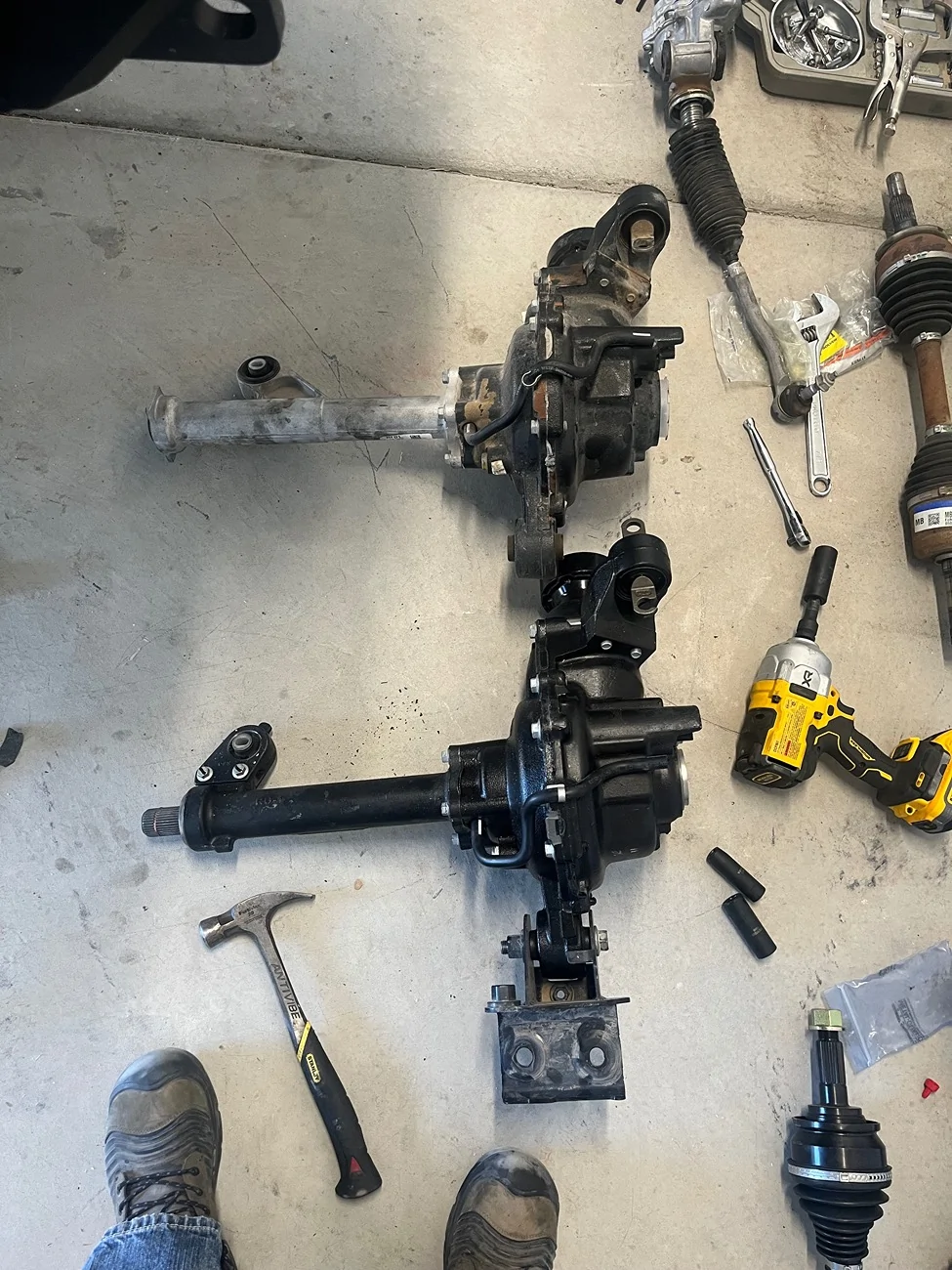
Personally, when changing the oil on various items, I just throw the oil pan under the drain and do other things as it empties. When wifey was draining the portal oil to swap the portals to a different axle, she was paying attention and noticed the driver side seemed to have much less oil than the passenger side. We couldn’t figure out where the oil went as there were no surface leaks, and we absolutely know that we filled them with the proper volume. This happened to occur when we were swapping parts between a 2022 and a 2024 bronco, and when we popped the axle shafts off of the new axle filled at the factory, there was a little bit of gear oil that came out, but not much. But when we pulled the portals off the old axle, a bunch of oil dumped out. Light bulb illuminated on where the oil possibly went. We reached out to other portal owners and asked that they park their rig on level ground and remove the fill port of the differential. If normal, no big deal. If excessive oil dumps out, check your portal levels. It turns out that one owner was losing so much oil that he was filling them every 1000 miles, but not realizing where the oil was going.
With the axle shaft going into the portal, you obviously need a way to seal the portal box vs the axle housing, just like you need to seal the axle housing or pinion. On a normal axle, if the seals develop a leak, you have a visual indication. No big deal. On the front portals, you have the same visual indication of a leak. But with portals bolted to a rear axle? As we and others have discovered, you have no idea that the seal is leaking unless you diligently measure how much oil is returned when changing the oil. The original oil change schedule is 3,000 miles and we adhered to it, despite the oil looking perfectly fine when being changed. In an effort to make the portals more palatable to the masses, manufacturers are now increasing that oil change frequency, and as far as oil life itself is concerned, that shouldn’t be an issue. But if your seals are leaking…your bearings might have a bad time if they run dry at high speeds. Which means you might have a bad time. To experiment we added a second breather hose to each rear portal and put them both on their own catch can “circuit” to see if that had any effect on reducing the case pressure and helping the seals out. We then ran to the rubicon (1200 miles) and back, with a stop in Moab, and checked the fluids again. They were slightly better but it’s difficult to conclusively say if that was due to the second hose or not. The seals were changed before making the same trip again, and that fixed the problem.
With all things considered, we started looking into running mixed ratios and deleting the rear portals. With portals up front on an IFS rig the issue associated with a broken/unpowered axle isn’t the same, and it seems to be due to being pushed up and over opstacles, as well as the directional of travel being transverse or “perpendicular” to the direction of travel as opposed to longitudinal, or “parallel” travel of the trailing solid axle. @Ducati1098 and @BigMeatsBronco were contacted to see if there were any output sensors on the transfer case to worry about, and it seemed all is well. Only need to be concerned with the wheel speed sensors. From there came finding gearing combinations that would work. We created a spreadsheet to easily spit out rear R&P ratios needed for all the available front differential options and different portal reductions. The 32 spline ultimate D44 FDU is compatible with any D44 combination that uses Advantek gears. As for the rear axle, searches were done on ratios for Dana 60, Ford 9”, and GM 14 bolt. F9 and G14 were of particular interest for the triple sheared pinion, knowing that the gear ratio would likely be very short. Unfortunately, locker options were limited and we weren’t terribly interested in ARB due to the pneumatic system. Ford 9” had many gear ratio selections, but everything seemed to always be race gears and not suitable for daily driving. Ultimately we settled on a Dana60 equipped with an Ox Locker with a gear ratio of 6.17:1. The front was regeared to 4.56 and with Werewolf portals 1.35 reduction, the final ratio up front comes out to 6.156:1.
In researching this project, we learned a lot about the history of mis-matched gears front to rear. It’s very common in tractors with their tire size differences, but it was even a normal practice by automobile OEM’s, some running a combination of 4.09 front and 4.10 rear. It’s important that between the two the front is driving harder, as it’s easier to drag the rear wheels slightly to avoid bind vs the rears pushing the heavily weighted front. That’s when drivetrain bind occurs and parts start breaking. Some manufacturers have gone as far as 1.5% between front and rear, and it sounds like the Ford computer won’t freak out below 2%. So we should be plenty fine with our very small difference.
Live axle mounting practices
With bolt-on rear portals, the boxes are using the factory mounts on the flange meant to bolt the semi-floating axles in to the housing. These small bolts and the tapped internal threads in the portal box the bolts or studs are threaded in to are now being subjected to massive amounts of stress from the leverage of the portals. On the more careless side of the manufacturing options, threads were simply cut in to the aluminum, short cutting generally accepted safe thread engagement practices in what seems to be an effort to reduce overall packaging width. Those portals were quick to show this design flaw when used with bolts accommodating Japanese platforms and started failing. The portal manufacturer increased the bolt size and fixed the old portals. As for the bronco platform specifically, the long term life of these threads would be safe to question, as the decision was made to use 1.5xdiameter for thread engagement, the very minimum of what’s considered acceptable thread engagement with no safety factor in aluminum threads. A safe opinion could be that while 1.5x might suffice for lighter static loads in high-strength aluminum like 7075, blind threads in a portal box could be severe duty use given the combination of high torque from large tires and gear reduction, shock loading from aggressive offroading, vibration-induced fatigue, and potential mixed-mode stresses (tension, shear, and bending) and demands a more conservative approach. Engineering references consistently recommend 2.0–2.5x diameter (1.0–1.25 inches) for aluminum threads in high-vibration environments to ensure reliability and safety, though it could be argued that the use of four bolts reduces the need for even 1.5x thread engagement. Given the importance of these bolts and referring back to the conditions they’re being subjected to, some might say it’s better to be safe than sorry. Not to focus in on one portal makers choices, there are various other ways the mounting is being addressed by the other manufacturers in the space. Steel inserts embedded into the portal housing, steel flanges that increase bolt count in the aluminum, and steel portal boxes with supplemental braces. It does seem prudent to try increasing the strength of this critical mounting surface and will be interesting to see how these designs hold up over time. And while some designs could be interpreted as better than others, that still doesn’t address the next topic associated with bolting portals on to an OEM solid axle.
As already noted, (maybe not. I don’t remember where I’m inserting this information) it’s quite likely that you’ll discover the desire to continue making modifications to your rig after installing the portals. Suspension changes are likely, and depending on what route you take you may find yourself starting to tear the boots on the rzeppa driveline, or rubbing the driveline against your fuel tank. A great upgrade is a double cardan 1350 driveshaft to gain strength and operating angles while mitigating vibration. The OEM Pinion angle is just slightly under aligning with the driveline, and when swapping to a DC unit it is recommended to adjust your pinion angle to be 1 degree above the driveline in order to keep the cups spinning to move the grease in the needle bearings. This small rotation, as previously mentioned, is exacerbated at the end of the portals, where they are no longer perpendicular to the ground but instead at an angle biased towards the front of the vehicle. Your control arms are now under constant strain, even when stationary. The threads previously mentioned, despite the portal box being supported by the full-float engagement into the axle housing, are also being subjected to this constant stress. Your axle housing itself is now constantly being “twisted” ever so slightly. The M220 has already gained a reputation for the axle tubes spinning inside the diff housing when trail turn assist is used in high traction situations, and portals in their normal position certainly aren’t helping mitigate the forces on the tubes. This angle only further compromises the strength of the axles. Plan your modifications accordingly.
Lost benefits?
The first obvious negative that we’re looking at is the loss in clearance. We had already reduced the clearance by dropping the lower link location, and now we’ll be dropping it again by another four inches. As well as the differential. Is this something I’m terribly worried about? Not particularly. A counterpoint could be made that with the portals moving the wheel down in relation to the output, you now have to mount the brake calipers on the bottom of the rotor. All that clearance you gained with the portals is now effectively cancelled. One could even argue that it is less clearance. You definitely need to be mindful of your brake calipers and portal users have indeed hit and broken their rear park brake actuators or hoses. This is no longer as much of a concern with the brake calipers being back in their OEM placement on top of the rotor.
On the flip side of the clearance issue, this setup is making up that four inch axle lift difference with longer coilovers. Something that is not focused on enough is that portal lift is not “active“ as far as suspension is concerned. It is an incompressible lift and that 4-5 inches needs to be accounted for somewhere within the system. With the 12” coilovers and relatively low ride height, bottoming out was still a concern. “Pushing” the axle down is similar to what we did up front by pushing the shock towers up. With the 14” coilovers in place, we now have 6” of shock up travel, or 8” of up travel at the wheel, with 9.25” of clearance from the tire to fender. We set the hydraulic bump stops appropriately to ensure we don’t tear the fenders off when articulating but we’re very happy with how that turned out. More articulation can open up your line options if clearance is an issue, though it’s certainly not always a possibility.

With the coilover length change, that also gave us some options for additional tuning of the coils themselves. We previously had a 12” 400 lb/in coil stacked with a 12” 500. This gave us 14.4” of coil travel on a 12” coilover and an effective spring rate of 222 without accounting for motion ratio. With the 14” shocks, we stacked a 12” 400 with a 16” 400, providing 16.8” of coil travel and a spring rate of 200. The 12” 400/500 combo suspends 2970 pounds not accounting for motion ratio. The 12” 400/16” 400 is 3364. So not only are we getting more travel, but we’ll be able to support our slightly heavier load (tools and parts when wheeling) while also having a more supple ride.
Rear Block Height Travel Block Load
12” x 400 4.57 7.43 2970
12” x 500 5.00 7.00 3503
9.57 14.43 6473
12” x 400 4.57 7.43 2970
16” x 400 6.61 9.39 3754
11.18 16.82 6724
With the old 400/500 setup, the upper coil lockout engaging took the spring rate from 222 to 500, and the transition felt quite harsh. We ended up setting the lockout for the block height only to protect the coil. With the new 400/400 setup, we’re going to try setting the upper coil lockout to where the 12” coil will stop compressing at six inches. At that point the remaining compression travel will be on the single spring, taking the spring rate from 200 to 400. Still a big jump, but shouldn’t be as jarring as before.
Did we lose strength?
A common selling point of the portals is the reduced stress on drivetrain components. It is even been said by those selling portals that the portals will make your drivetrain stronger. One seller going so far as to suggest that a Dana 44 with portals is stronger than a D60. Absolutely having a reduction at the hubs will aid in keeping a numerically lower (taller) ring and pinion that will be stronger than regearing to shorter options. But many IFS owners are still frequently breaking their CVs, even with smaller tire sizes. Rear axles are being broken as well, including those with the Dana 60. Yes fatigue and driving styles are absolutely going to play a factor, but to suggest that the portals will prevent breaking is misleading. If big tires and heavy wheeling are planned for your build, it would be recommended to still upgrade both front and rear axles to improve reliability, whether running portals or not

Gearing Math and Tradeoffs
With portals front and rear, the common bolt-on options are getting reductions from mild of ~1.10:1 with Turn portals to wild of 1.35:1 with Werewolf. It’s nice to be able to leave the gears in your differentials alone. Of course, we didn’t do that, and had to go very aggressive out back. With 6.17:1 gearing, the pinion gear is going to be pretty small despite being a D60. (D80 was preferred but again-no locker options of interest. Until just recently when Ox released their D80 locker. Dangit!) As a result-weak gears. It’s still a one-ton gearset and the shop that built the axle believes it should hold up as long as we aren’t doing huge sends, but it’s something we need to keep in mind. Wifey has a soft foot and that will be helpful, but I would have much preferred to be in the mid or low 5’s. We opted for a 1310 ujoint to act as a fuse with it being easier to replace than the R&P, but it’s still in the back of my mind that even the little tike will be stronger than the pinion gear. Allegedly, the gear contact ratio of a D60 with 6.17’s is higher than a D44 with 5.38’s, though…that’s not saying a whole lot. Luckily these gears are not difficult to source for the D60, but it’s still not a simple job to swap them out and really sucks to break gears on the trail. Hopefully the four spider gears used in the Ox locker help keep carrier alignment true by distributing loads more evenly as compared to lockers with two gears. The locking mechanism on Ox lockers is also meant to stay positively engaged in even the harshest conditions, minimizing ratcheting (partial disengagement) that can damage gears.
The short rear gearing will be more susceptible to heat, especially on long climbs at highway speeds. That said, so far in 1300 miles of use on the 6.17 gears we haven’t seen temperatures above 151F. We’ll still be changing the oil frequently, so having a drain in the diff cover will be quite useful assuming we don’t need to frequently pull the cover due to broken gears.

How is the hybrid setup performing?
Before testing it on the road, we put the rig on jack stands then applied a strip of masking tape to the tires. In 4L we put the transmission in drive and let the tires rotate freely, using the tape to count rotations and compare distance traveled. Just to be safe. At one point while putting everything together I had a moment of panic when thinking that I was trusting these vendors to provide the correct gearing as ordered. I didn’t check any tooth counts myself personally. What if the portals were actually 1.3 instead of 1.35?!? Or the front diff was 4.10 not 4.56?!? This test put my mind at ease and everything looked good.
First item of note-the ABS system. The portals use the input gear for the wheel speed sensors. This prevents the need to accommodate any kind of tone rings in the rear portals, and the factory tone rings on the axle can be used. As it relates to a front-portal-only build, now the computer sees very different speeds, despite the tires turning at the same speed. Hopefully custom tone rings on the rear axle will fix the difference. We used Forscan to monitor the wheel speed sensors and it showed us to be off by an average of 35%. Makes sense given 6.17/4.56=1.35. But we wanted to be certain before getting custom rings made. Besides the ABS not working due to the discrepancy, it drove just fine and could cruise at 89 mph.
As to the offroad ability, from the perspective of the spotter absolutely this setup worked very well. All the additional flex made obstacles previously attempted possible or easier, and the reduced axle wrap was noticeable. We did get hung up on the diff on one obstacle and opted for a winch rather than velocity to get through it. Wifey said that this is definitely her favorite build of what we’ve done so far. It felt very planted and more predictable, but she’s looking forward to comparing it against a long travel rig. More on that in the near future.

An introduction to portals
These accessories are marketed to mount on OEM components and utilize factory ABS sensors, maintaining all the electronics without creating a Christmas tree dashboard. No modifications to the suspension, axles, or steering needed! Sounds pretty great! You may hear influencers touting portals as “the ultimate bolt on accessory” with a focus on all of the benefits (some stretched significantly on reality) and zero drawbacks. Nothing is free, as the saying goes, but unfortunately many people believe the hype, and portal manufacturers seem to rely heavily on internet personalities to push their products. I was slightly more fortunate to have a modicum of skepticism, recognizing that this was not as simple as bolting on a set of knuckles due to the associated forces from the leverage and weight of the units. When planning the original build, strength to support the addition of the portals was a primary focus. Upper control arms were replaced and the mounting bolts double sheared. Lower control arm tabs were reinforced. The rear upper arm mounts were boxed in with 1/4” plate. The diff housing on the stock axle was welded to the tubes and a truss installed. The M210 front drive unit was replaced with a 32 spline Dana Ultimate 44. You get the idea.
While it’s obvious that portals won’t provide any kind of articulation increase, part of the allure is that, despite the previously mentioned modifications, you’ll still be able to use many OEM parts that are easily sourced if broken. Sticking with OEM means extended CV’s and tierods aren’t needed, but you are limited in CV angle. We chose to run Rock Krawler coilovers on the build to try to maximize the travel available within the constraints of the OEM mounting points, with adjustable preload to try to keep the ride height down due to the increase of center of gravity. That brings us to the first topic of discussion.
Edit-including brief information of steering and suspension
This write-up originally started as an explanation for why we sought out to experiment with the rear portal delete. For this reason, I didn’t include a discussion on steering and suspension tuning as those weren’t changing between the two builds. But the original post grew into a being more informative on portals themselves, so I’m inserting that information here.
Steering and Scrub Radius
From a simplistic perspective , think of the portals as expensive wheel spacers. Four inches wide. When you push the portals away from the king pin axis, you are creating a bigger arc that the tires will make when turning. A pattern similar to a windshield wiper. The further away from the pivot point, the larger the arc created by the tires. And portals create a very large arc. The steering is heavier, bumps in the road are more noticeable, and the performance of the steering rack is reduced. More stress is also seen by the steering components due to the additional leverage applied to the tires trying to toe out with acceleration, and toe in under braking. Higher offset wheels will help, but each portal manufacturer has their limits on what wheel options will work. When planning our build, I reached out to a manufacturer to see what offset would be possible with 20” wheels and their portals. The owner had no interest in sharing this information, saying no difference would be noticed, and instead suggested the best option is to buy their 17” wheels with +45mm offset. The performance of their customers build was less important than selling another $4000 in wheels…this theme of deceiving marketing seems to persist within the portal industrial complex…
Suspension tuning
With the added width of the portals, you are going to need to adjust your spring rate on the coilovers used on the independent suspension. You’re also significantly increasing your unsprung mass. You will absolutely want custom tuning done to account for all these changes associated with the portals. My good friend on Tibus portals ran with coilovers tuned for a conventional bronco for over a year before taking the plunge on custom units. He couldn’t believe how much better it was, as the violent diving under braking or hard lifting with acceleration was gone. The vehicle felt much more stable and controlled. You will also want to add limit straps, as not all coilovers are created equally and some will not hold up to the abuse of being used as a limiting device.
Center Of Gravity Realities-
When it comes to the center of gravity (COG) the portal manufacturers claim it’s a non-issue as you are increasing the width by the same height of lift. This isn’t exactly accurate. The nature of the axle-lift and the clearance provided lifts everything above the hub centerline. An axle lift compared to a conventional lift is a small, but meaningful difference. The next big change is of course, tires. And then, because you’re still limited on travel, aftermarket coilovers are added-all of which further lift the vehicle. The following is information put together by @87-Z28 . He provides a brief explanation, then provides numbers based on OEM data and some math to provide support to the information.
Stability Angle as a reference to COG, simply put - if track width stays the same and CG height increases, then stability angle increases. It gets steeper/easier to tip over. A very simple geometric metric. Dropping CG and keeping track width the same always decreases angle. Dropping CG is good for stability.
As the stability angle increases you get closer to the static tipping point, when angle is exactly 90 degrees.
Of course this is all only static and dynamic forces dominate, for example lateral G’s. But nonetheless, stability angle helps compare two different rigs. The lower the stability angle the greater rotation required to reach tipping point.
Sasquatch : distance from rear axle center line to CG is 13.5. So on 35s the CG= 13.5+17.5=31 and track width 66” so about 43 degrees.
OEM on 37s with 3” suspension lift, a common build. CG=13.5+18.5+3=35 and track width 33, so 47 degrees. About 4 degrees worse than SAS.
Aluminum portal Bronco on 40s with 2” suspension lift (coilovers). CG= 13.5+20+2+4=39.5 and track width goes to 74. So 47 degrees. 4 degrees worse than SAS. Steeper than SAS and less stable.
At first thought when comparing these numbers, it looks like the portals are the better option, but it’s important to keep in mind that the lifted OEM on 37’s is still using the stock width suspension. If you were to replace the arms and axles to get a width similar to that of portals, not only will the stability angle be improved, but you’ll have significantly more travel. And less clearance, of course.
Keep in mind, these numbers only reflect a basic lift, and do not account for additional changes that would reflect an axle lift.
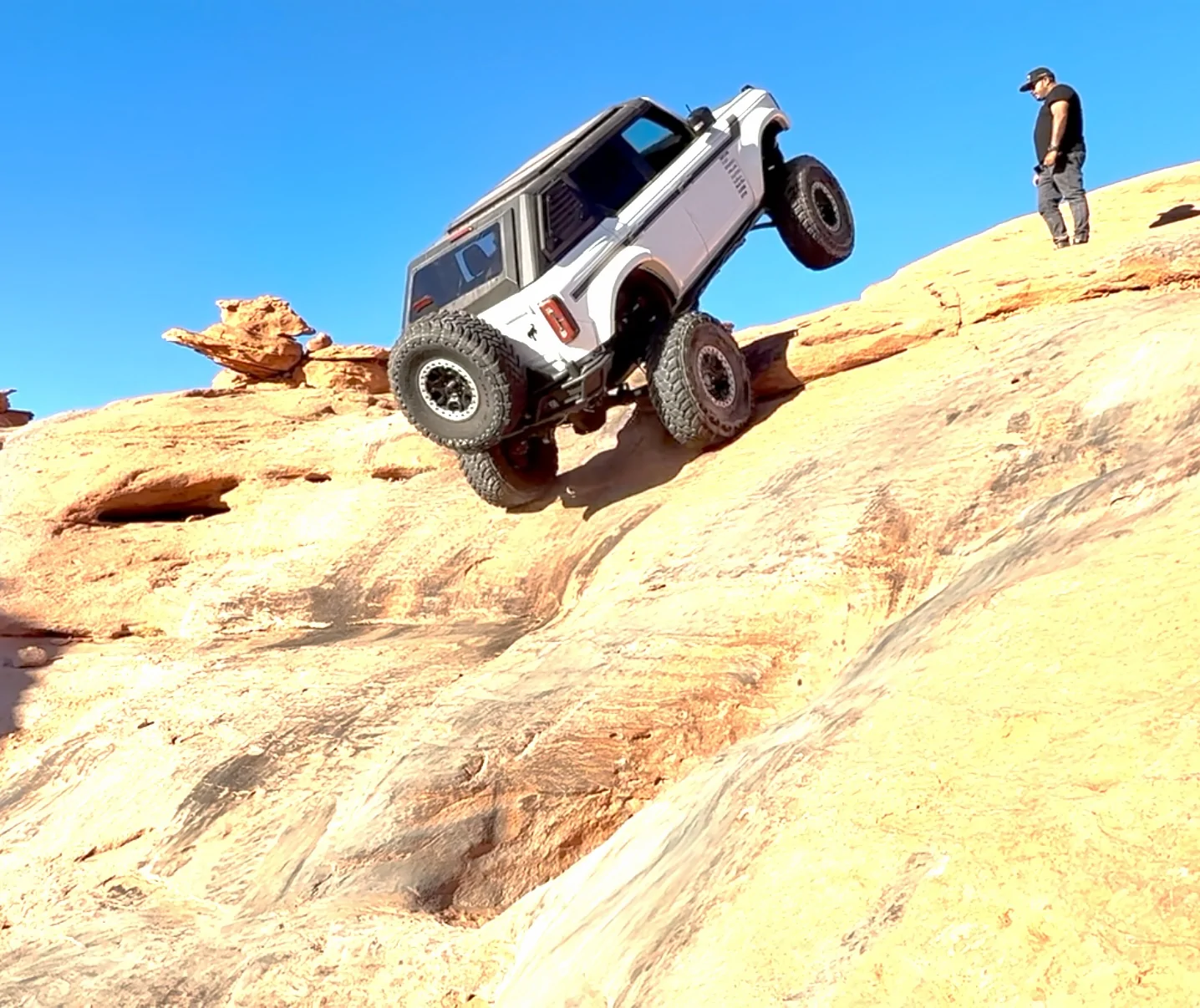
Ours on the left, with 5.5” of portal lift. On the right, 4” of portal lift with a Belltech diff drop. Both rigs running the same 8” Rock Krawler coilovers up front.
On the first version of our portal build, with coilovers set properly (roughly mid-stroke as the normal ride height) right away we noticed the COG increase with the portals while on the shakedown run. We reduced the preload to lower the ride height, but then we were bottoming out the coilovers on the smallest of bumps. This started our plans to lower the ride height via taller shock towers. And if we were doing that, we might as well run longer coilovers as well and maximize the available travel. The OEM towers were cut off and we built our own units that are 3.75” taller, allowing the use of 8” coilovers while also reducing ride height by two inches. Lowering the rig was no small feat, and most people are not terribly interested in cutting apart the structure of their new car. But it made a significant difference in stability and was a very welcome change when running portals. The change up front also required the rear suspension to be modified. That said, more needed addressed on the back than simply lowering the ride height. That brings us to the next topic-axle wrap aka the portal bounce.
Portal-Induced Axle wrap
The “portal bounce” is in reference to the bouncing all vehicles sometimes experience when climbing or accelerating due to axle wrap. I never really thought too much about our bronco bouncing when other rigs didn’t, as we primarily wheeled with Jeeps up until UBB last year. It’s difficult to use different vehicles as a basis of comparison. Then we had the opportunity to wheel with similarly equipped broncos, with and without portals. The portal rigs on the same obstacles, regardless of portal brand, consistently bounced when the conventionally equipped bronco’s did not.
What is axle wrap?
When wishing to move forward, anytime you apply the throttle and the tires have traction, your axle will try to rotate backwards. The axle moves forward before the vehicle and the suspension links are placed under tension. Depending on the forces created and the suspension kinematics, the vehicle will start moving forward smoothly or, in more demanding cases, the friction on the tire is overcome and the axle snaps back to the normal positioning under the car. This is called axle wrap. To illustrate what axle wrap is, let’s use a leaf sprung vehicle as an example. With spring under the axle, you have the least amount of potential axle wrap, or twisting the spring as the axle tries to rotate. But you also lose clearance. Easy solution-slap the springs on top of the axle. Quick three inch lift and more clearance at the leafs. (Not diff) But! Now the torque is under the leafs, applying more leverage against the long plies of metal, trying to twist the layers into an S shape. As the leafs twist, energy is built to the point of overcoming the traction of the tires, and the tires snap rearward back into position. Despite this phenomena occurring, some owners still want even more lift without spending cash on new leaf packs, so they put even taller blocks between the leaf and axle. The blocks create a huge leverage increase, just like using a cheater bar to break a stubborn nut loose. The additional leverage deforms the springs more easily. Further deformation of the spring allows the axle to travel forward even further before snapping back, resulting in preposterous axle wrap. You’ll see these trucks hopping like crazy just accelerating on pavement. Now ask that rig to climb a steep rock, transferring the weight to the rear axle. The bouncing that occurs is next level, and broken parts are inbound. Next they buy traction bars that run from the frame to a pivot point under the axle to try to gain some control over the axle rotation. Bonus points because those bars look cool running from the middle of the frame to the axle. It’s basically a trophy truck now. If I did a good job explaining what axle wrap is, you should easily be able to understand how putting portals onto a leaf-sprung vehicle would be a terrible idea. Yet, you’ll see portal manufacturers or retailers installing portals onto a Toyota Tacoma then proudly announcing to the world how it is now an ultimate build. If my explanation wasn’t clear, I do apologize for failing you. Please do a search on the internet for videos of axle wrap to get an explanation and visual that helps make sense of all this.
Enter modern suspension with upper/lower links that help control rotation and keep the axle in place. The lower link is typically below the axle and the uppers are above it. Throttle is applied and the axle still has a need to rotate, but that rotation is much more controlled. The bushings within the link ends, like most OEM designs, are set up to find the optimum balance between comfort, longevity, and deflection. As such, they are on the softer side and it’s possible to get 1-2 degrees of rotation in the axle due to the 1/16”-1/8” deflection in the bushings. Then we add portals. We have now moved the output under the lower links, gave it a lever, and multiplied the torque with the gear reduction. (Bigger tires also increase leverage) Basically a very expensive lift block with many more failure points. The OEM suspension isn’t set up for these forces and any small amount of axle rotation is exaggerated by whatever length of lever you have-aka your portal lift. If you have a 4” lever attached to a 3” circle (5.5” lever overall) that 1/8” of rotation at the axle comes out to the portal itself rotating forward almost a half inch. It’s not as extreme as the 2-4” you might realistically see with a leaf spring suspension, but it does indeed make a difference, and as a result-portal rigs utilizing OEM suspension mounting locations bounce more.
To address the axle wrap in our portal build, we went the “traction bar” route by getting trailing arms that mounted UNDER the output of the portal. We also went higher above the diff for our upper mounts. The goal being an increase in link separation to gain more control over the axle rotation. Deflection was also decreased by sacrificing ride comfort by using heim joints at the axle. Polyurethane anti-wobbles are still used at the frame. In the limited testing we did with another 4-Door bronco on the same portals and smaller 38” tires (less leverage) our changes made a very noticeable difference when it came to the portal-equipped rear axle induced bounce. Of course, in lowering the lower link attachment point, we lost clearance at the trailing arms, but it was an acceptable tradeoff. We also adjusted the arm mounting location and moved it outside the frame, putting the arm next to the tire to help reduce how often it was getting snagged. (There are other benefits to this as well) We did the front shock tower modification and rear suspension changes at the same time, lowering the ride height to improve COG while also bottoming out less, and we were quite pleased with the results. Other portal owners seeing the changes in action were impressed as well.
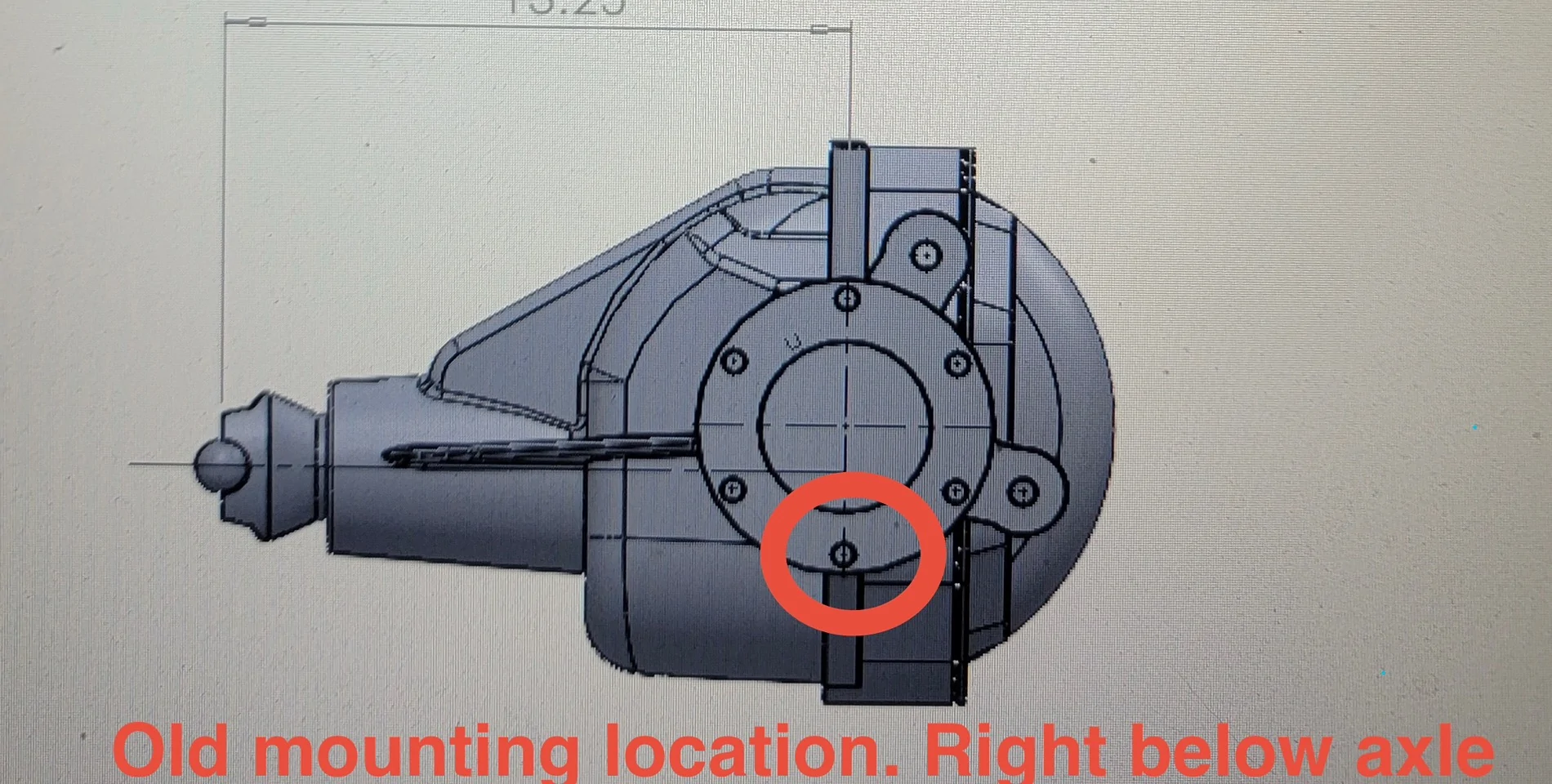
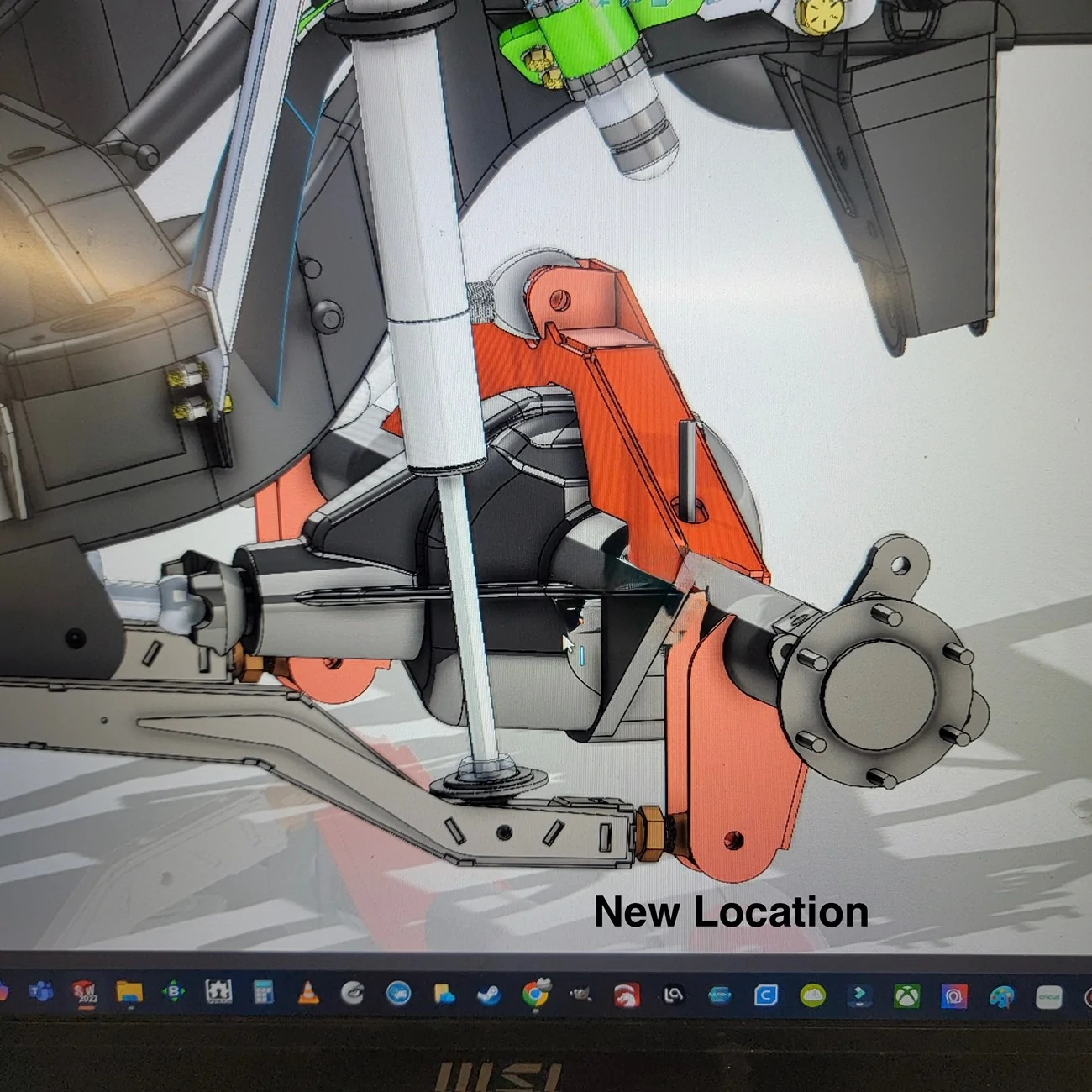
We’re in the process putting the long travel bronco together, and I needed a better way of explaining the different link suspensions to wifey. French fries and straw wrappers at a local restaurant wasn’t cutting it. Found this series and this guy does a phenomenal job.
How is this relevant to the portal conversation? In the linked video, he talks about bushing deflection, and has a great example showing pinion angle change from bushing deflection. He also shows how link separation can make a difference in the angle change, based solely on the same bushing deflection. When we increased our link separation, the only real consideration was to counteract the portal leverage and control axle rotation. Didn’t even think to consider that there would be an appreciable difference in how the bushing deflection might change things. And while we do have heims at the axle end, all the anti-wobble bushings are indeed polyurethane. With links next to the axle-you have more rotation from bushing deflection. Increased link separation will decrease rotation.
Edit to include more explanation from @87-Z28 from another thread
Link to post with pictures
The distinction between loading and response is necessary. For the scenario of interest, body rotations in the for-aft and up-down plane must be considered. So pitch motions.
The loading occurs from traction forces at the tire/ground interface generated by torque at the wheel hub. That torque is multiplied by the portal gear ratio. The torque from the portal box also adds a moment at the axle shaft due to the moment arm (leverage). This doesn’t exist in non portal configuration. First plot shows a free body diagram. Second plot shows the increased reaction forces at the lower link due to portals. Link forces in non portal rig are fairly symmetric. Lower link forces for portal rig can double.
Now the response to this loading. If instant center for rear links is located on 100% anti squat line then the links will take all of the load and the springs will not be loaded. This is however not the case with the Bronco platform with oem link hard point locations. Plots 3, 4, & 5 show the “effective” anti squat for oem on 35s (sas), oem on 38s with a 3” suspension lift, and portals on 40s. Notice instant center moves further away from 100% anti squat. Hence the springs will need to respond to applied loading.
Springs are only slightly more engaged for portal build (as compared to a typical non portal build on 38s), but applied loading is more severe in portal rig. This will begin to engage pitch motions and thus portal bounce. The applied loading is the cause.
Effects of the portal on a trailing live axle
Continuing the build with a rear portal delete-On one of our trips to the Rubicon last year, we snapped a rear axle shaft. Okay, no big deal. Axle shafts break. Pull the sucker out, cut it off after the tone ring, and let’s go, right? There was a Jeep out with us that also had a broken axle, and this was very much the case with them. On portals? Well…maybe not so much.
Perhaps always having lockers we never really noticed it, but with an unpowered rear corner and portals (the portal itself wasn’t damaged. It spun freely) it seemed that whenever you had a ledge to climb while going uphill the dead corner would act like an anchor. Certainly the problem is exacerbated going uphill due to the weight transfer and the other side spinning when using the locker, effectively giving you a trail turn assist dialed up to eleven. But even being pulled or winched, the portals on the solid rear axle and OEM suspension link placement seemed to resist moving forward and would instead start trying to twist the axle, even with the tire aired up to street pressure. Initially I thought our suspension setup might have exaggerated this problem, as it was semi triangulated upper links with parallel lowers and a panhard delete, but it does seem to be an issue with conventional five links as well. The way the portal acts as a moment arm seems to have a deleterious effect on a suspension not designed for those forces. I’ve made offers to other portal owners to borrow the stub that plugs into the portal to seal it, then go wheeling to confirm that this is not an isolated incident. Seems that the idea of pulling the portal, removing the axle, placing the plug, then taking it out to wheel with a certain loss of performance isn’t how most people want to spend their day wheeling, and no one has accepted the offer. There are videos on the internet showing this same issue on other portal-equipped rigs, so there does seem to be some legitimacy to the issue not being an isolated event.
The axle seals
Personally, when changing the oil on various items, I just throw the oil pan under the drain and do other things as it empties. When wifey was draining the portal oil to swap the portals to a different axle, she was paying attention and noticed the driver side seemed to have much less oil than the passenger side. We couldn’t figure out where the oil went as there were no surface leaks, and we absolutely know that we filled them with the proper volume. This happened to occur when we were swapping parts between a 2022 and a 2024 bronco, and when we popped the axle shafts off of the new axle filled at the factory, there was a little bit of gear oil that came out, but not much. But when we pulled the portals off the old axle, a bunch of oil dumped out. Light bulb illuminated on where the oil possibly went. We reached out to other portal owners and asked that they park their rig on level ground and remove the fill port of the differential. If normal, no big deal. If excessive oil dumps out, check your portal levels. It turns out that one owner was losing so much oil that he was filling them every 1000 miles, but not realizing where the oil was going.
With the axle shaft going into the portal, you obviously need a way to seal the portal box vs the axle housing, just like you need to seal the axle housing or pinion. On a normal axle, if the seals develop a leak, you have a visual indication. No big deal. On the front portals, you have the same visual indication of a leak. But with portals bolted to a rear axle? As we and others have discovered, you have no idea that the seal is leaking unless you diligently measure how much oil is returned when changing the oil. The original oil change schedule is 3,000 miles and we adhered to it, despite the oil looking perfectly fine when being changed. In an effort to make the portals more palatable to the masses, manufacturers are now increasing that oil change frequency, and as far as oil life itself is concerned, that shouldn’t be an issue. But if your seals are leaking…your bearings might have a bad time if they run dry at high speeds. Which means you might have a bad time. To experiment we added a second breather hose to each rear portal and put them both on their own catch can “circuit” to see if that had any effect on reducing the case pressure and helping the seals out. We then ran to the rubicon (1200 miles) and back, with a stop in Moab, and checked the fluids again. They were slightly better but it’s difficult to conclusively say if that was due to the second hose or not. The seals were changed before making the same trip again, and that fixed the problem.
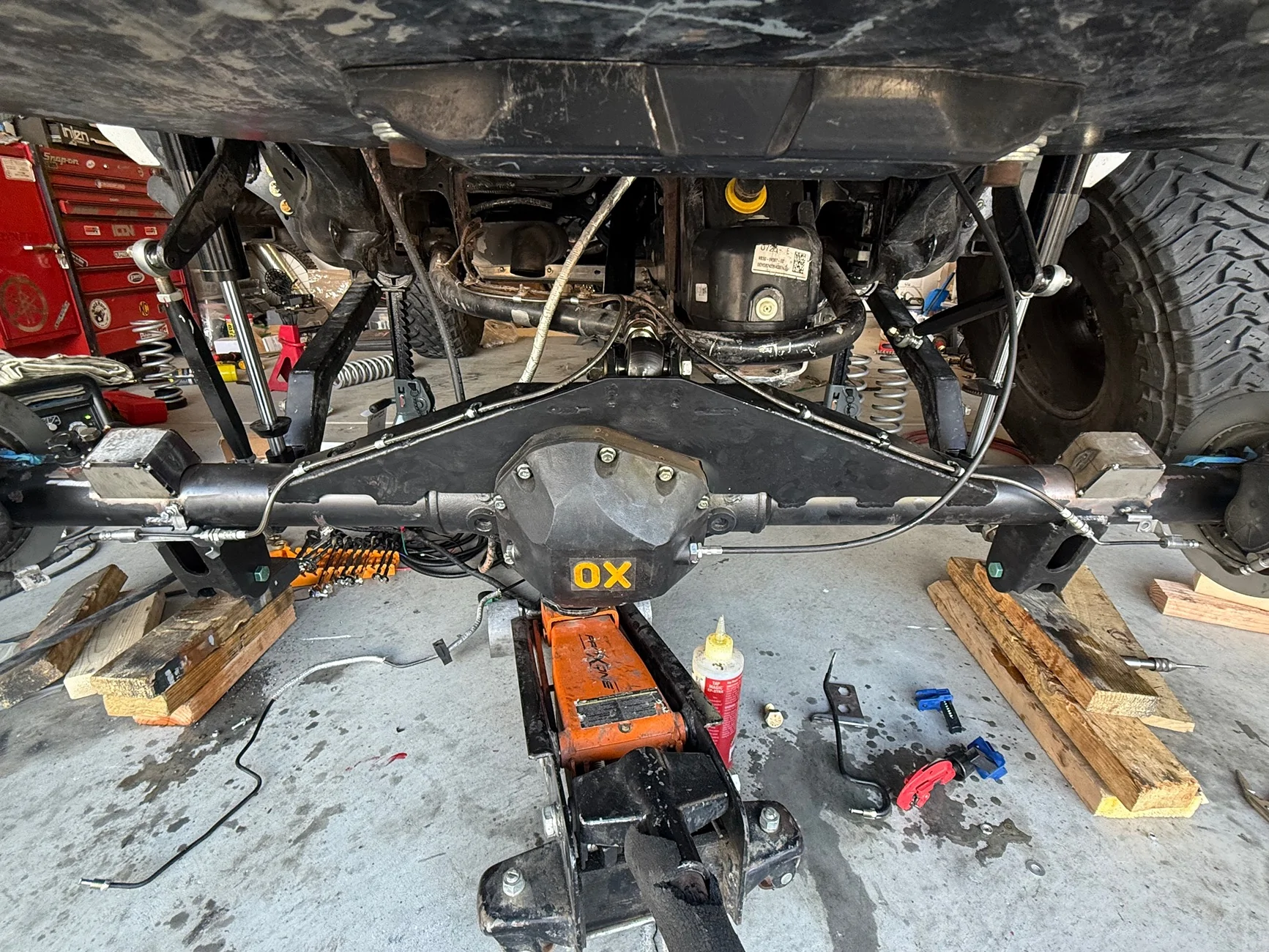
With all things considered, we started looking into running mixed ratios and deleting the rear portals. With portals up front on an IFS rig the issue associated with a broken/unpowered axle isn’t the same, and it seems to be due to being pushed up and over opstacles, as well as the directional of travel being transverse or “perpendicular” to the direction of travel as opposed to longitudinal, or “parallel” travel of the trailing solid axle. @Ducati1098 and @BigMeatsBronco were contacted to see if there were any output sensors on the transfer case to worry about, and it seemed all is well. Only need to be concerned with the wheel speed sensors. From there came finding gearing combinations that would work. We created a spreadsheet to easily spit out rear R&P ratios needed for all the available front differential options and different portal reductions. The 32 spline ultimate D44 FDU is compatible with any D44 combination that uses Advantek gears. As for the rear axle, searches were done on ratios for Dana 60, Ford 9”, and GM 14 bolt. F9 and G14 were of particular interest for the triple sheared pinion, knowing that the gear ratio would likely be very short. Unfortunately, locker options were limited and we weren’t terribly interested in ARB due to the pneumatic system. Ford 9” had many gear ratio selections, but everything seemed to always be race gears and not suitable for daily driving. Ultimately we settled on a Dana60 equipped with an Ox Locker with a gear ratio of 6.17:1. The front was regeared to 4.56 and with Werewolf portals 1.35 reduction, the final ratio up front comes out to 6.156:1.
In researching this project, we learned a lot about the history of mis-matched gears front to rear. It’s very common in tractors with their tire size differences, but it was even a normal practice by automobile OEM’s, some running a combination of 4.09 front and 4.10 rear. It’s important that between the two the front is driving harder, as it’s easier to drag the rear wheels slightly to avoid bind vs the rears pushing the heavily weighted front. That’s when drivetrain bind occurs and parts start breaking. Some manufacturers have gone as far as 1.5% between front and rear, and it sounds like the Ford computer won’t freak out below 2%. So we should be plenty fine with our very small difference.
Live axle mounting practices
With bolt-on rear portals, the boxes are using the factory mounts on the flange meant to bolt the semi-floating axles in to the housing. These small bolts and the tapped internal threads in the portal box the bolts or studs are threaded in to are now being subjected to massive amounts of stress from the leverage of the portals. On the more careless side of the manufacturing options, threads were simply cut in to the aluminum, short cutting generally accepted safe thread engagement practices in what seems to be an effort to reduce overall packaging width. Those portals were quick to show this design flaw when used with bolts accommodating Japanese platforms and started failing. The portal manufacturer increased the bolt size and fixed the old portals. As for the bronco platform specifically, the long term life of these threads would be safe to question, as the decision was made to use 1.5xdiameter for thread engagement, the very minimum of what’s considered acceptable thread engagement with no safety factor in aluminum threads. A safe opinion could be that while 1.5x might suffice for lighter static loads in high-strength aluminum like 7075, blind threads in a portal box could be severe duty use given the combination of high torque from large tires and gear reduction, shock loading from aggressive offroading, vibration-induced fatigue, and potential mixed-mode stresses (tension, shear, and bending) and demands a more conservative approach. Engineering references consistently recommend 2.0–2.5x diameter (1.0–1.25 inches) for aluminum threads in high-vibration environments to ensure reliability and safety, though it could be argued that the use of four bolts reduces the need for even 1.5x thread engagement. Given the importance of these bolts and referring back to the conditions they’re being subjected to, some might say it’s better to be safe than sorry. Not to focus in on one portal makers choices, there are various other ways the mounting is being addressed by the other manufacturers in the space. Steel inserts embedded into the portal housing, steel flanges that increase bolt count in the aluminum, and steel portal boxes with supplemental braces. It does seem prudent to try increasing the strength of this critical mounting surface and will be interesting to see how these designs hold up over time. And while some designs could be interpreted as better than others, that still doesn’t address the next topic associated with bolting portals on to an OEM solid axle.
As already noted, (maybe not. I don’t remember where I’m inserting this information) it’s quite likely that you’ll discover the desire to continue making modifications to your rig after installing the portals. Suspension changes are likely, and depending on what route you take you may find yourself starting to tear the boots on the rzeppa driveline, or rubbing the driveline against your fuel tank. A great upgrade is a double cardan 1350 driveshaft to gain strength and operating angles while mitigating vibration. The OEM Pinion angle is just slightly under aligning with the driveline, and when swapping to a DC unit it is recommended to adjust your pinion angle to be 1 degree above the driveline in order to keep the cups spinning to move the grease in the needle bearings. This small rotation, as previously mentioned, is exacerbated at the end of the portals, where they are no longer perpendicular to the ground but instead at an angle biased towards the front of the vehicle. Your control arms are now under constant strain, even when stationary. The threads previously mentioned, despite the portal box being supported by the full-float engagement into the axle housing, are also being subjected to this constant stress. Your axle housing itself is now constantly being “twisted” ever so slightly. The M220 has already gained a reputation for the axle tubes spinning inside the diff housing when trail turn assist is used in high traction situations, and portals in their normal position certainly aren’t helping mitigate the forces on the tubes. This angle only further compromises the strength of the axles. Plan your modifications accordingly.
Lost benefits?
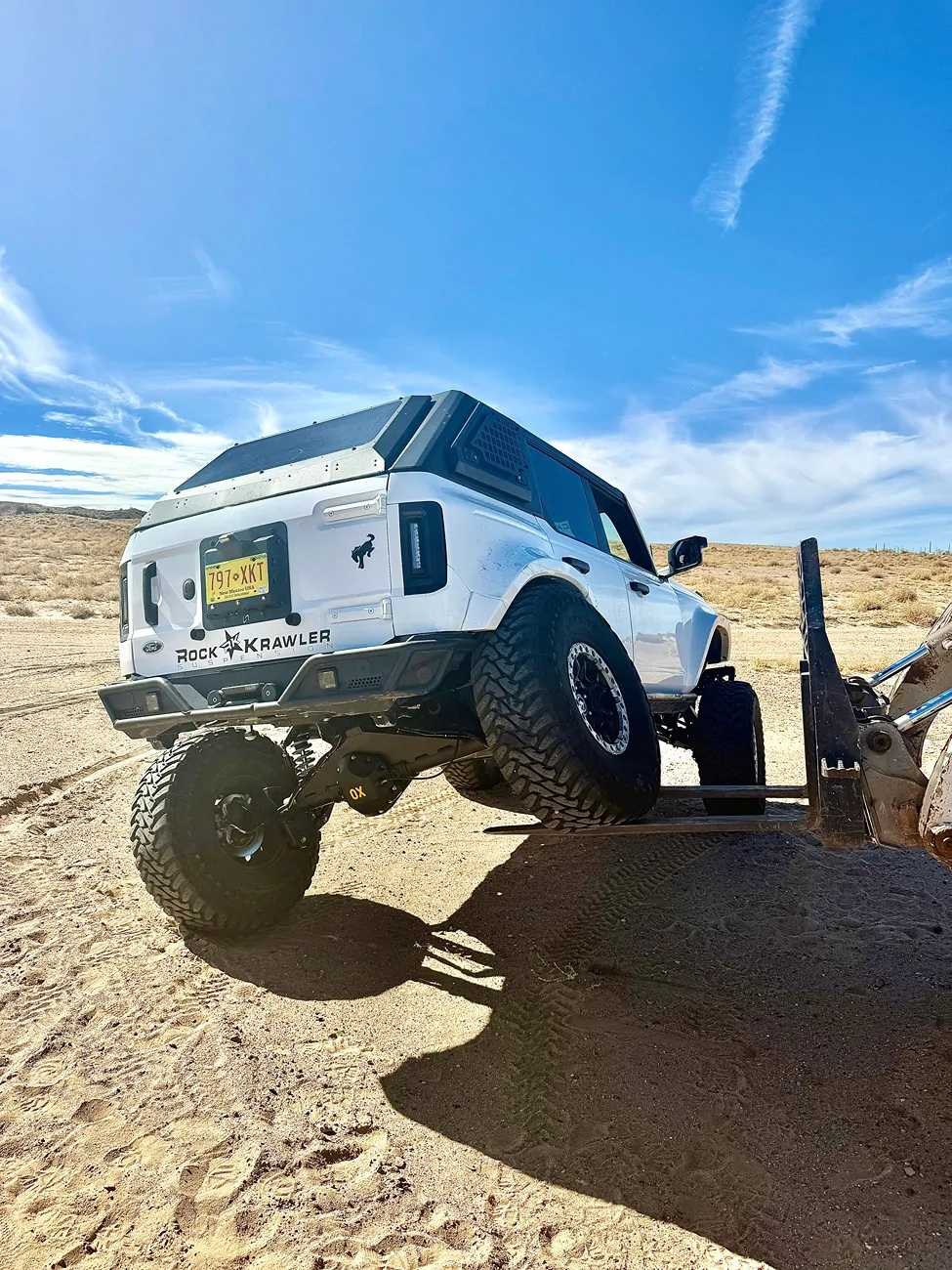
The first obvious negative that we’re looking at is the loss in clearance. We had already reduced the clearance by dropping the lower link location, and now we’ll be dropping it again by another four inches. As well as the differential. Is this something I’m terribly worried about? Not particularly. A counterpoint could be made that with the portals moving the wheel down in relation to the output, you now have to mount the brake calipers on the bottom of the rotor. All that clearance you gained with the portals is now effectively cancelled. One could even argue that it is less clearance. You definitely need to be mindful of your brake calipers and portal users have indeed hit and broken their rear park brake actuators or hoses. This is no longer as much of a concern with the brake calipers being back in their OEM placement on top of the rotor.
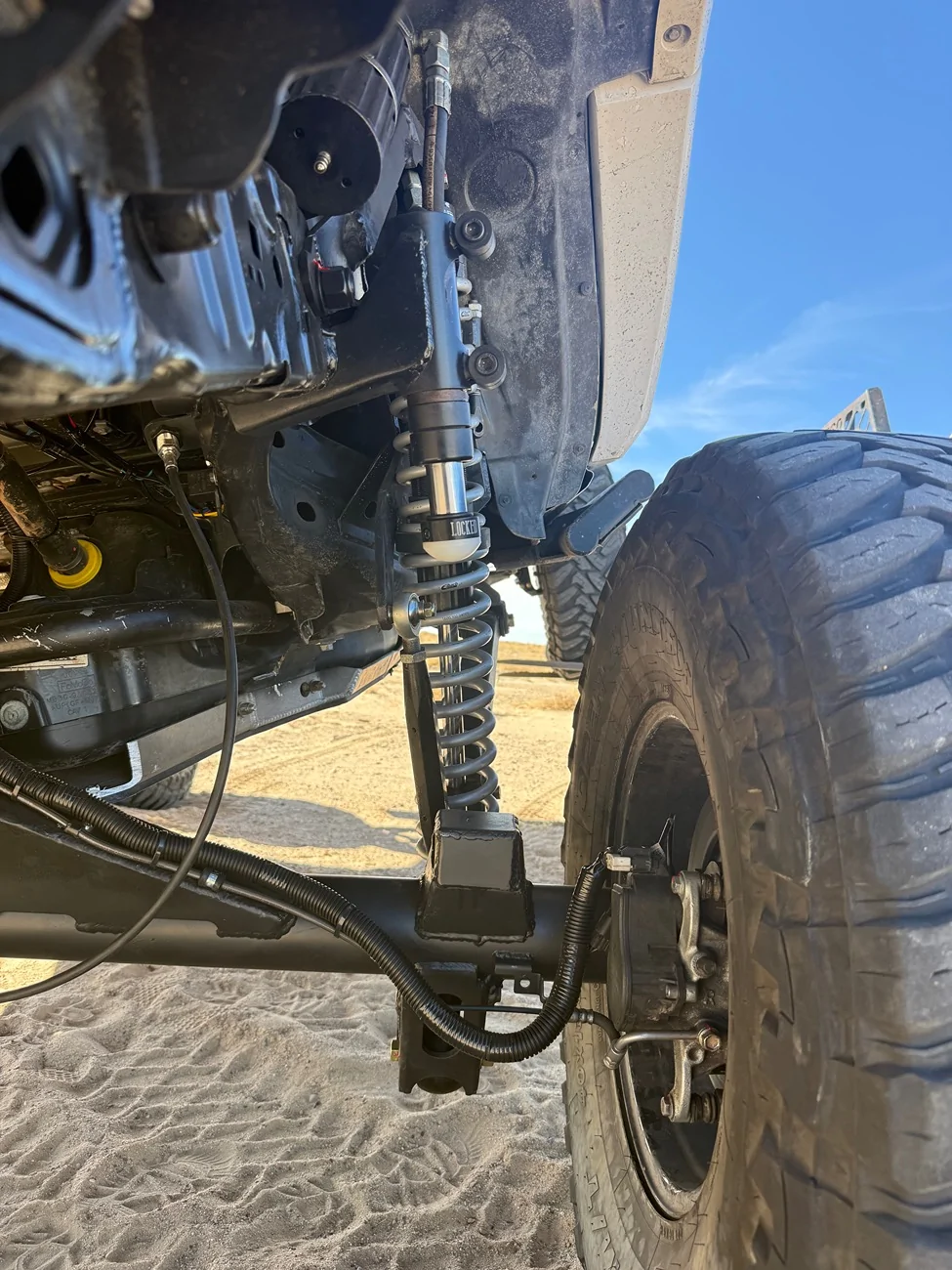
On the flip side of the clearance issue, this setup is making up that four inch axle lift difference with longer coilovers. Something that is not focused on enough is that portal lift is not “active“ as far as suspension is concerned. It is an incompressible lift and that 4-5 inches needs to be accounted for somewhere within the system. With the 12” coilovers and relatively low ride height, bottoming out was still a concern. “Pushing” the axle down is similar to what we did up front by pushing the shock towers up. With the 14” coilovers in place, we now have 6” of shock up travel, or 8” of up travel at the wheel, with 9.25” of clearance from the tire to fender. We set the hydraulic bump stops appropriately to ensure we don’t tear the fenders off when articulating but we’re very happy with how that turned out. More articulation can open up your line options if clearance is an issue, though it’s certainly not always a possibility.
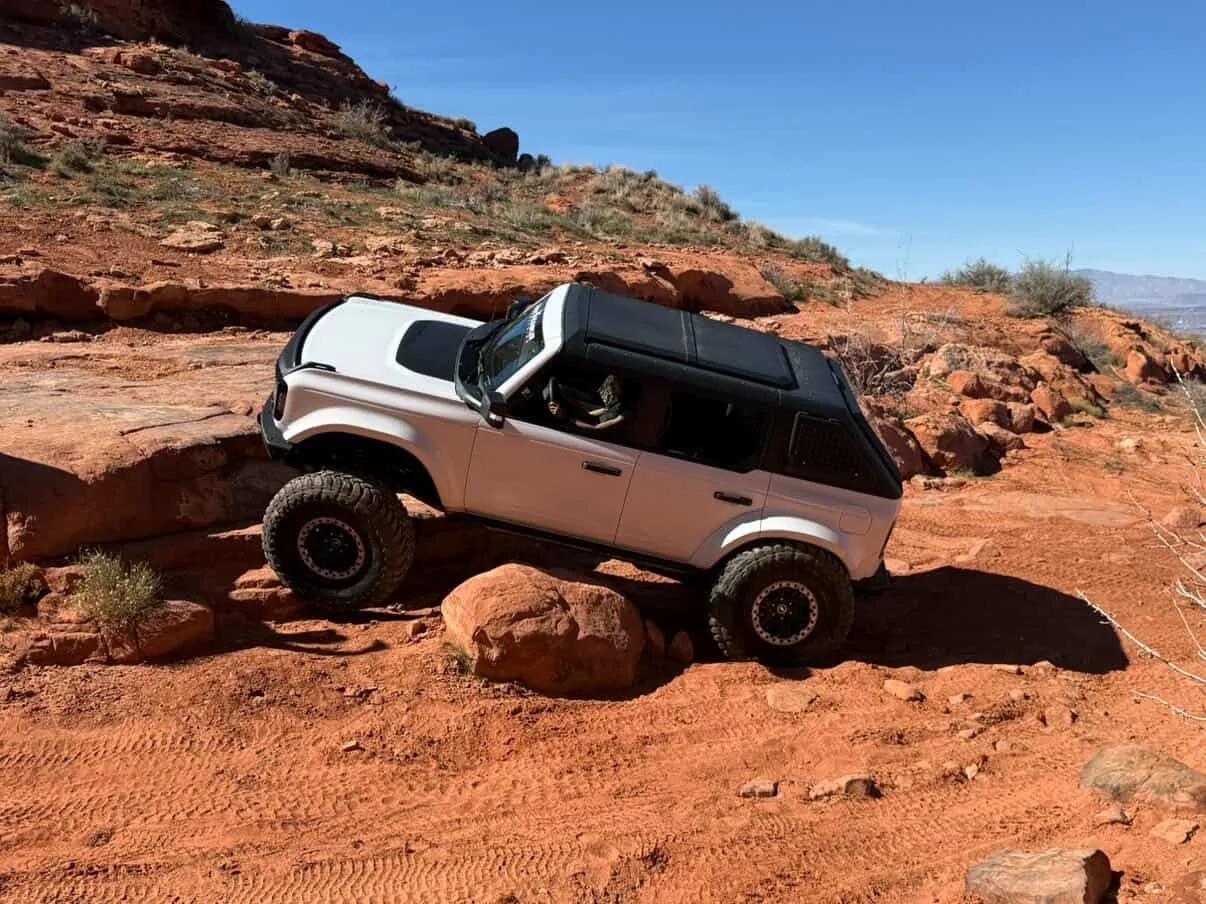
With the coilover length change, that also gave us some options for additional tuning of the coils themselves. We previously had a 12” 400 lb/in coil stacked with a 12” 500. This gave us 14.4” of coil travel on a 12” coilover and an effective spring rate of 222 without accounting for motion ratio. With the 14” shocks, we stacked a 12” 400 with a 16” 400, providing 16.8” of coil travel and a spring rate of 200. The 12” 400/500 combo suspends 2970 pounds not accounting for motion ratio. The 12” 400/16” 400 is 3364. So not only are we getting more travel, but we’ll be able to support our slightly heavier load (tools and parts when wheeling) while also having a more supple ride.
Rear Block Height Travel Block Load
12” x 400 4.57 7.43 2970
12” x 500 5.00 7.00 3503
9.57 14.43 6473
12” x 400 4.57 7.43 2970
16” x 400 6.61 9.39 3754
11.18 16.82 6724
With the old 400/500 setup, the upper coil lockout engaging took the spring rate from 222 to 500, and the transition felt quite harsh. We ended up setting the lockout for the block height only to protect the coil. With the new 400/400 setup, we’re going to try setting the upper coil lockout to where the 12” coil will stop compressing at six inches. At that point the remaining compression travel will be on the single spring, taking the spring rate from 200 to 400. Still a big jump, but shouldn’t be as jarring as before.
Did we lose strength?
A common selling point of the portals is the reduced stress on drivetrain components. It is even been said by those selling portals that the portals will make your drivetrain stronger. One seller going so far as to suggest that a Dana 44 with portals is stronger than a D60. Absolutely having a reduction at the hubs will aid in keeping a numerically lower (taller) ring and pinion that will be stronger than regearing to shorter options. But many IFS owners are still frequently breaking their CVs, even with smaller tire sizes. Rear axles are being broken as well, including those with the Dana 60. Yes fatigue and driving styles are absolutely going to play a factor, but to suggest that the portals will prevent breaking is misleading. If big tires and heavy wheeling are planned for your build, it would be recommended to still upgrade both front and rear axles to improve reliability, whether running portals or not
Gearing Math and Tradeoffs
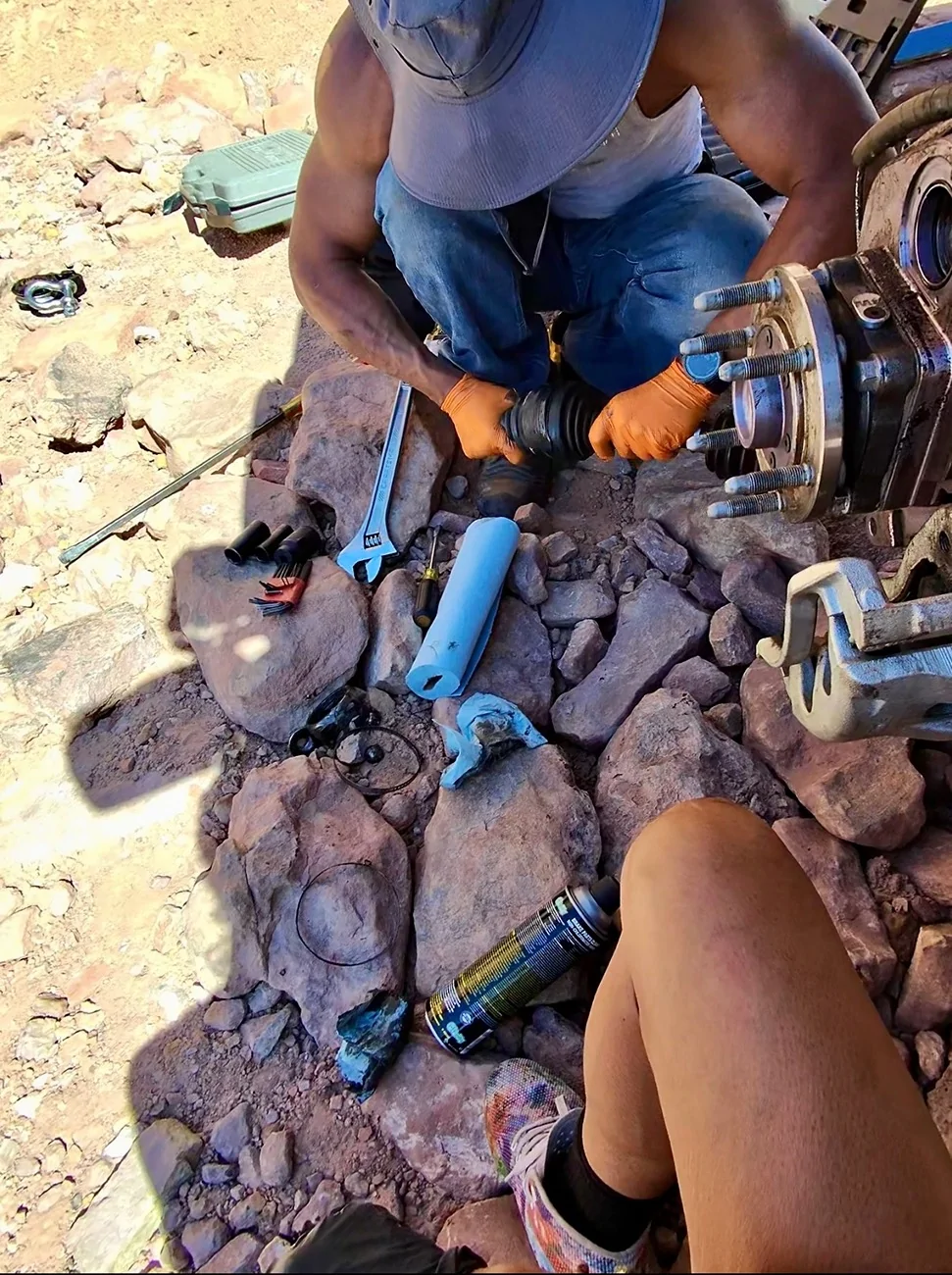
With portals front and rear, the common bolt-on options are getting reductions from mild of ~1.10:1 with Turn portals to wild of 1.35:1 with Werewolf. It’s nice to be able to leave the gears in your differentials alone. Of course, we didn’t do that, and had to go very aggressive out back. With 6.17:1 gearing, the pinion gear is going to be pretty small despite being a D60. (D80 was preferred but again-no locker options of interest. Until just recently when Ox released their D80 locker. Dangit!) As a result-weak gears. It’s still a one-ton gearset and the shop that built the axle believes it should hold up as long as we aren’t doing huge sends, but it’s something we need to keep in mind. Wifey has a soft foot and that will be helpful, but I would have much preferred to be in the mid or low 5’s. We opted for a 1310 ujoint to act as a fuse with it being easier to replace than the R&P, but it’s still in the back of my mind that even the little tike will be stronger than the pinion gear. Allegedly, the gear contact ratio of a D60 with 6.17’s is higher than a D44 with 5.38’s, though…that’s not saying a whole lot. Luckily these gears are not difficult to source for the D60, but it’s still not a simple job to swap them out and really sucks to break gears on the trail. Hopefully the four spider gears used in the Ox locker help keep carrier alignment true by distributing loads more evenly as compared to lockers with two gears. The locking mechanism on Ox lockers is also meant to stay positively engaged in even the harshest conditions, minimizing ratcheting (partial disengagement) that can damage gears.
The short rear gearing will be more susceptible to heat, especially on long climbs at highway speeds. That said, so far in 1300 miles of use on the 6.17 gears we haven’t seen temperatures above 151F. We’ll still be changing the oil frequently, so having a drain in the diff cover will be quite useful assuming we don’t need to frequently pull the cover due to broken gears.
How is the hybrid setup performing?
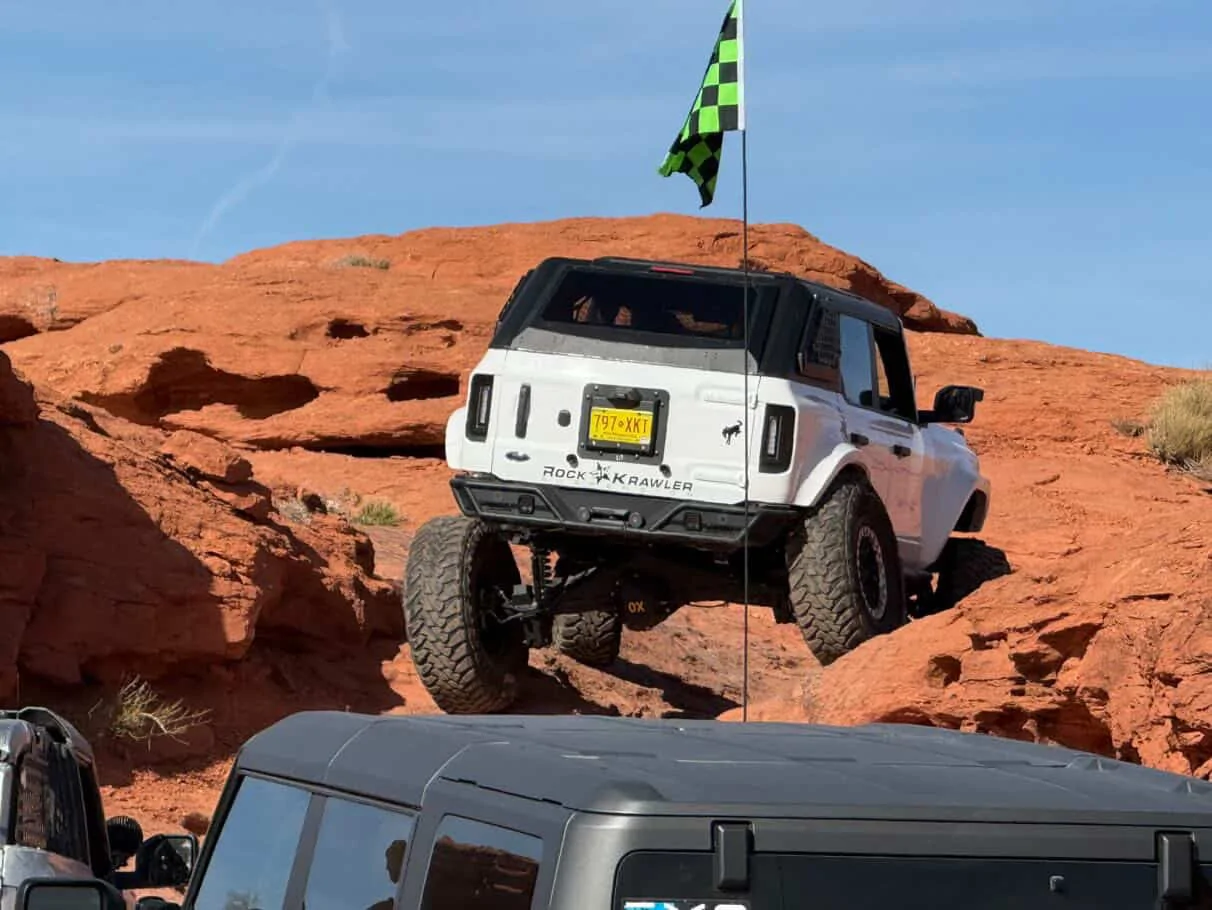
Before testing it on the road, we put the rig on jack stands then applied a strip of masking tape to the tires. In 4L we put the transmission in drive and let the tires rotate freely, using the tape to count rotations and compare distance traveled. Just to be safe. At one point while putting everything together I had a moment of panic when thinking that I was trusting these vendors to provide the correct gearing as ordered. I didn’t check any tooth counts myself personally. What if the portals were actually 1.3 instead of 1.35?!? Or the front diff was 4.10 not 4.56?!? This test put my mind at ease and everything looked good.
First item of note-the ABS system. The portals use the input gear for the wheel speed sensors. This prevents the need to accommodate any kind of tone rings in the rear portals, and the factory tone rings on the axle can be used. As it relates to a front-portal-only build, now the computer sees very different speeds, despite the tires turning at the same speed. Hopefully custom tone rings on the rear axle will fix the difference. We used Forscan to monitor the wheel speed sensors and it showed us to be off by an average of 35%. Makes sense given 6.17/4.56=1.35. But we wanted to be certain before getting custom rings made. Besides the ABS not working due to the discrepancy, it drove just fine and could cruise at 89 mph.
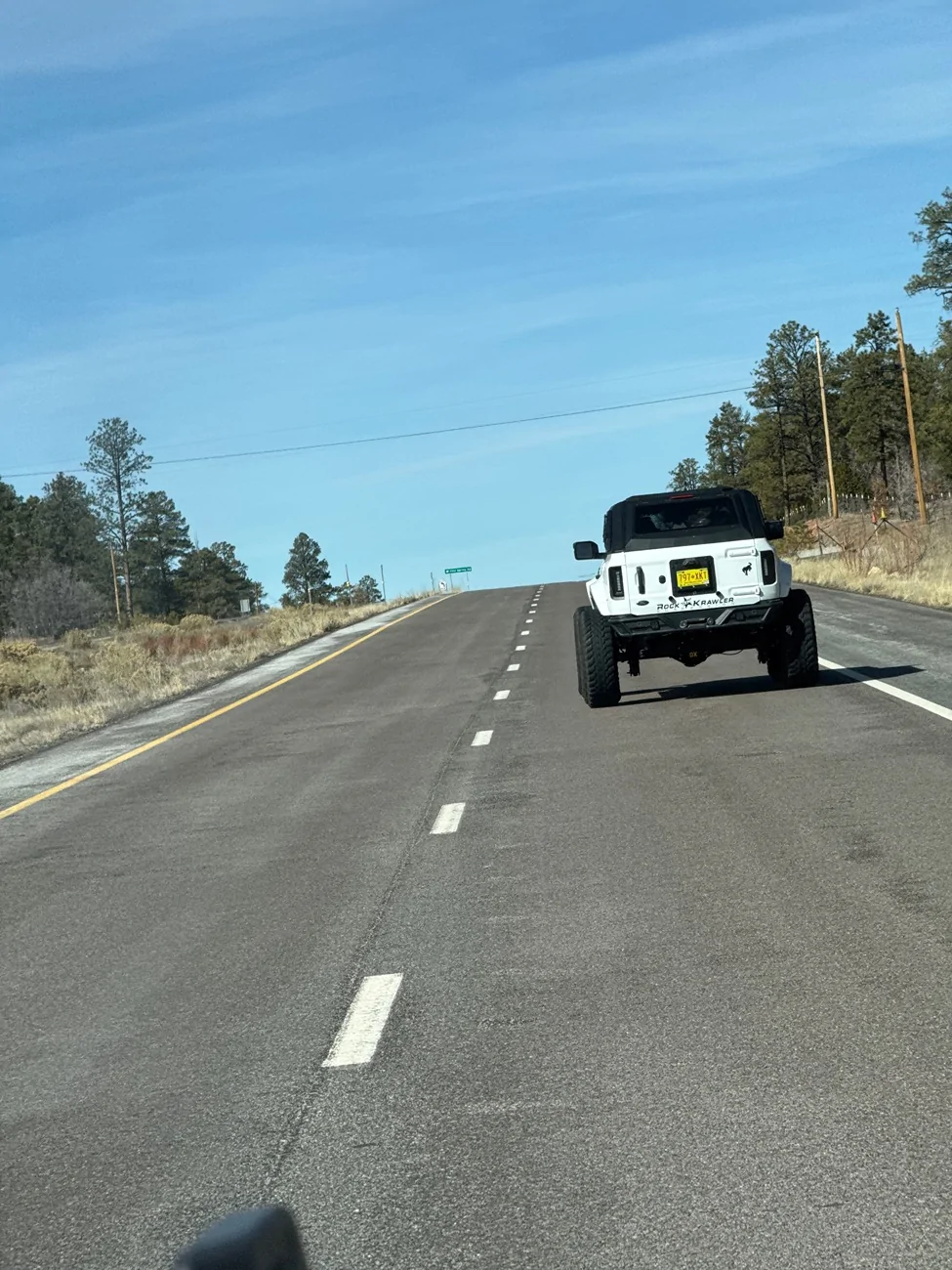
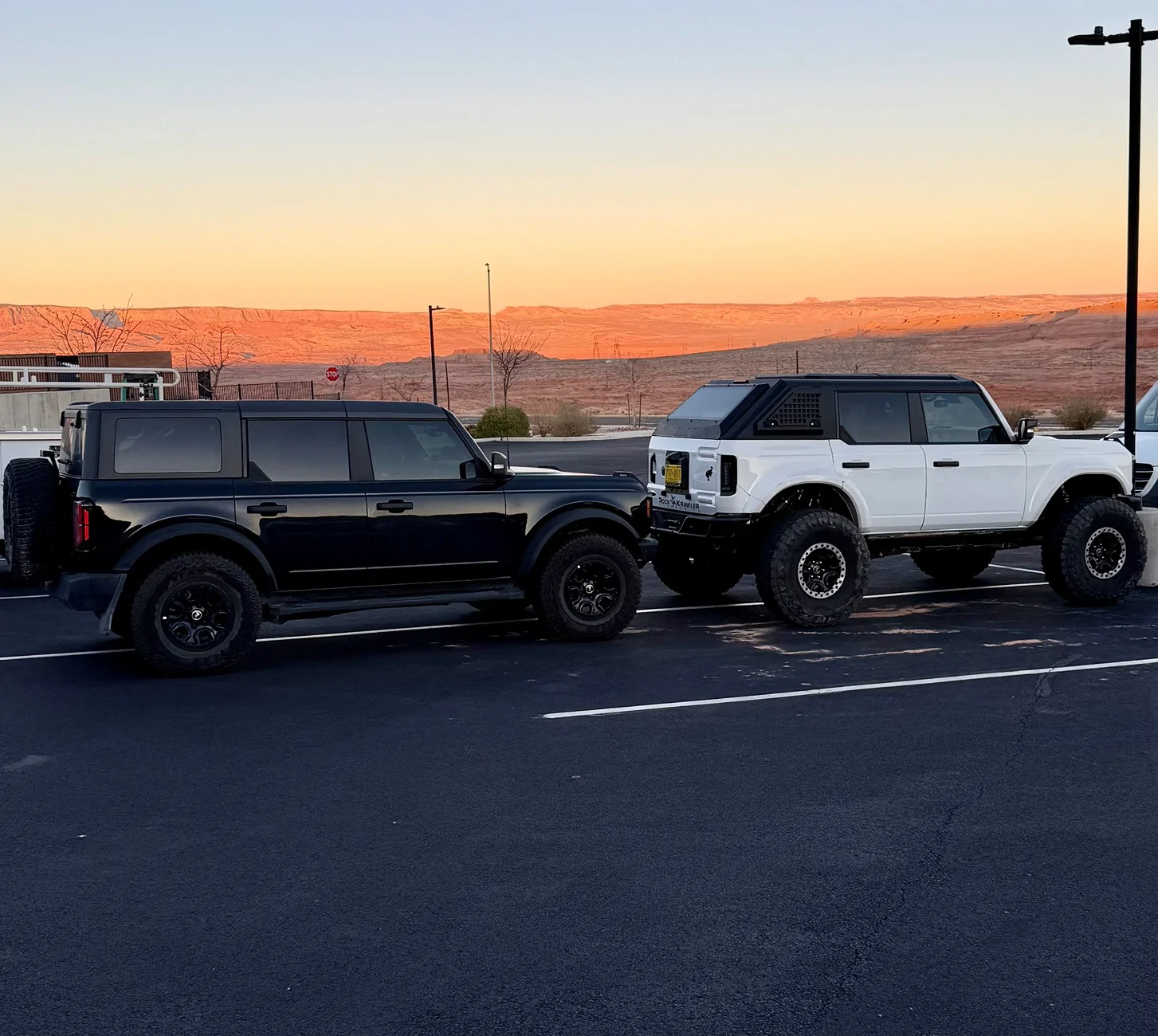
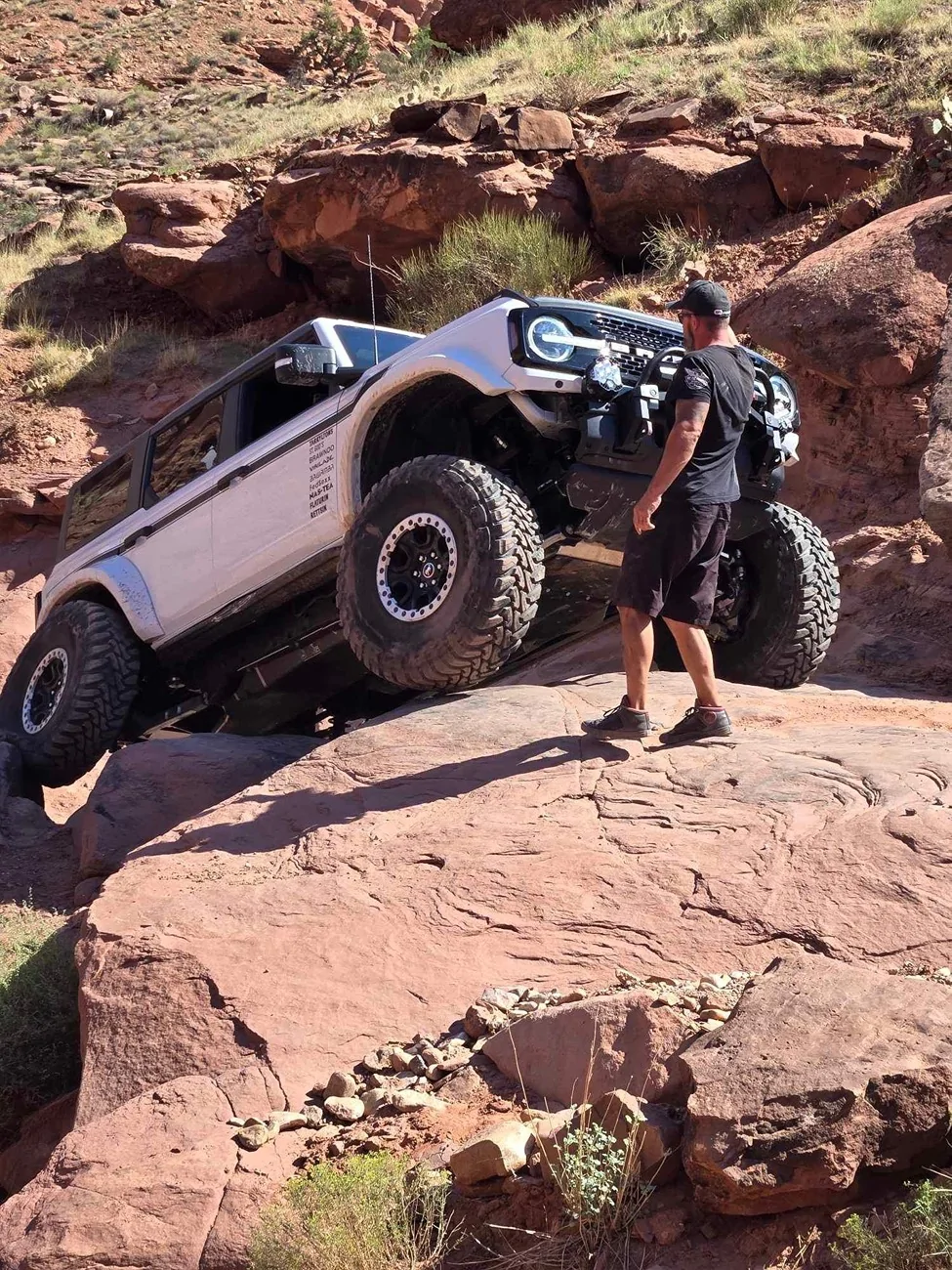
As to the offroad ability, from the perspective of the spotter absolutely this setup worked very well. All the additional flex made obstacles previously attempted possible or easier, and the reduced axle wrap was noticeable. We did get hung up on the diff on one obstacle and opted for a winch rather than velocity to get through it. Wifey said that this is definitely her favorite build of what we’ve done so far. It felt very planted and more predictable, but she’s looking forward to comparing it against a long travel rig. More on that in the near future.
Sponsored
Last edited:
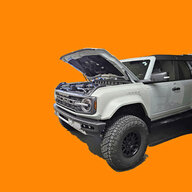







 It's unfortunate that a number of uniformed folks will buy into the influencer /racer marketing hype ill prepared for the "extras" needed to make it all work as well as the lack of realization that these folks have many luxuries & budgets the commoners do not have access to. Bolting on portals is a huge investment that can end in both a broken rig & broken wallet if one isn't prepared for all the extra tuning to make it work. Then once it's all together and running, it's still not over because you have increased maintenance and other concerns over time.


