
- Thread starter
- #1
TLDR: After a year and a half of use and significant abuse using the coilovers without limit straps or external bumpstops (with 40” tires and portals), it is my opinion that the coilovers from Rock Krawler are a “hidden gem” of sorts and do not get the attention they should from the Bronco community. They are tuned well for the Bronco platform and have held up incredibly well. We like them so much we bought a second set to run on the Long Travel build. And while there is no “perfect shock” I would absolutely recommend the Rock Krawler coilovers to anyone looking at upgrading their suspension.

@robbob created a great list that has comparisons of all the latest coilovers with exception of I think just Accutune. So I will not dig deep into all those specs. https://www.bronco6g.com/forum/threads/the-ultimate-travel-guide-bronco-suspension-data-compilation.109821/
Actual review:
If you’ve read any of my threads or reviews, you’ll already know to expect more details and backstory than is necessary. My ramblings are not conducive to those affected by tiktok brain and the associated seven second attention span. If you feel like I should change my ways, please leave a comment in the thread so that I can ignore your requests and continue doing write-ups in the manner I prefer. Thank you for your attention on the subject.
Backstory:
When the plan to start building the Bronco became a thing, we decided to go with portals. I started planning out the build to accommodate the additional forces that the suspension mounts would endure from the increased leverage from the portals. Double shear UCA mounts, reinforce LCA mounts, strengthen rear upper link mounts, and of course-do something with the rear axle. For those that don’t know, at the beginning of the 6G Bronco saga there were many owners spinning their axle tubes in the diff housing when using trail turn assist. Ford would deny the warranty claims if bigger tires than stock were used, so when the thought of running portals enters the chat, one would certainly think the additional leverage and torque on top of the bigger tires is even more of a concern, and the axle needs to be addressed as well. This is where search for a truss began.
While the Bronco D44 and the Wrangler D44 are “the same” axle, there are differences, especially the mounting points. Not wanting to find those differences the hard way, I was only interested in finding a truss designed specifically for the Bronco. This is how I discovered Rock Krawler. I had never heard of them before or knew they existed, but they had a truss for the axle that was included in the Triangulated Four Link setup. I looked into the system and it took care of everything I was looking to do while also providing the potential for more articulation with the right accessories. Online order placed! I wasn’t comfortable welding the tubes to the diff housing and didn’t have a stick welder, so I just had a machine shop weld the truss on for me while also welding the tubes to the housing. Likely unnecessary to do both but it wasn’t much to get the diff housing welded so might as well. While the machine shop had the axle, Rock Krawler released their PB&J links for the Bronco. I figured it would be nice to have everything match as far as rod ends/connections go, so I ordered those as well. (There is a point to sharing all this. Be patient) After getting the axle installed we took the rig out and played around taking measurements, noting the difference in travel and how it felt, then randomly posted about it on some off-road facey group, including a note about looking forward to discovering whether the PB&J links will make a noticeable difference or not. A day or two goes by and I get a random message from some Jeremy fellow, telling me that Rock Krawler has a discount for return customers and that if I didn’t use it on the PB&J links, give them a call and they’d refund it. Well how about that? Pretty cool of them to do. I would expect most companies to just say “yeah we got you on the next order, but we aren’t going to give you a refund for something you didn’t even know existed” and that is perfectly understandable. So already that’s pretty cool customer service.

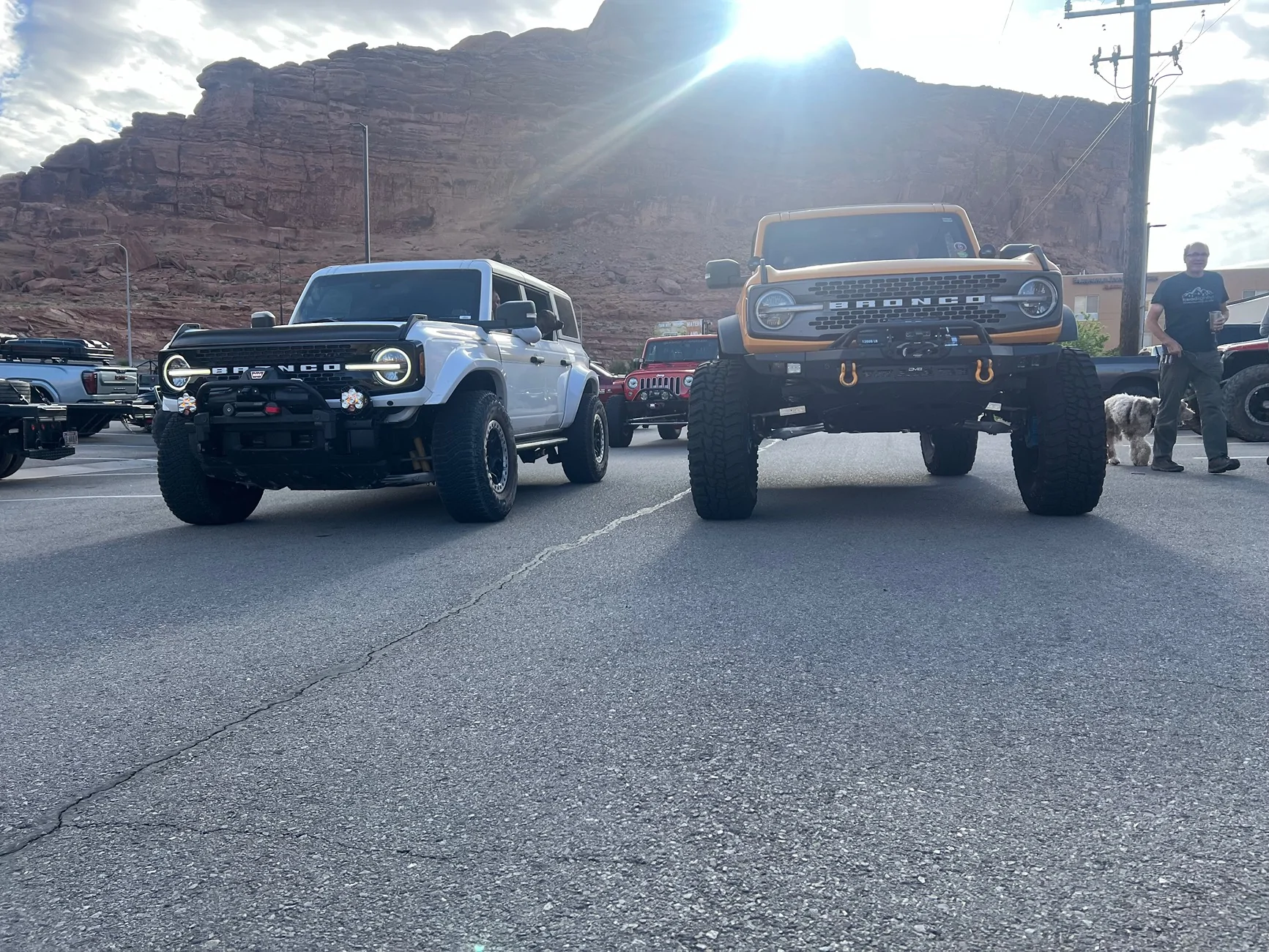
Fast forward a couple months and I get an email from Next Venture Motorsports inviting us on a customer appreciation run in Moab. Well heck, it’s not terribly far and we happened to have the time to go, so why not? Bronco was still basically stock with exception of the four link, PB&J links, belly skids, double shear, and RPG UCA’s but that’s not a big deal. I’ll skip the trail run part of it but unbeknownst to us, this event actually had a few different companies hosting it, one of which was Rock Krawler, and they had their recently completed Bronco on 40’s there. One evening at the hotel we parked next to their rig to check it out, and as it turns out, one of the Rock Krawler guys came out and started chatting us up about our rig. He noticed the stuff out back, and asked why we went with RPG for the UCA up front rather than using their stuff like we did on the back, explaining the advantages their UCA had over the RPG unit. I was actually convinced to give their UCA’s a try and said I may place an order for a set. Went on to tell him the plan to run portals and that because of the portals, we did not want to have any deflection in the UCA joints, so full heim was the best way to accomplish that. He paused for a moment, and said “you know, while our stuff is definitely strong enough to handle anything you’ll throw at it, I think for a portal build you made the right choice going full heim.” That mentality from an aftermarket parts manufacturer very much resounds with me. It wasn’t purely about his bottom line and making a sale, he was genuinely interested in what was best for the consumer. It’s a trait that seems to be mostly lost with today’s manufacturers. That has stuck with me, and Rock Krawler has proven to me on multiple occasions that they were more concerned with what was right for us rather than making a sale. It wasn’t a one-off scenario. These are genuinely solid people.

Coilovers. Finally
Alright, enough backstory. Time to discuss the coilovers themselves. First of all, I wanted to thoroughly run the coilovers before actually doing a write up about them. I recognize the excitement behind getting something new and immediately wanting to tell everyone about how your purchase has completely changed the rig, but with something like coilovers there is so much more going on. At least let the coils break in before telling the world how great they are. But I wanted to really run them through their paces and see how they held up before providing an assessment. Did any start leaking? Did they break? Did the performance break down? These questions are likely not going to be answered in a short timeline, and coilovers are typically an item the consumer is buying that will likely be on their vehicle until they sell it. Longevity is important. What if the resevoirs start falling off after a year?!?
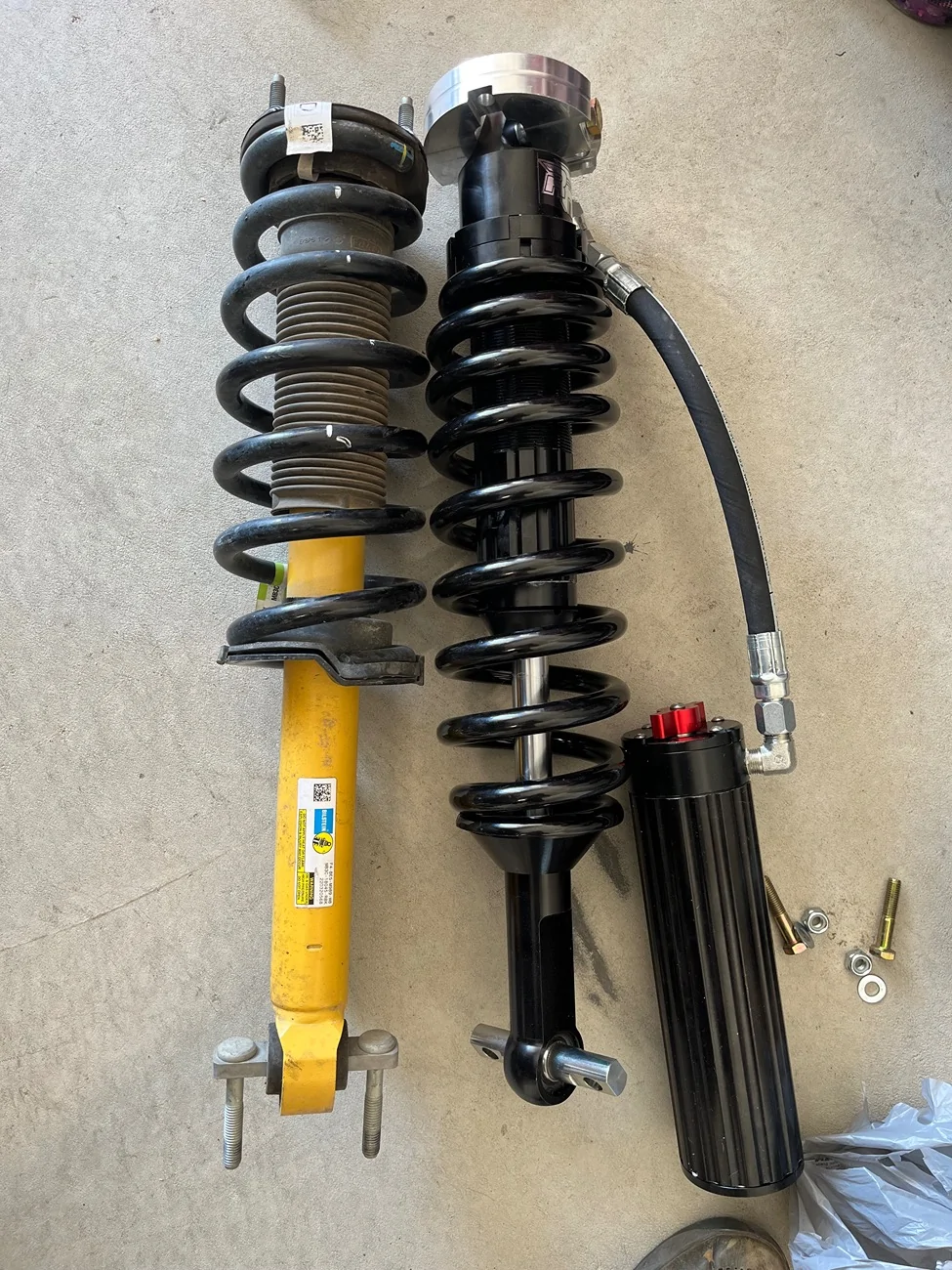
I can only imagine how difficult it is to try to offer a “one size fits all” package when you don’t actually know what the consumer will be doing. Rock Krawler does offer customization, but more on that later. Will the recipient be an overlander with enough accessories to get 1500 pounds over the GVWR, or are they just looking to balance things out to accommodate the Bubba Gump bumper they installed with a shiny new winch? Are they crawling over rocks, bombing through whoops, or perhaps just getting groceries and going to cars and coffee to hang out? In our case, strength and durability were important. Rock Krawler has that locked in as they use 1” 17-4 Stainless hard chrome plated and polished shafts with 2.625” bodies packaged to fit within the 2.5” coilover class. So girthy. The use of 17-4 is considered the “gold standard” for reliability, being incredibly resistant to scratches and corrosion, improving seal life. Most high end coilovers besides Fox Factory series use chromoly 1045/1050 with a lower hardness susceptible to surface damage. I think @AccuTune Offroad also uses 17-4 but not fully certain. Also not certain what Bilstein uses on the 5/8” shafts on the 8112. Either way-this higher quality material will help the seals last longer.
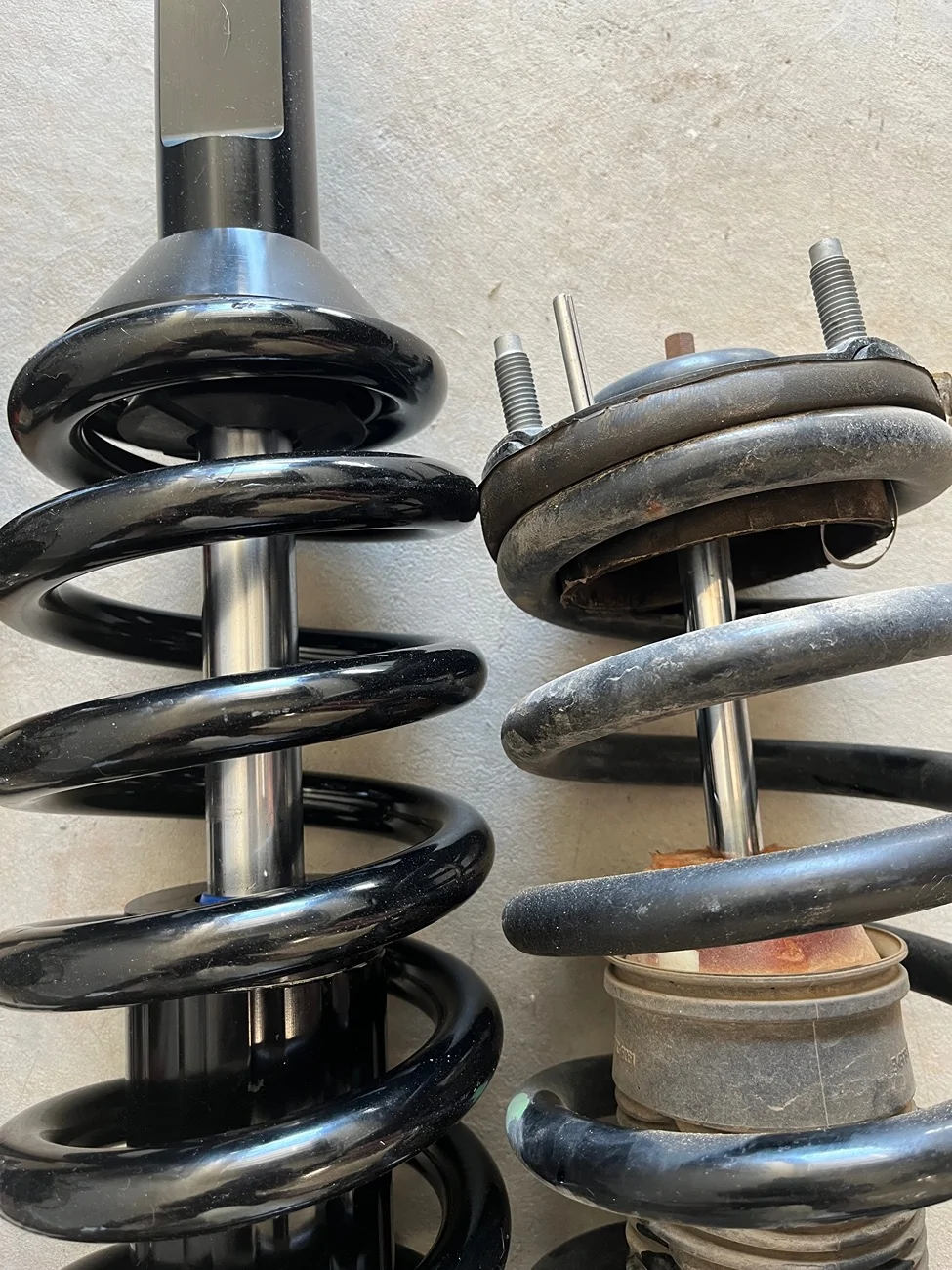
With a 3” ID coil spec you will need to be diligent on coil compressors if you swap to a linear spring as the clearance is tight. A rental from your local parts store may have you regretting life choices.
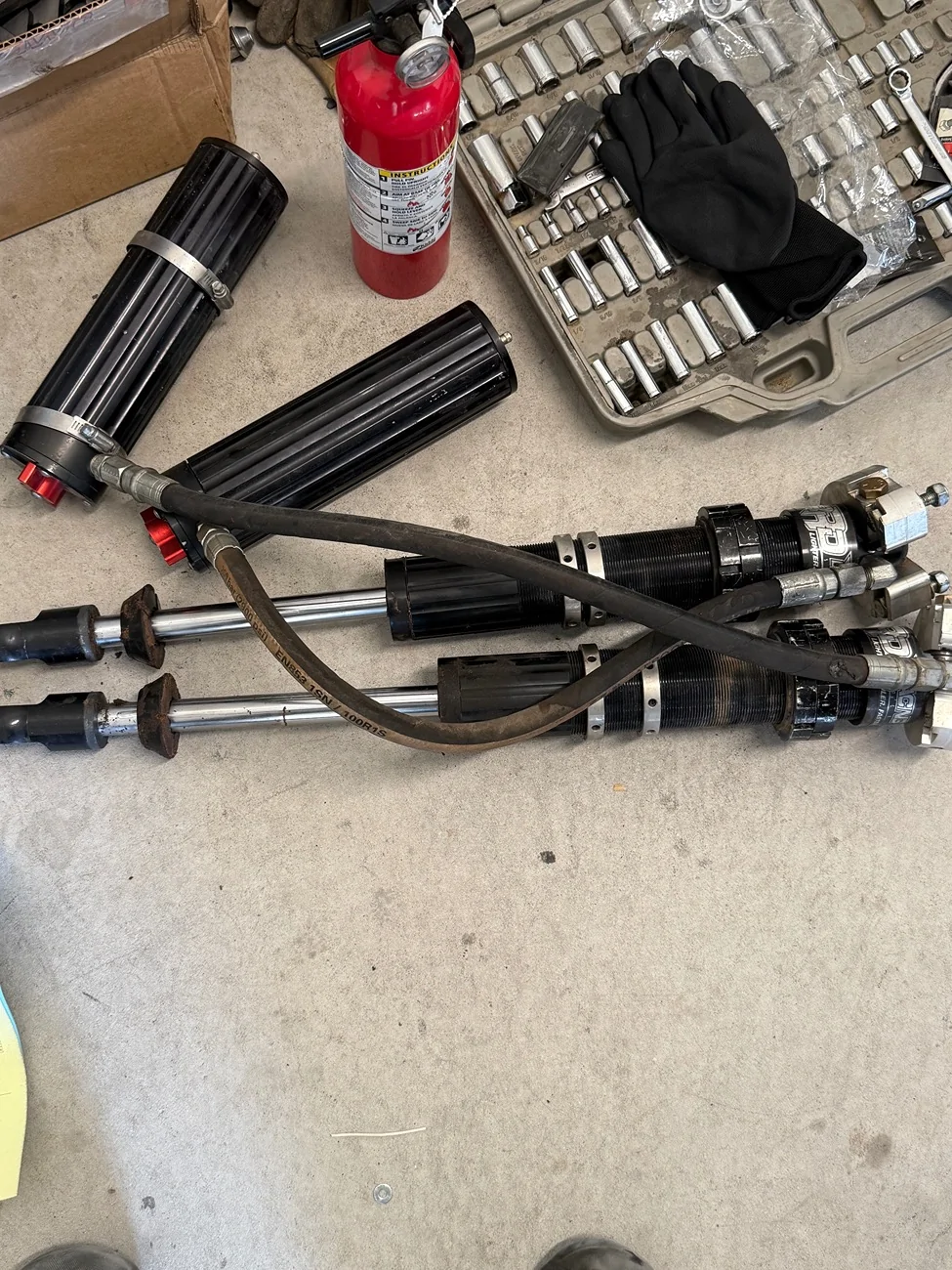
The very large reservoirs are charged with pure argon (not nitrogen)and use fully synthetic Amsoil fluid, if that is something you’re curious about. The valve circuits are linear but run two stage valving on both sides of the piston, for both the front and rear coilovers. It’s not a simple linear, digressive, or progressive tune. There is a lot more going on to their tuning and it’s similar to the expression “have your cake and eat it too.” They have ample compliance around town while body roll is controlled, but your high speed performance offroad isn’t sacrificed either. So while I went on a big diatribe as to how difficult it would be to try to accommodate every facet of the aftermarket needs, Rock Krawler put the extra time, effort, and capital into trying to make a do it all coilover a reality. They have an easily adjustable compression knob on the reservoir, and going from zero to five nets a 35% increase in overall compression. There’s no external rebound adjustment.
Ride quality
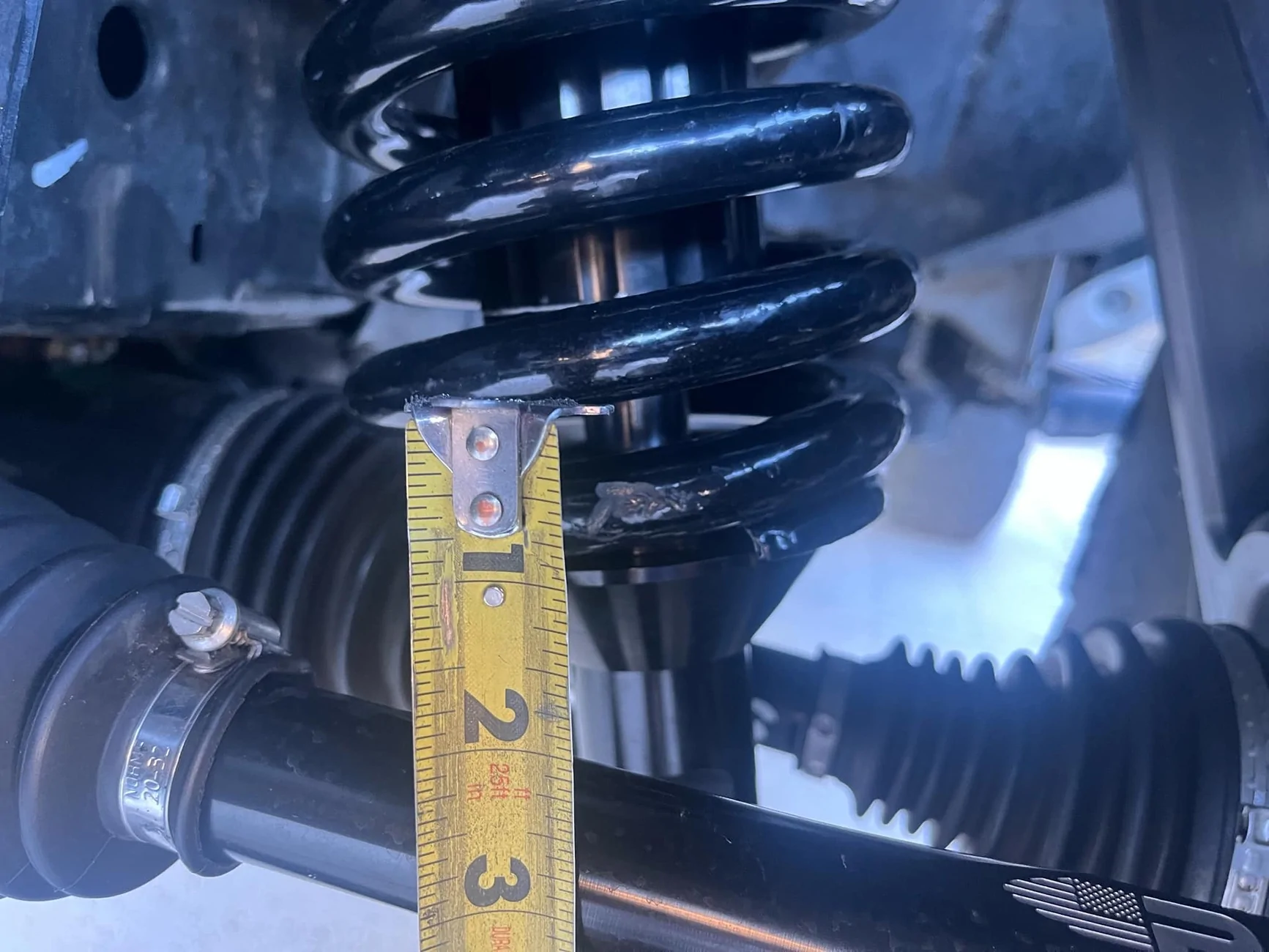
This is a tough one as it is such a subjective topic, and with full belly skids, front/rear winches, sliders, UFDU, portals, and 40’s, our rig was far from stock when the coilovers were installed. Rock Krawler has the Bronco coilovers set up with dual rate coils. Front is 525/625 lb/in and rear is 175/275 lb/in. It seems they’re set up to provide a plush ride and resist bottoming out while trying to accommodate a wide range of weights. I don’t know that anyone has determined what the stock spring rates are, so for reference, Accutune sends out their Bronco coilovers with 550 pound coils on stock rigs, and 650 lb coils for the car camping crowd. The RK coilovers are sent out with billet top hats, and will provide lift no matter what you do with the preload. In our case, we already have significant lift with the portals, and tried to set the preload as low as we could get away with. Unfortunately for us, this only gave us about 1” of shaft (~1.6” of uptravel), and we bottomed out a lot when offroading with this setup. It was great around town, but we decided to go with linear 600 pound coils up front and it did help. Rock Krawler did get back to us on what was needed for shim stack adjustments for both the new spring and the rebound to account for the significant unsprung mass increase, but I never followed through as we planned on changing everything anyway to lower the rig and gain even more travel by installing longer coilovers. It should be clarified that the Bronco-spec coilovers are single, dual rate springs. (The coilovers with two coils are the custom RK units we later installed and much longer.)
The RK coilovers, like most any aftermarket coilover, delete the rubber bushings in favor of spherical bearings. This is stronger and provides some misalignment ability, but you will feel the road slightly more. Nothing that a tire pressure adjustment can’t solve. When set at the correct ride height they soak up speed bumps without issue. However, when you’ve lowered the ride height to accommodate portals, the speed bumps will be noticed. As they would with any coilover riding that low.
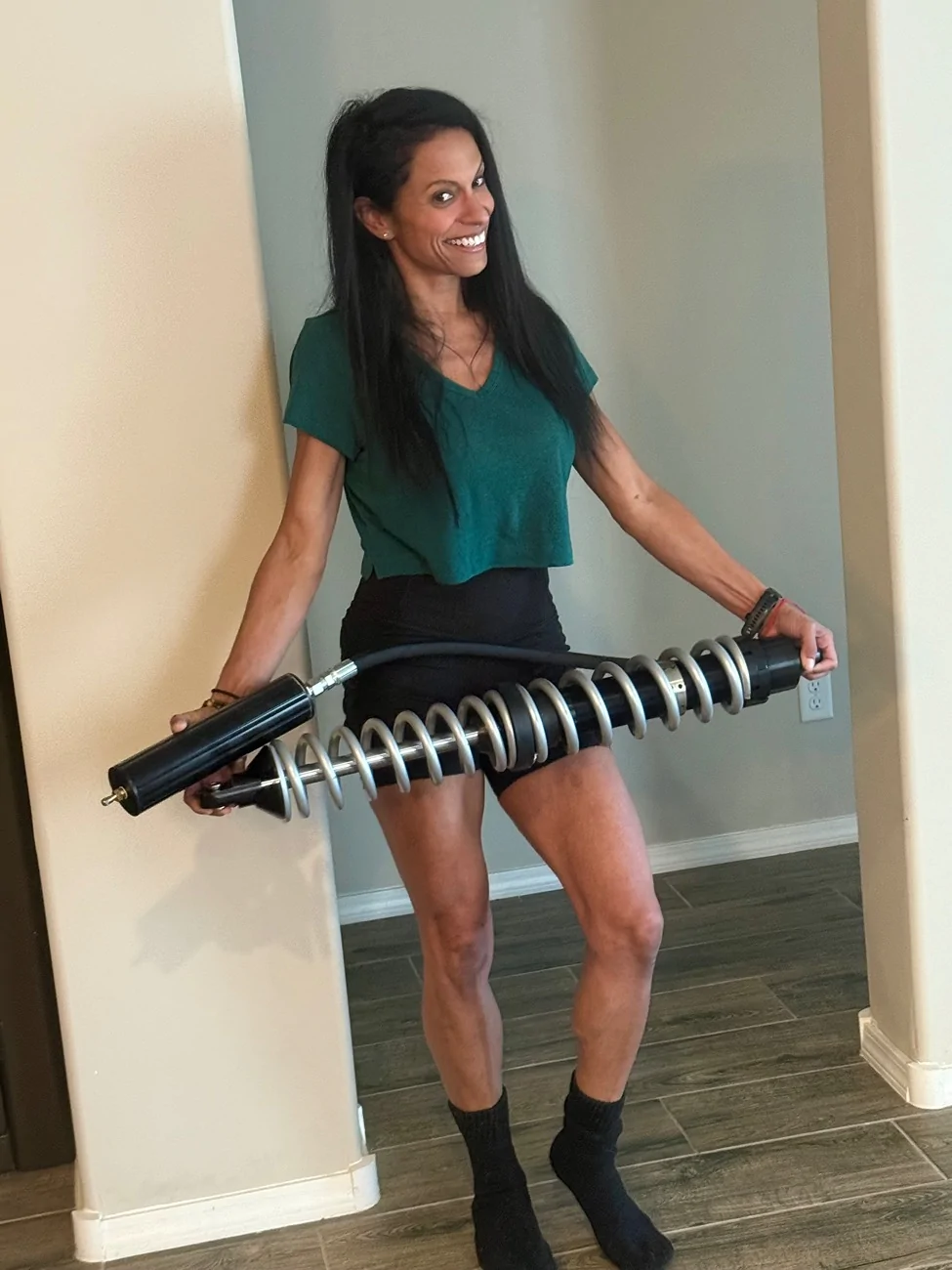
That said, we were able to get a feel for how well RK tunes the product when we bought 8” length coilovers and provided our specifications. They took their universal coilovers and put the Bronco extension on the bottom, then adjusted the shim stack for our coils, weight, and unsprung mass. We were wanting to lower the bronco and figured if we were cutting off the OEM shock towers, might as well put on longer stroke coilovers while we were at it. With the coilovers now riding at the appropriate height we were no longer experiencing harsh bottom outs hitting whoops or curbs. Just able to float through stuff, within reason of course. Anyone can order their universal coilovers and have them adjusted, just gotta give them a call and be patient while the units are built. The same math is used for the Bronco-spec coilovers compared to the custom units, so unless you’re planning on something wild you’ll be well served by their normal Bronco units.
Strength and durability
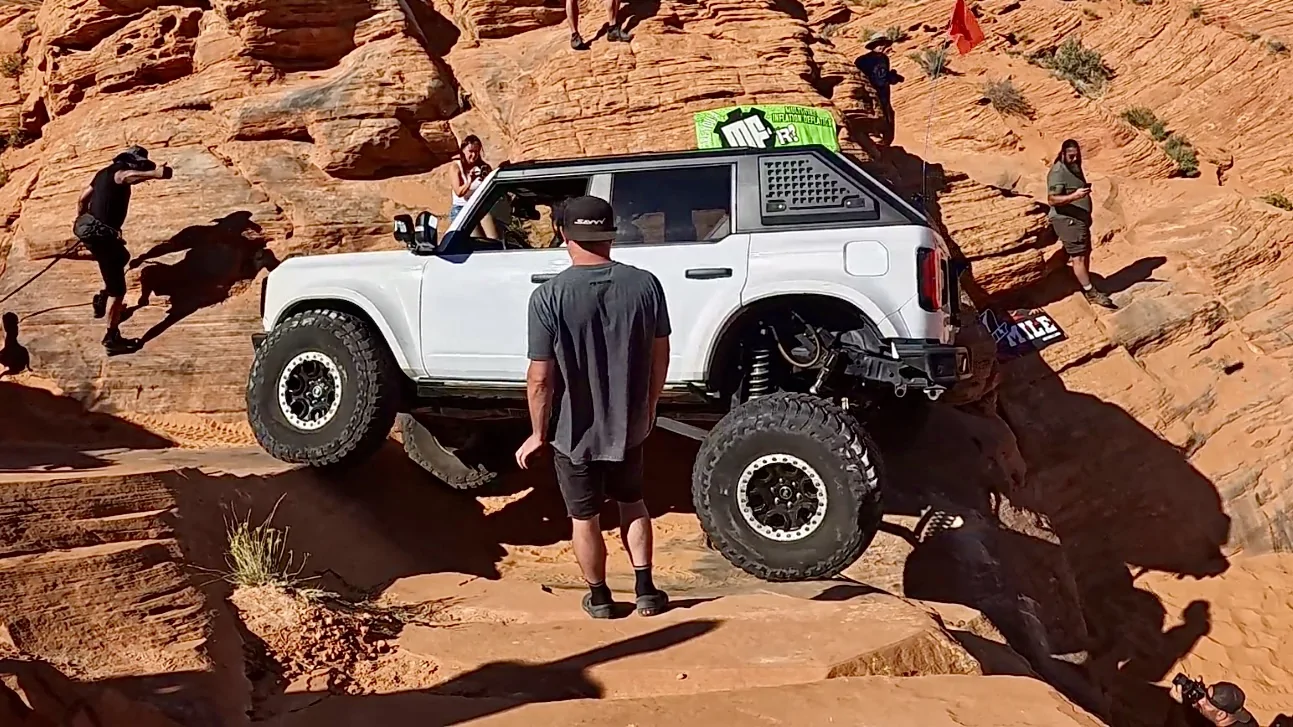
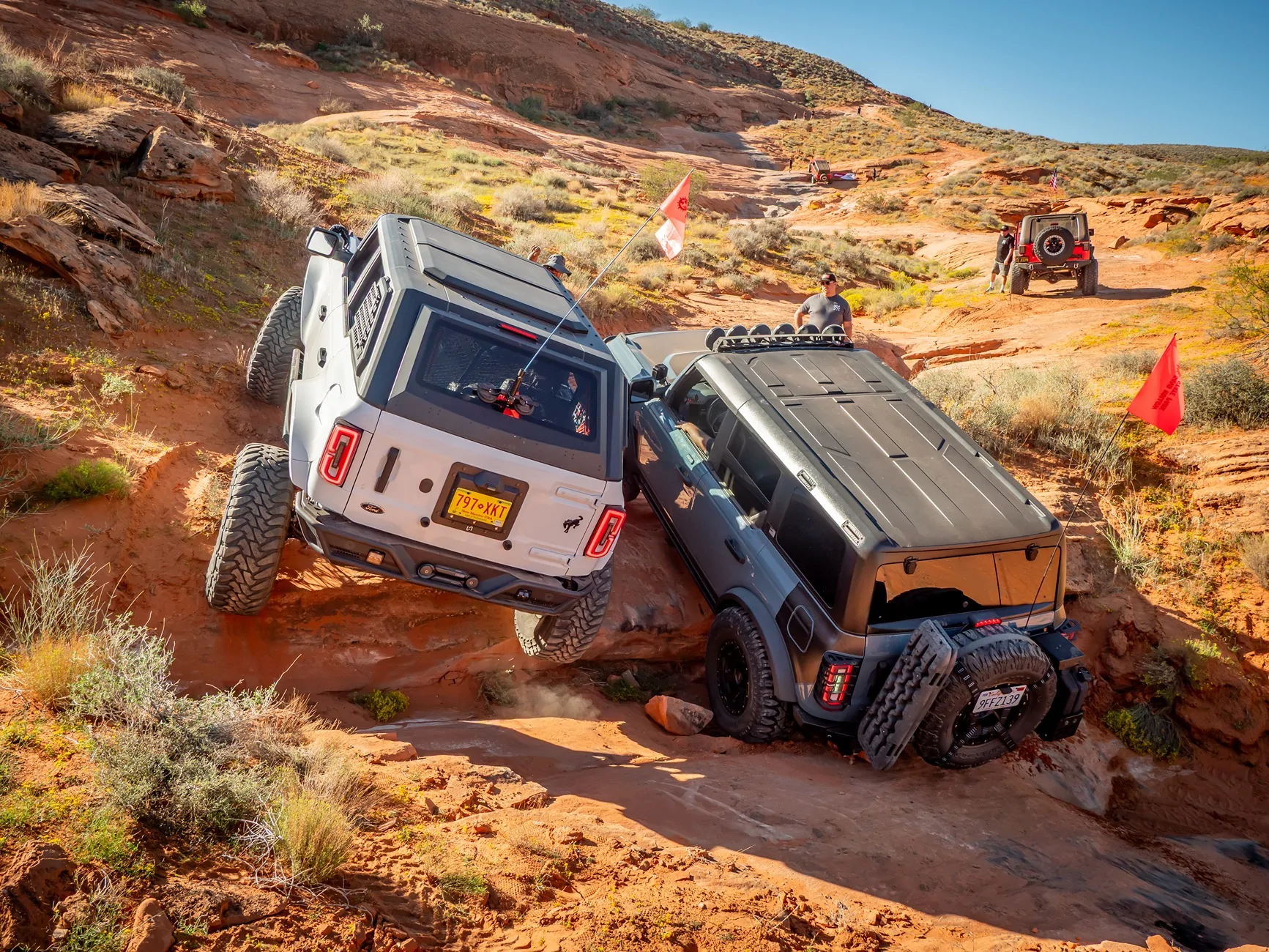
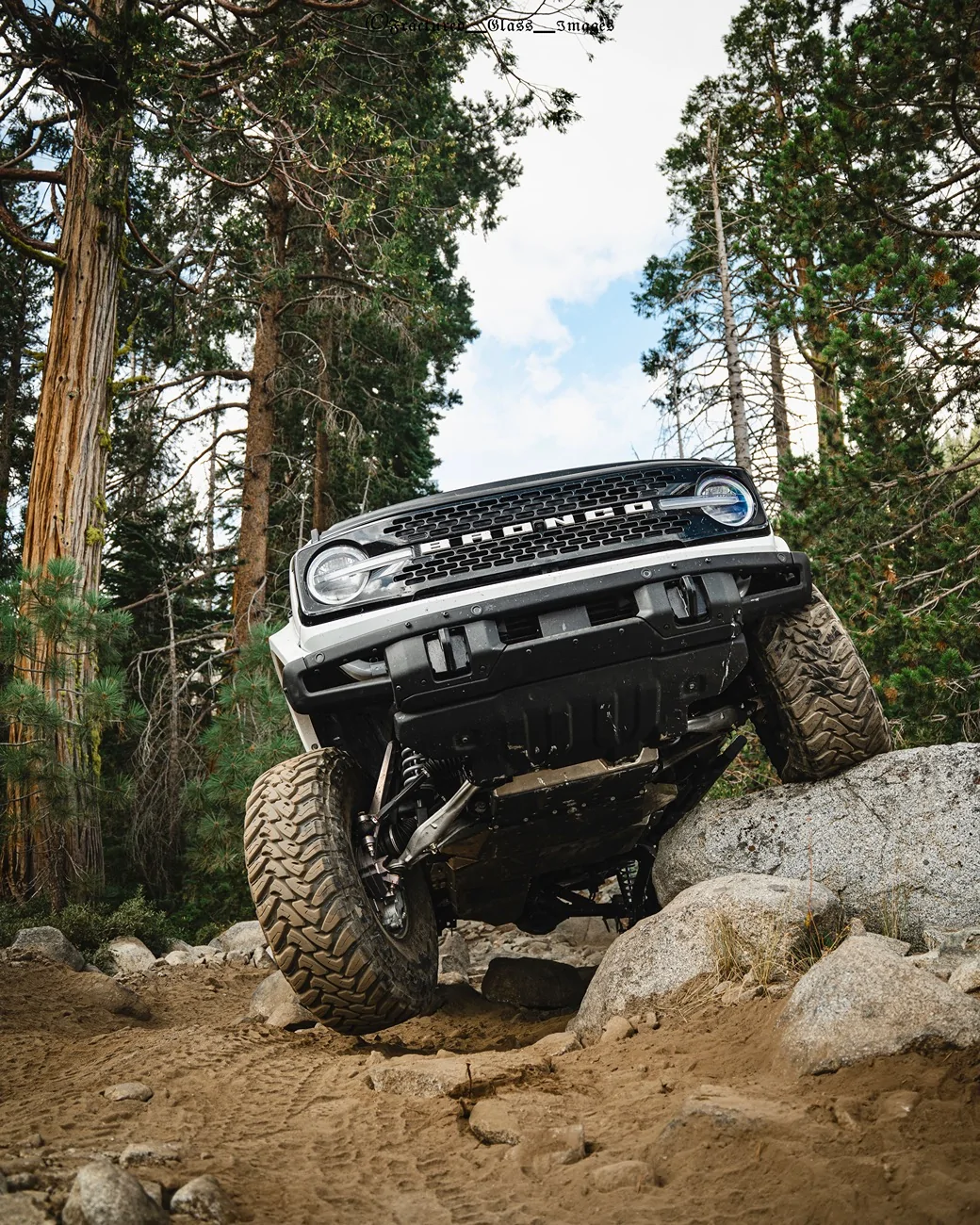
In addition to the modifications previously mentioned, we also have a big ARB toolbox mounted in the back. And an Armadillo aluminum top. And fiberglass fenders. We also carry everything you would need to damn near fix anything on the Bronco, including a full impact socket set with deep sockets sized 8mm to 36mm. We also carry four spare tierods, a spare steering rack, impacts, drivers, gear oil of various weights, a multi-tool kit, and several other ancillary items I won’t bother going in to. Basically-it’s not a light rig. As stated in the TLDR summary, we did not run these coilovers with limit straps or external bump stops. The coilovers themselves took on that duty, which is not recommended for any aftermarket coilover besides the Bilstein 8112. (ORI’s are a different category) To make things even harder on them, we are running the heaviest 40” tires out there plus portals, significantly increasing the unsprung mass and stress the coilovers are being subjected to when drooped out. There are some people out there with similar setups (6G Bronco, hard wheeling, 38-40 inch tires, no limit straps, and portals) that have literally pulled their coilovers apart while wheeling. No such issues on ours. My good friend is running a four door with portals and 40’s, but with a Dana 60. He also has RK coilovers on the back and he wheels his ride harder than we do. No limit straps. And no problems. He was impressed with the performance and recently ordered a custom set for the front. To be clear-not saying that no limit straps or bumps is a best practice, I’m simply using it as an example for how robust the RK coilovers are with the small sample size I have real world experience with.

While the fronts have certainly been subjected to some hits while fully drooped out, the control arms are taking most of the stress there. The big consideration is the back. On both our rig and my buddy’s rig, we ran the RK triangulated four link setup and deleted the panhard bar. While this setup is fantastic, with the higher misalignment ability of the lower links and coilovers, there is a lot more potential for lateral movement of the axle. We have bent or broken several swaybar links and tabs as a result, so it’s not a stretch to recognize the coilovers are now part of the support structure of the suspension taking on a lot of lateral stress. There have been countless situations where the Bronco was at such an angle while drooped out that the coilovers were taking on significant amounts of pressure, and yet they never bent nor did we lose the shock ends or spherical bearings. Taking on huge loads (heh) in these conditions were a testament to the 6.5x increase in strength over 5/8” shafts, and 1.7x increase over 7/8”. (1” is 71% stronger than 7/8 and more than 500% stronger than 5/8, according to grok)
We never did any real mudding (which is good. Mud is to be avoided) but they’ve had a lot of sand exposure. The seals were still solid after a year +. They were never really subjected to much high speed stuff, but I did pull the hoses to check the oil and it was still blue as could be.
If you made it this far you already know that we’re very happy with the Rock Krawler coilovers and wouldn’t hesitate to recommend them to anyone looking. So much so that we bought another set, and sent the old abused coilovers back to Rock Krawler to get the shafts and bodies swapped out for use in the long travel rig. That build is happening soon.


@robbob created a great list that has comparisons of all the latest coilovers with exception of I think just Accutune. So I will not dig deep into all those specs. https://www.bronco6g.com/forum/threads/the-ultimate-travel-guide-bronco-suspension-data-compilation.109821/
Actual review:
If you’ve read any of my threads or reviews, you’ll already know to expect more details and backstory than is necessary. My ramblings are not conducive to those affected by tiktok brain and the associated seven second attention span. If you feel like I should change my ways, please leave a comment in the thread so that I can ignore your requests and continue doing write-ups in the manner I prefer. Thank you for your attention on the subject.
Backstory:
When the plan to start building the Bronco became a thing, we decided to go with portals. I started planning out the build to accommodate the additional forces that the suspension mounts would endure from the increased leverage from the portals. Double shear UCA mounts, reinforce LCA mounts, strengthen rear upper link mounts, and of course-do something with the rear axle. For those that don’t know, at the beginning of the 6G Bronco saga there were many owners spinning their axle tubes in the diff housing when using trail turn assist. Ford would deny the warranty claims if bigger tires than stock were used, so when the thought of running portals enters the chat, one would certainly think the additional leverage and torque on top of the bigger tires is even more of a concern, and the axle needs to be addressed as well. This is where search for a truss began.
While the Bronco D44 and the Wrangler D44 are “the same” axle, there are differences, especially the mounting points. Not wanting to find those differences the hard way, I was only interested in finding a truss designed specifically for the Bronco. This is how I discovered Rock Krawler. I had never heard of them before or knew they existed, but they had a truss for the axle that was included in the Triangulated Four Link setup. I looked into the system and it took care of everything I was looking to do while also providing the potential for more articulation with the right accessories. Online order placed! I wasn’t comfortable welding the tubes to the diff housing and didn’t have a stick welder, so I just had a machine shop weld the truss on for me while also welding the tubes to the housing. Likely unnecessary to do both but it wasn’t much to get the diff housing welded so might as well. While the machine shop had the axle, Rock Krawler released their PB&J links for the Bronco. I figured it would be nice to have everything match as far as rod ends/connections go, so I ordered those as well. (There is a point to sharing all this. Be patient) After getting the axle installed we took the rig out and played around taking measurements, noting the difference in travel and how it felt, then randomly posted about it on some off-road facey group, including a note about looking forward to discovering whether the PB&J links will make a noticeable difference or not. A day or two goes by and I get a random message from some Jeremy fellow, telling me that Rock Krawler has a discount for return customers and that if I didn’t use it on the PB&J links, give them a call and they’d refund it. Well how about that? Pretty cool of them to do. I would expect most companies to just say “yeah we got you on the next order, but we aren’t going to give you a refund for something you didn’t even know existed” and that is perfectly understandable. So already that’s pretty cool customer service.
Fast forward a couple months and I get an email from Next Venture Motorsports inviting us on a customer appreciation run in Moab. Well heck, it’s not terribly far and we happened to have the time to go, so why not? Bronco was still basically stock with exception of the four link, PB&J links, belly skids, double shear, and RPG UCA’s but that’s not a big deal. I’ll skip the trail run part of it but unbeknownst to us, this event actually had a few different companies hosting it, one of which was Rock Krawler, and they had their recently completed Bronco on 40’s there. One evening at the hotel we parked next to their rig to check it out, and as it turns out, one of the Rock Krawler guys came out and started chatting us up about our rig. He noticed the stuff out back, and asked why we went with RPG for the UCA up front rather than using their stuff like we did on the back, explaining the advantages their UCA had over the RPG unit. I was actually convinced to give their UCA’s a try and said I may place an order for a set. Went on to tell him the plan to run portals and that because of the portals, we did not want to have any deflection in the UCA joints, so full heim was the best way to accomplish that. He paused for a moment, and said “you know, while our stuff is definitely strong enough to handle anything you’ll throw at it, I think for a portal build you made the right choice going full heim.” That mentality from an aftermarket parts manufacturer very much resounds with me. It wasn’t purely about his bottom line and making a sale, he was genuinely interested in what was best for the consumer. It’s a trait that seems to be mostly lost with today’s manufacturers. That has stuck with me, and Rock Krawler has proven to me on multiple occasions that they were more concerned with what was right for us rather than making a sale. It wasn’t a one-off scenario. These are genuinely solid people.
Coilovers. Finally
Alright, enough backstory. Time to discuss the coilovers themselves. First of all, I wanted to thoroughly run the coilovers before actually doing a write up about them. I recognize the excitement behind getting something new and immediately wanting to tell everyone about how your purchase has completely changed the rig, but with something like coilovers there is so much more going on. At least let the coils break in before telling the world how great they are. But I wanted to really run them through their paces and see how they held up before providing an assessment. Did any start leaking? Did they break? Did the performance break down? These questions are likely not going to be answered in a short timeline, and coilovers are typically an item the consumer is buying that will likely be on their vehicle until they sell it. Longevity is important. What if the resevoirs start falling off after a year?!?
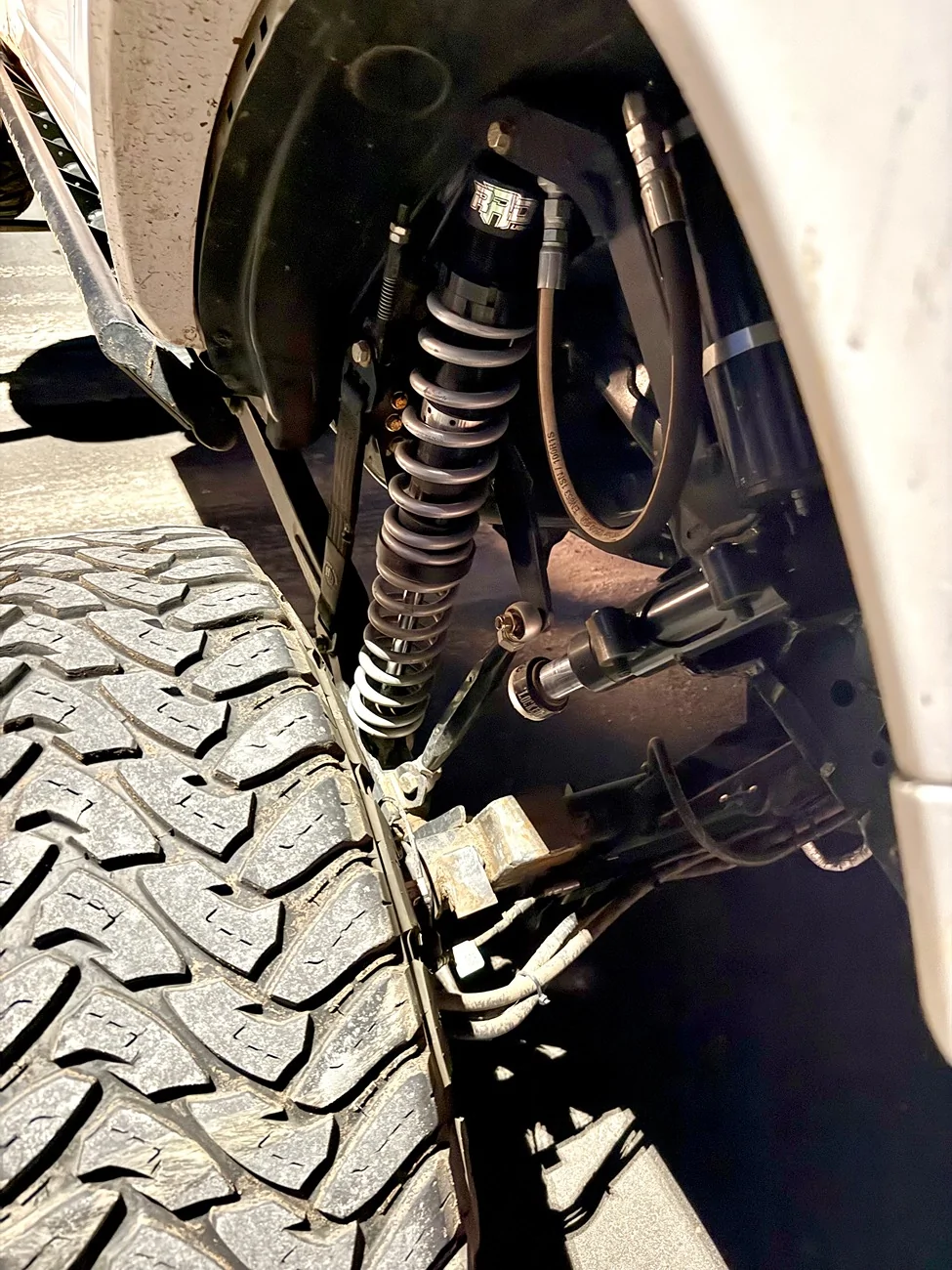
I can only imagine how difficult it is to try to offer a “one size fits all” package when you don’t actually know what the consumer will be doing. Rock Krawler does offer customization, but more on that later. Will the recipient be an overlander with enough accessories to get 1500 pounds over the GVWR, or are they just looking to balance things out to accommodate the Bubba Gump bumper they installed with a shiny new winch? Are they crawling over rocks, bombing through whoops, or perhaps just getting groceries and going to cars and coffee to hang out? In our case, strength and durability were important. Rock Krawler has that locked in as they use 1” 17-4 Stainless hard chrome plated and polished shafts with 2.625” bodies packaged to fit within the 2.5” coilover class. So girthy. The use of 17-4 is considered the “gold standard” for reliability, being incredibly resistant to scratches and corrosion, improving seal life. Most high end coilovers besides Fox Factory series use chromoly 1045/1050 with a lower hardness susceptible to surface damage. I think @AccuTune Offroad also uses 17-4 but not fully certain. Also not certain what Bilstein uses on the 5/8” shafts on the 8112. Either way-this higher quality material will help the seals last longer.
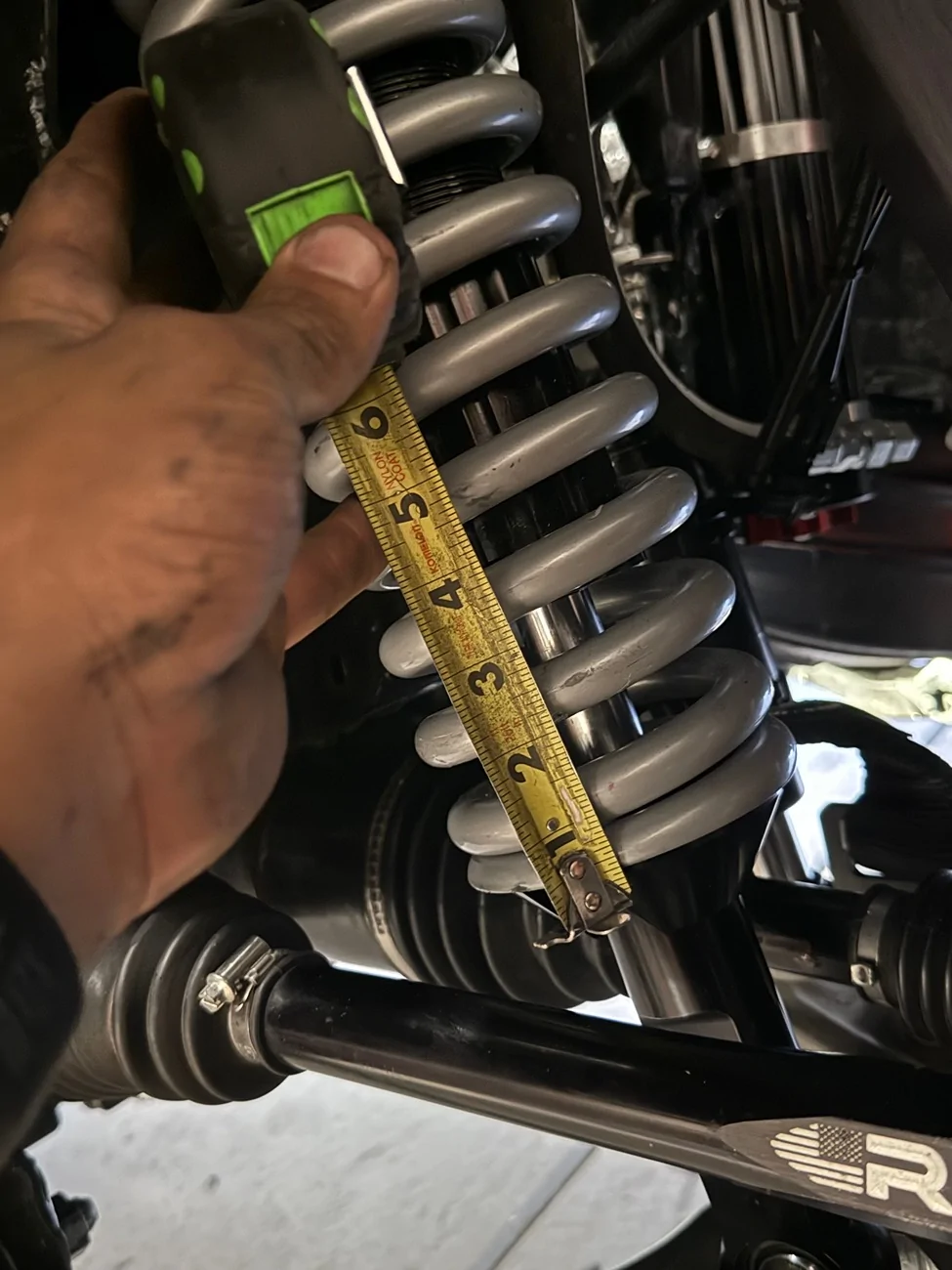
With a 3” ID coil spec you will need to be diligent on coil compressors if you swap to a linear spring as the clearance is tight. A rental from your local parts store may have you regretting life choices.
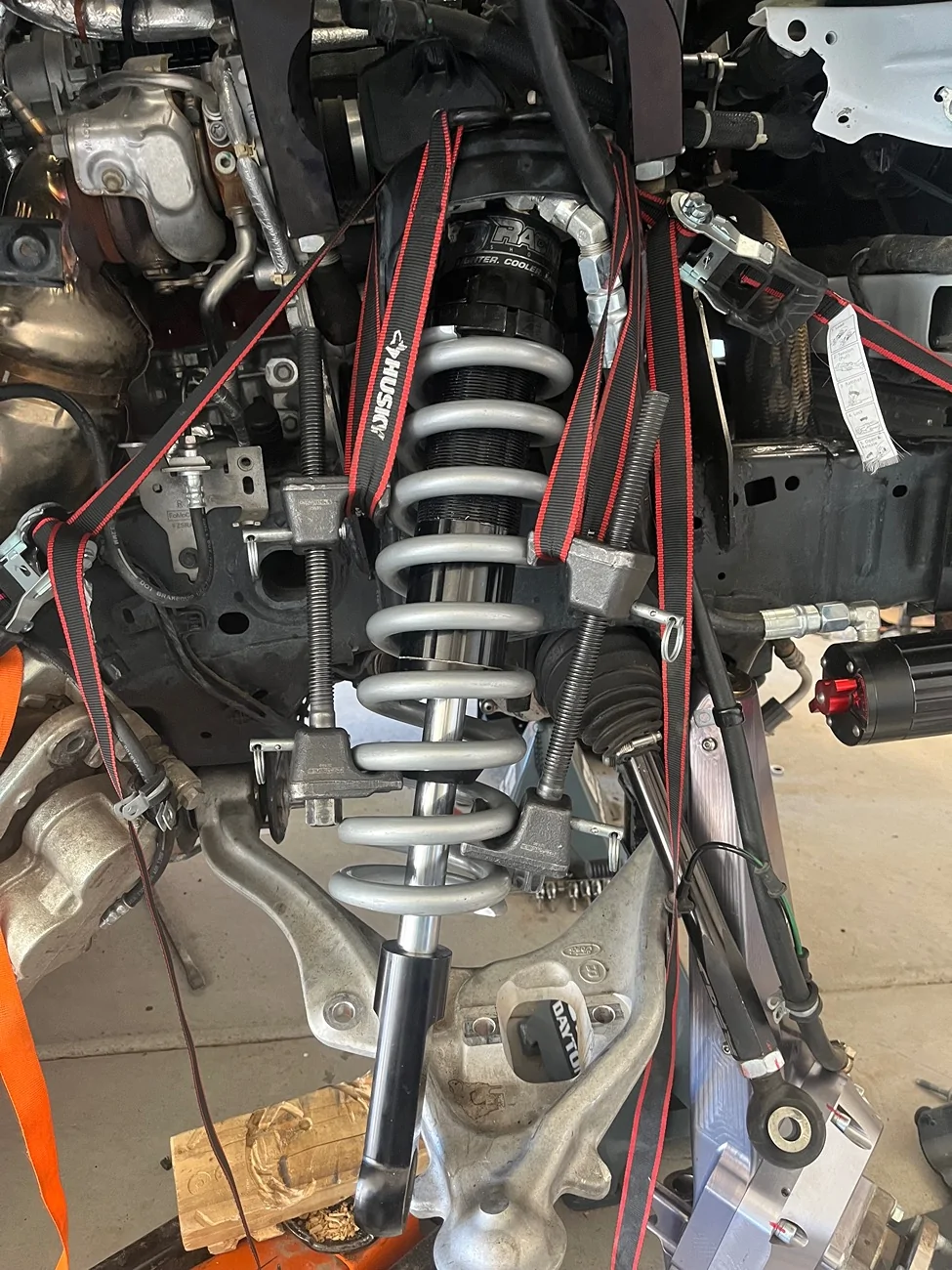
The very large reservoirs are charged with pure argon (not nitrogen)and use fully synthetic Amsoil fluid, if that is something you’re curious about. The valve circuits are linear but run two stage valving on both sides of the piston, for both the front and rear coilovers. It’s not a simple linear, digressive, or progressive tune. There is a lot more going on to their tuning and it’s similar to the expression “have your cake and eat it too.” They have ample compliance around town while body roll is controlled, but your high speed performance offroad isn’t sacrificed either. So while I went on a big diatribe as to how difficult it would be to try to accommodate every facet of the aftermarket needs, Rock Krawler put the extra time, effort, and capital into trying to make a do it all coilover a reality. They have an easily adjustable compression knob on the reservoir, and going from zero to five nets a 35% increase in overall compression. There’s no external rebound adjustment.
Ride quality
This is a tough one as it is such a subjective topic, and with full belly skids, front/rear winches, sliders, UFDU, portals, and 40’s, our rig was far from stock when the coilovers were installed. Rock Krawler has the Bronco coilovers set up with dual rate coils. Front is 525/625 lb/in and rear is 175/275 lb/in. It seems they’re set up to provide a plush ride and resist bottoming out while trying to accommodate a wide range of weights. I don’t know that anyone has determined what the stock spring rates are, so for reference, Accutune sends out their Bronco coilovers with 550 pound coils on stock rigs, and 650 lb coils for the car camping crowd. The RK coilovers are sent out with billet top hats, and will provide lift no matter what you do with the preload. In our case, we already have significant lift with the portals, and tried to set the preload as low as we could get away with. Unfortunately for us, this only gave us about 1” of shaft (~1.6” of uptravel), and we bottomed out a lot when offroading with this setup. It was great around town, but we decided to go with linear 600 pound coils up front and it did help. Rock Krawler did get back to us on what was needed for shim stack adjustments for both the new spring and the rebound to account for the significant unsprung mass increase, but I never followed through as we planned on changing everything anyway to lower the rig and gain even more travel by installing longer coilovers. It should be clarified that the Bronco-spec coilovers are single, dual rate springs. (The coilovers with two coils are the custom RK units we later installed and much longer.)
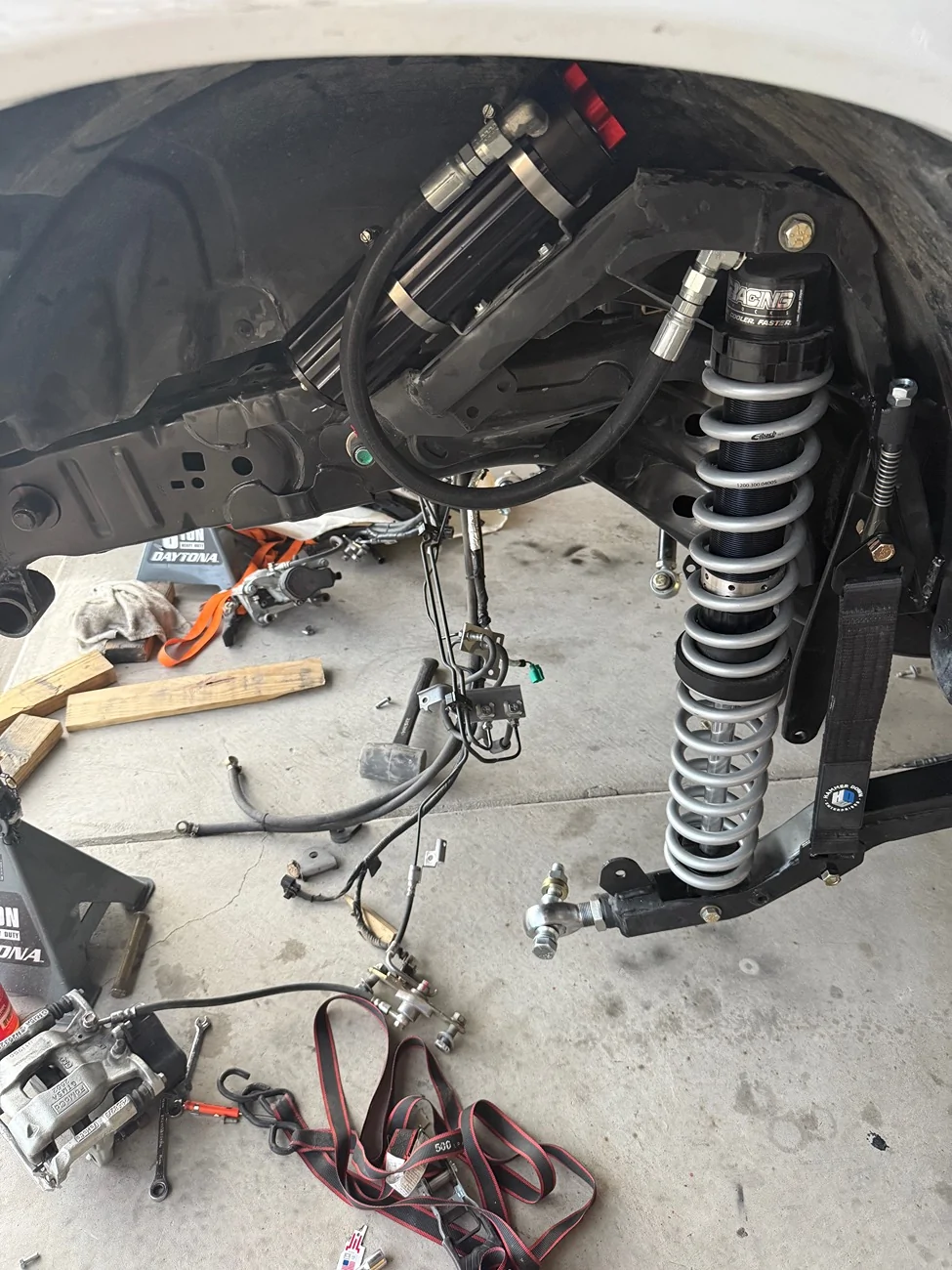
The RK coilovers, like most any aftermarket coilover, delete the rubber bushings in favor of spherical bearings. This is stronger and provides some misalignment ability, but you will feel the road slightly more. Nothing that a tire pressure adjustment can’t solve. When set at the correct ride height they soak up speed bumps without issue. However, when you’ve lowered the ride height to accommodate portals, the speed bumps will be noticed. As they would with any coilover riding that low.
That said, we were able to get a feel for how well RK tunes the product when we bought 8” length coilovers and provided our specifications. They took their universal coilovers and put the Bronco extension on the bottom, then adjusted the shim stack for our coils, weight, and unsprung mass. We were wanting to lower the bronco and figured if we were cutting off the OEM shock towers, might as well put on longer stroke coilovers while we were at it. With the coilovers now riding at the appropriate height we were no longer experiencing harsh bottom outs hitting whoops or curbs. Just able to float through stuff, within reason of course. Anyone can order their universal coilovers and have them adjusted, just gotta give them a call and be patient while the units are built. The same math is used for the Bronco-spec coilovers compared to the custom units, so unless you’re planning on something wild you’ll be well served by their normal Bronco units.
Strength and durability
In addition to the modifications previously mentioned, we also have a big ARB toolbox mounted in the back. And an Armadillo aluminum top. And fiberglass fenders. We also carry everything you would need to damn near fix anything on the Bronco, including a full impact socket set with deep sockets sized 8mm to 36mm. We also carry four spare tierods, a spare steering rack, impacts, drivers, gear oil of various weights, a multi-tool kit, and several other ancillary items I won’t bother going in to. Basically-it’s not a light rig. As stated in the TLDR summary, we did not run these coilovers with limit straps or external bump stops. The coilovers themselves took on that duty, which is not recommended for any aftermarket coilover besides the Bilstein 8112. (ORI’s are a different category) To make things even harder on them, we are running the heaviest 40” tires out there plus portals, significantly increasing the unsprung mass and stress the coilovers are being subjected to when drooped out. There are some people out there with similar setups (6G Bronco, hard wheeling, 38-40 inch tires, no limit straps, and portals) that have literally pulled their coilovers apart while wheeling. No such issues on ours. My good friend is running a four door with portals and 40’s, but with a Dana 60. He also has RK coilovers on the back and he wheels his ride harder than we do. No limit straps. And no problems. He was impressed with the performance and recently ordered a custom set for the front. To be clear-not saying that no limit straps or bumps is a best practice, I’m simply using it as an example for how robust the RK coilovers are with the small sample size I have real world experience with.
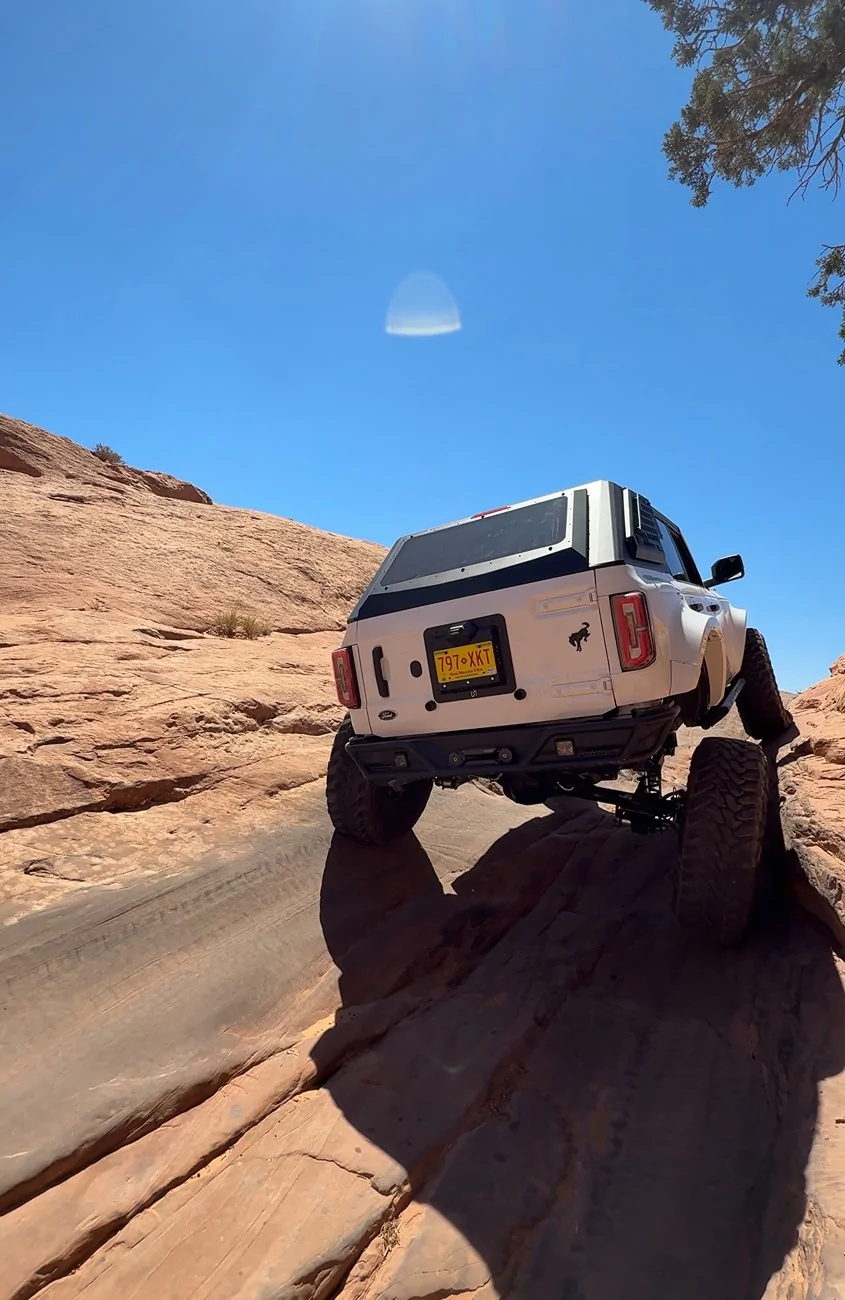
While the fronts have certainly been subjected to some hits while fully drooped out, the control arms are taking most of the stress there. The big consideration is the back. On both our rig and my buddy’s rig, we ran the RK triangulated four link setup and deleted the panhard bar. While this setup is fantastic, with the higher misalignment ability of the lower links and coilovers, there is a lot more potential for lateral movement of the axle. We have bent or broken several swaybar links and tabs as a result, so it’s not a stretch to recognize the coilovers are now part of the support structure of the suspension taking on a lot of lateral stress. There have been countless situations where the Bronco was at such an angle while drooped out that the coilovers were taking on significant amounts of pressure, and yet they never bent nor did we lose the shock ends or spherical bearings. Taking on huge loads (heh) in these conditions were a testament to the 6.5x increase in strength over 5/8” shafts, and 1.7x increase over 7/8”. (1” is 71% stronger than 7/8 and more than 500% stronger than 5/8, according to grok)
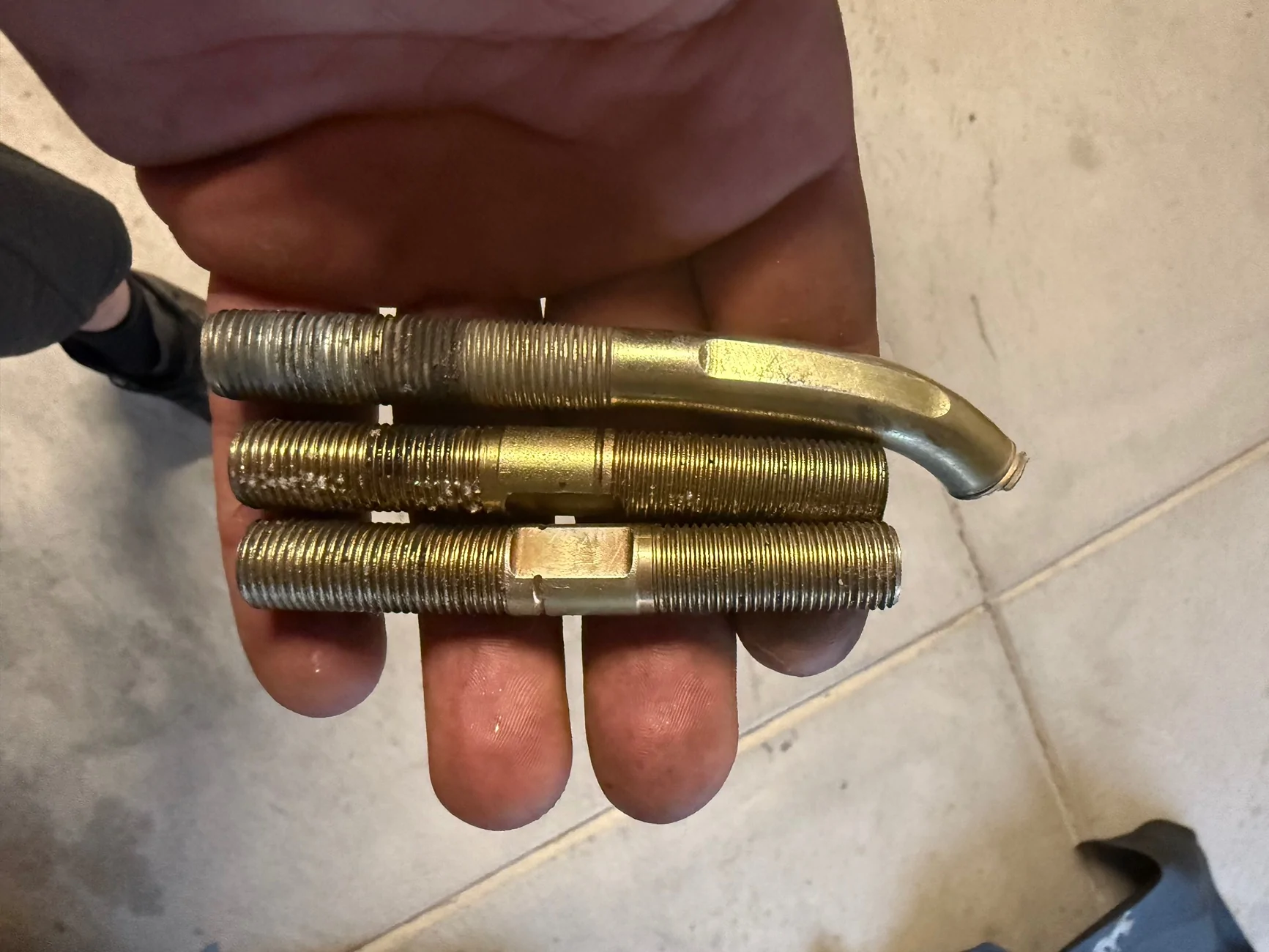
We never did any real mudding (which is good. Mud is to be avoided) but they’ve had a lot of sand exposure. The seals were still solid after a year +. They were never really subjected to much high speed stuff, but I did pull the hoses to check the oil and it was still blue as could be.
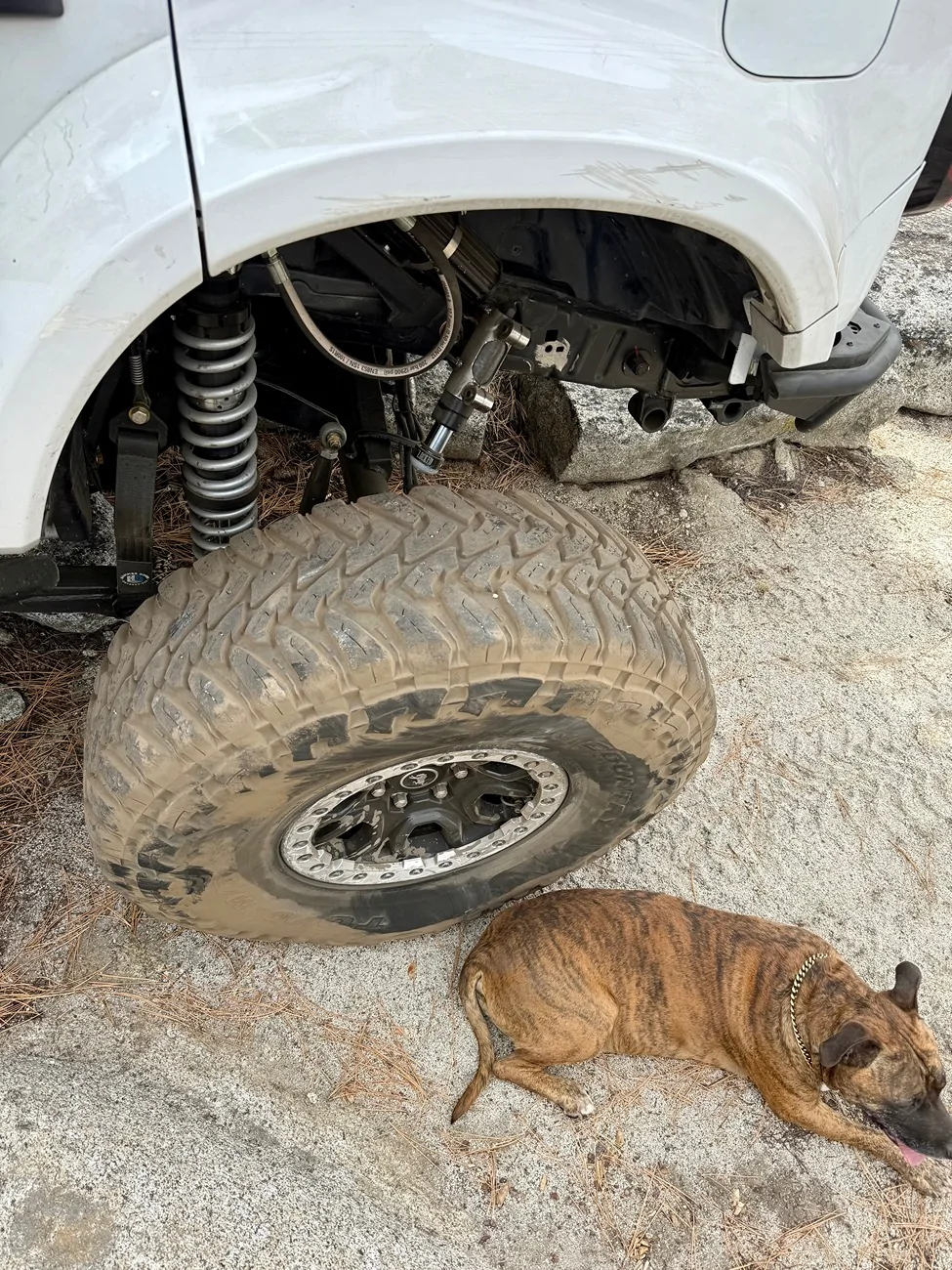
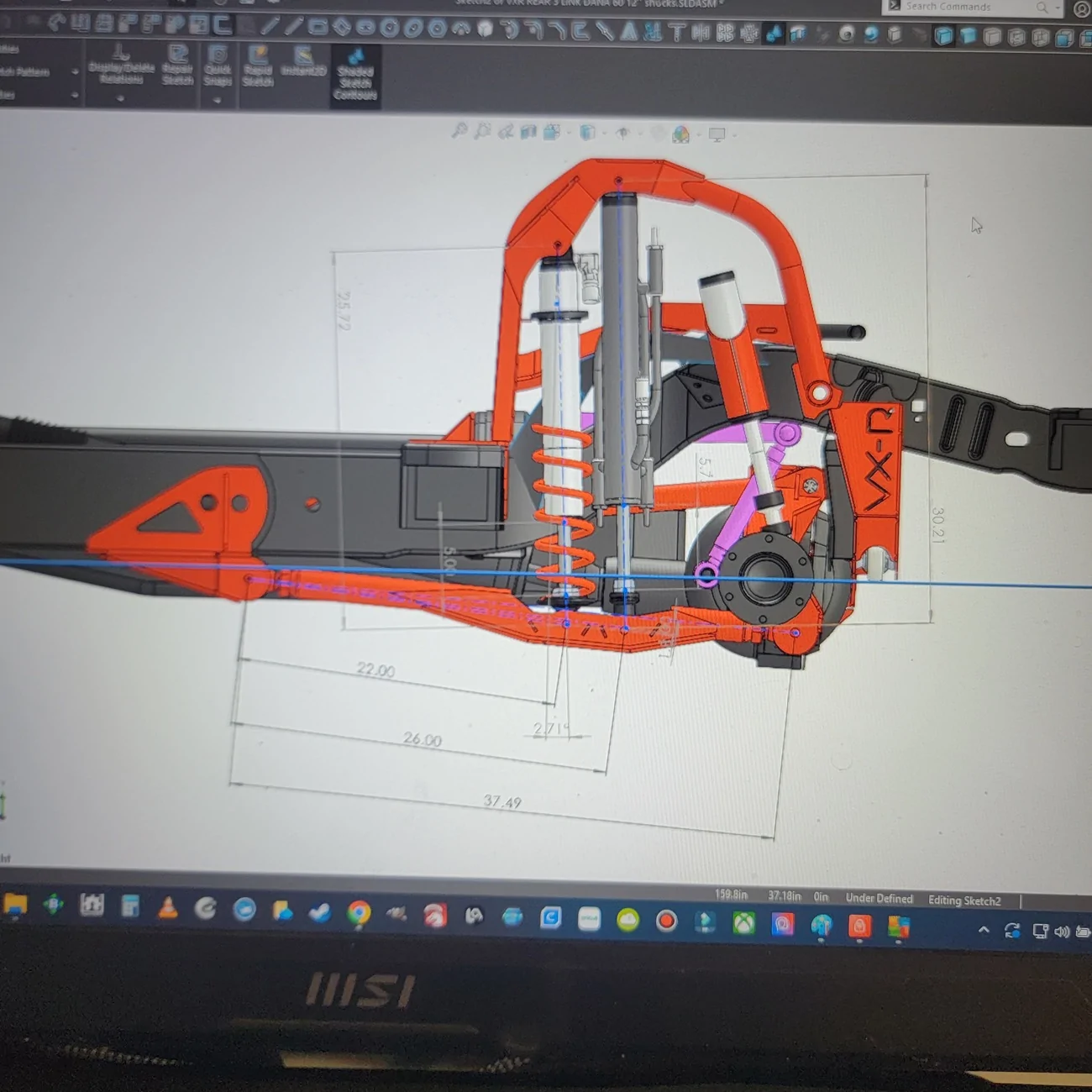
If you made it this far you already know that we’re very happy with the Rock Krawler coilovers and wouldn’t hesitate to recommend them to anyone looking. So much so that we bought another set, and sent the old abused coilovers back to Rock Krawler to get the shafts and bodies swapped out for use in the long travel rig. That build is happening soon.
Sponsored
Last edited: