
Sponsored

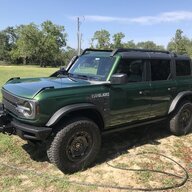
MT Baja Boss AT 255/85 R17 - MT recommends 52-55 psi

kodiakisland

Black Diamond
Well-Known Member
Joined
Jul 10, 2020
Threads
31
Messages
6,168
Reaction score
17,783
Location
Arkansas
Vehicle(s)
12 Tacoma, 18 Indian, 25 GX550
Your Bronco Model
Black Diamond
Clubs
 

vrtical

Raptor
Well-Known Member
First Name
Doug AI
Joined
Jul 14, 2020
Threads
49
Messages
7,575
Reaction score
15,424
Location
GSMNP, TN
Vehicle(s)
Fords
Your Bronco Model
Raptor
Clubs
 
I run my 37s at 42/44, they are D rated and 55psi cold spec. I now have almost 20k on them.
 

hellbilly

Badlands
New Member
First Name
Brandon
Joined
Jul 27, 2026
Threads
0
Messages
1
Reaction score
0
Location
The Colony
Vehicle(s)
2021 Badlands Manual 4dr
Your Bronco Model
Badlands
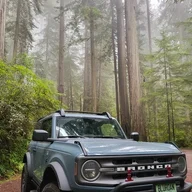
Any chance of getting a picture straight on from the front and rear? I’m considering a similar size in a c load. Would love to see how they present.
 

DALOLA

Big Bend
Well-Known Member
First Name
Retired
Joined
Aug 6, 2025
Threads
9
Messages
956
Reaction score
2,416
Location
Ohio 🇺🇸
Vehicle(s)
'24 Mach-E, '22 Maverick, Hot Rods
Your Bronco Model
Big Bend
lol... I'm waiting for some mfg'r to come up with a tweel for the Bronco....😂
 

CitrusBronco

Everglades
Well-Known Member
First Name
Jim
Joined
May 12, 2024
Threads
28
Messages
1,318
Reaction score
2,668
Location
Citrus county, FL
Vehicle(s)
Former 72 & 73 Bronco driver, f250 7.3 powerstroke
Your Bronco Model
Everglades
Clubs
 
Why not grab a laser thermometer and go for a drive and measure tire temperature. Would be real easy to see what effect psi has on temperature and you would actually know the answer.
 

Sponsored

ducksface

Stroppe
Active Member
First Name
Bill
Joined
Jul 29, 2026
Threads
2
Messages
29
Reaction score
42
Location
AZ
Vehicle(s)
2025 stroppe
Your Bronco Model
Stroppe
According to real-world fleet testing and thermal imaging data from tire manufacturers and safety experts: [1, 2]
  • At 30 PSI (Standard): On a normal 75°F day, a properly inflated tire driving at highway speeds will warm up to around 110°F to 125°F. That is a natural rise of about 35°F to 50°F over the outside air. [1]
  • At 20 PSI (Slightly Under-inflated): Because the tire is softer, it flexes more. This extra flexing adds a real-world increase of about 15°F to 20°F on top of the normal driving heat, pushing the internal temperatures closer to 130°F to 145°F.
No one said to run as low as 20psi. But if you do te temps are completely reasonable. Extrapolate that the 42psi guys are within 15°f(ish) of the 28psi guys. There is no worry at those temps.

The fear number here are numbers from a dead flat tires at high speed NOT from a low psi tire.

You have to know laboratory from real world on your own.
No one should blindly believe a sales brochure.
No one reasonable ever said a tire guy was the last word in tire inflation. They're just a guy with a job, not a career.

Just drive your bronco.
 
Last edited:
OP
OP
sandersd

sandersd

Badlands
Member
First Name
Don
Joined
Jan 29, 2021
Threads
1
Messages
24
Reaction score
10
Location
Houston, TX
Vehicle(s)
2019 C43
Your Bronco Model
Badlands
Why not grab a laser thermometer and go for a drive and measure tire temperature. Would be real easy to see what effect psi has on temperature and you would actually know the answer.
One can do that, but a pyrometer is required as surface temperature is not the same as internal temperature, which is what should be monitored. They start at $150 and go up from there.
 

CitrusBronco

Everglades
Well-Known Member
First Name
Jim
Joined
May 12, 2024
Threads
28
Messages
1,318
Reaction score
2,668
Location
Citrus county, FL
Vehicle(s)
Former 72 & 73 Bronco driver, f250 7.3 powerstroke
Your Bronco Model
Everglades
Clubs
 
One can do that, but a pyrometer is required as surface temperature is not the same as internal temperature, which is what should be monitored. They start at $150 and go up from there.
How much difference would that temp be from inside to outside, would it not be measurable enough to estimate inside temp from actual outside temp?

Is there a rise in psi when temp rises that could also be used to watch for increase temperatures?
It seems one should be able to get at least some reading that could help determine if a high temperature condition is occurring.
 
OP
OP
sandersd

sandersd

Badlands
Member
First Name
Don
Joined
Jan 29, 2021
Threads
1
Messages
24
Reaction score
10
Location
Houston, TX
Vehicle(s)
2019 C43
Your Bronco Model
Badlands
How much difference would that temp be from inside to outside, would it not be measurable enough to estimate inside temp from actual outside temp?

Is there a rise in psi when temp rises that could also be used to watch for increase temperatures?
It seems one should be able to get at least some reading that could help determine if a high temperature condition is occurring.
I went online and researched this. You'll get a more thorough explanation if you do that rather than me explaining it here.
 

CitrusBronco

Everglades
Well-Known Member
First Name
Jim
Joined
May 12, 2024
Threads
28
Messages
1,318
Reaction score
2,668
Location
Citrus county, FL
Vehicle(s)
Former 72 & 73 Bronco driver, f250 7.3 powerstroke
Your Bronco Model
Everglades
Clubs
 
I went online and researched this. You'll get a more thorough explanation if you do that rather than me explaining it here.
I did some reading today and I’m going with this is a non issue.
It would be a fun project to measure temps and psi, maybe some day.
 

Sponsored

Smocaine

Badlands
Well-Known Member
Joined
Jul 26, 2024
Threads
6
Messages
682
Reaction score
1,765
Location
DFW, TX
Vehicle(s)
Cervelo Caledonia
Your Bronco Model
Badlands
Clubs
 
I will gladly save your life from those deadly Baja Bosses. I won't even charge you a tire disposal fee. Just let me know when and where to pick them up.
 

87-Z28

Outer Banks
Well-Known Member
First Name
Andy
Joined
Sep 1, 2022
Threads
3
Messages
1,270
Reaction score
3,101
Location
Texas
Vehicle(s)
BMW
Your Bronco Model
Outer Banks
Clubs
 
I did some reading today and I’m going with this is a non issue.
It would be a fun project to measure temps and psi, maybe some day.
I am sure you could see some interesting trends just measuring surface temps. Agree that this all seems very silly.

It would be hard to convince me this is an issue. I am not really a tire guy but simply static equilibrium dictates the contact patch size, given the air pressure and load carried (corner weight). The Toyo tire tables say an LT255/80r17 has a capacity of 1954 lbs at 35 psi. That is a 1954/35=56 in^2 contact patch (7.5x7.5 ish inches). You are doing something wrong if you are carrying more than 2k lbs on a corner in a bronco.

As you start dropping pressure, the contact patch must increase to carry the load. This is the reason we air down, to increase contact patch. Tire side walls don’t carry any real load when properly inflated. The air pressure does. In example above 35 psi is sufficient to carry 1954 lbs without sidewall doing any work.

As pressure drops, then side walls can begin to share some of the load. they will undergo elastic deformation (begin to bulge). This elastic strain energy is necessary to get the side walls to heat up. strain energy generation in the bulging sidewall must dissipate heat. As rotation rate increases, strain energy generation rate increases and heat dissipation lags causing temperatures to rise. All that to say heat generation is related to strain energy rate, ie, tire bulging. Not much bulge. Not much strain energy. Easy for tires to dissipate heat. So not much temperature rise.

Sure temps go up even without bulging due to in-plane deformations, but those are small. Serious bulging induces much greater strain energy. If tire sidewalls couldn’t handle the heat dissipation from non bulging sidewalls no one would be driving.

I can’t believe these tires (LT255/85r17) will bulge by any significant amount at 30 psi. So very hard for me to believe that temperatures can become critical even at sustained speeds of 75 mph.

It would be very interesting to see how sidewall temps vary as pressures go down. This requires air pressure, vehicle speed, and duration to all be controlled for meaningful conclusive results. But for starters I would run these tires at 30 psi for an hour at 75 mph and measure temps.

It would be hard to convince me that minor sidewall bulge will cause critical temps. Granted the skinny tires (255s) begin to bulge at higher pressures than 315s, but I would think even 25 psi is fine at highway speeds. Lord knows I have run that way for many, many, many hours in the past.

This seems like paralysis from poorly constrained data (pressure vs load capacity tables).
 

dgorsett

Big Bend
Well-Known Member
Joined
Apr 3, 2019
Threads
25
Messages
5,058
Reaction score
10,123
Location
colorado
Vehicle(s)
F250, Mustang, Explorer
Your Bronco Model
Big Bend
Load E - set them at 32 and drive it like you stole it. ;)
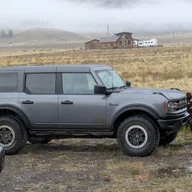
This I believe to be fact after clearing all the fog.
My stock BB with 255 SL Duelers the sticker said 35psi. I switched to 265/70x17 LRE Falkens and a forum recommended table said to run 44 psi to get the same load carrying capacity as the 255 SLs at 35 psi. Just couldn't force myself to do it, so I ran 35 and now down to 33psi. Wear is even after 4 years, ride is decent and my highly scientific temp checks when flat towing (walk around touch test for tires and bearings at every stop) indicate nothing over 120 degrees
 

crenca

Big Bend
Well-Known Member
First Name
Chris
Joined
Nov 4, 2024
Threads
24
Messages
1,396
Reaction score
2,267
Location
Southern New Mexico
Vehicle(s)
2016 Sequoia, 2012 Tundra, 2024 Sasquatched 2.3L 7M 4Door Bronco
Your Bronco Model
Big Bend
It would be hard to convince me that minor sidewall bulge will cause critical temps. Granted the skinny tires (255s) begin to bulge at higher pressures than 315s, but I would think even 25 psi is fine at highway speeds. Lord knows I have run that way for many, many, many hours in the past.
^This^

This seems like paralysis from poorly constrained data (pressure vs load capacity tables).
That, and the fact that almost all these various recommendations the OP was getting (especially the one about how he needed to use a 10K lbs in the calculation :ROFLMAO: ) are not an coming from an engineering perspective, which is to say from an objective point of view based in known physical facts of materials, construction, effect of heat, etc. Rather these are cultural answers, based in legal liability fears, government regulation, and general "consensus" (i.e. "what everybody else is doing - we can't $afford$ to be different or even truthful".)

Cultural "science":
6 feet and paper masks are necessary to prevent spread of covid virus.

Real science:
6 feet and paper makes no measurable difference (other factors do of course).

Cultural "science":
Public/private indoor swimming pool staff need to remove swimmers for pool when lighting (even if only at 15k feet!) is detected within 10 miles to prevent electrocution of said swimmers.

Real science:
There is no record of a single person being electrocuted by lighting in an indoor pool (public or private) in the last 70 years in NA, SA, Western Europe, Australia, New Zealand, Japan, and other assorted Asian countries. If actual engineering is taken into account, the reason why is obvious.

Of course such examples could go on ad infinitum. The OP (somewhat understandably) thought he could contact Micky Thompson and get a straight/useful answer from them. The reality is this is simply not the truth...
Sponsored


Top