

- Thread starter
- #1
Frankly I'm a bit shocked at how well this Cobb IC for the Raptor Performs. Although there was a lager outside air temperature difference between the tests than I wanted (55 °F ambient with OEM vs 48 °F with the Cobb) the primary way I will show the differences should account for most of this.
The OEM data is 2 WOT pulls from a dig to about 95 mph whereas the Cobb is just one, to the same speed. However, I will primarily compare the first pull from each hence apples to apples. I did not yet have the time/space/safety to do testing that accounts for sustained high rpm or high load use along with potential heak soak. Call this the street "drag race" version of the data/results.
My relevant mods are ZFG E50 Race Tune, S&B CAI (dry filter) and the Cobb IC (front shutters still on, rears removed). Data was taken with the HP Tuners MPVI3 dongle and VCM Scanner software.
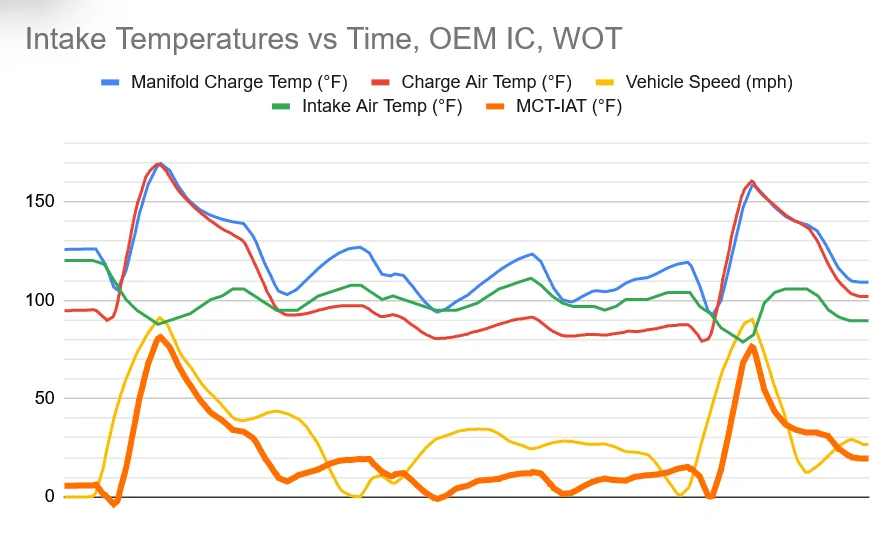
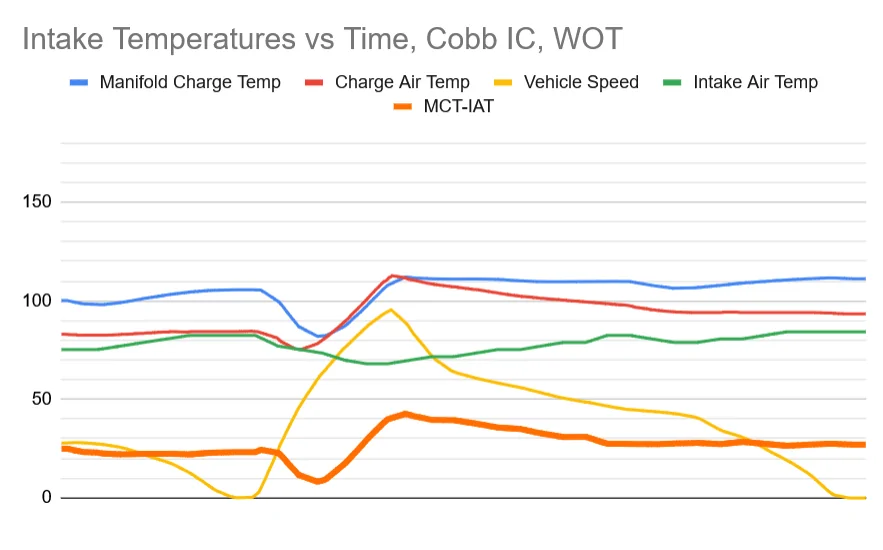
The temperatures recorded here include intake (IAT), maifold charge (MCT) and charge (CAT). The IAT is just that - using the temperature sensor near the airbox. The MCT is the temperature of the air in the intake manifold. I don't fully understand the CAT, but I think it is supposed to be a calculation (not direct measurement) of the actual in cylinder charge temperature.
Input from ZFG stated that at a MCT of 130 °F and above, the PCM will be cutting power. Now to largely account for ambient air temperature differences, I have calculated and plotted (in organge and bold) the key result here: MCT minus IAT, which better shows the effect of the IC swap not really the small difference in my ambient conditions.
Here are the data:


(* Do note the time scales in the two graphs are not identical as you can most easily see in the yellow speed vs. time traces as the WOT parts do in actuality have almost identical slopes. Obviously not all of the data is WOT. If you can't tell which parts are and which are not, kindly go away...)
Just look at those orange traces! It is 81 °F vs. 43 °F at the peaks, or a 38 °F lower manifold charge temperature increase over ambient (really over IAT, technically).
Also, with the OEM IC that critical 130 °F manifold charge temperature is reached at only 69 mph, whereas the maximum MCT with the Cobb was only 113 °F, nowhere close to the critical 130 °F limit. With the OEM IC the MCT peaked at 170 °F, really deep into the power cutting temperatures.
I plan to repeat the Cobb tests again soon, hopefully tomorrow evening, at a closer or identical ambient temperature. I also hope to do a more severe duty test of the Cobb, but I am not going to bother swapping back to the OEM IC.
I am thoroghly impressed.
Shout out to @GooseTuned for the Cobb IC!
*EDIT/UPDATE* 2/2/26 - @GooseTuned has verified similar numbers via dyno testing here in post 45. Differences not as large, as expected, since vehicle wasn't moving hence reduced convection cooling.
The OEM data is 2 WOT pulls from a dig to about 95 mph whereas the Cobb is just one, to the same speed. However, I will primarily compare the first pull from each hence apples to apples. I did not yet have the time/space/safety to do testing that accounts for sustained high rpm or high load use along with potential heak soak. Call this the street "drag race" version of the data/results.
My relevant mods are ZFG E50 Race Tune, S&B CAI (dry filter) and the Cobb IC (front shutters still on, rears removed). Data was taken with the HP Tuners MPVI3 dongle and VCM Scanner software.
The temperatures recorded here include intake (IAT), maifold charge (MCT) and charge (CAT). The IAT is just that - using the temperature sensor near the airbox. The MCT is the temperature of the air in the intake manifold. I don't fully understand the CAT, but I think it is supposed to be a calculation (not direct measurement) of the actual in cylinder charge temperature.
Input from ZFG stated that at a MCT of 130 °F and above, the PCM will be cutting power. Now to largely account for ambient air temperature differences, I have calculated and plotted (in organge and bold) the key result here: MCT minus IAT, which better shows the effect of the IC swap not really the small difference in my ambient conditions.
Here are the data:
(* Do note the time scales in the two graphs are not identical as you can most easily see in the yellow speed vs. time traces as the WOT parts do in actuality have almost identical slopes. Obviously not all of the data is WOT. If you can't tell which parts are and which are not, kindly go away...)
Just look at those orange traces! It is 81 °F vs. 43 °F at the peaks, or a 38 °F lower manifold charge temperature increase over ambient (really over IAT, technically).
Also, with the OEM IC that critical 130 °F manifold charge temperature is reached at only 69 mph, whereas the maximum MCT with the Cobb was only 113 °F, nowhere close to the critical 130 °F limit. With the OEM IC the MCT peaked at 170 °F, really deep into the power cutting temperatures.
I plan to repeat the Cobb tests again soon, hopefully tomorrow evening, at a closer or identical ambient temperature. I also hope to do a more severe duty test of the Cobb, but I am not going to bother swapping back to the OEM IC.
I am thoroghly impressed.
Shout out to @GooseTuned for the Cobb IC!
*EDIT/UPDATE* 2/2/26 - @GooseTuned has verified similar numbers via dyno testing here in post 45. Differences not as large, as expected, since vehicle wasn't moving hence reduced convection cooling.
Sponsored
Last edited: