

Sponsored

F150LEDs - Automatic Engine Bay LED Kit

CalvinT

Badlands
Well-Known Member
First Name
Calvin
Joined
Mar 15, 2022
Threads
16
Messages
2,445
Reaction score
3,078
Location
Phoenix, AZ
Vehicle(s)
2002 Subaru WRX Wagon, 2023 Badlands (nonSAS)
Your Bronco Model
Badlands
Clubs
 
This is in case the vehicle ground conductor goes bad to the battery. You don't want your starter current running through your 2-way chassis to get back to the battery.
How would starter current start running though the 2-way chassis? Also if the vehicle ground conducter to the battery goes bad your Bronco won't run.
Sponsored

 
OP
OP
redone17

redone17

Black Diamond
Well-Known Member
First Name
Chris
Joined
Mar 6, 2021
Threads
75
Messages
4,752
Reaction score
5,184
Location
Cold Spring, NY
Vehicle(s)
2021 Bronco, 2020 Ranger
Your Bronco Model
Black Diamond
@BroncoDave24 - mind posting a pic of your tilt switch location? Mine comes in a few days. Gonna give that a try.

I realized after it was too late that the rear light location they suggested interferes with the hood seal along the back. So, I pulled it the next day and was thankfully able to mount it using the same 3M. Since I didn’t commit to the location at first - It’s not my best RTV work without the precision tip - looking a bit sloppy. Again, I wish I mounted both up front like you did.

I’m pretty much over trying to talk to their support team. I’ll likely never buy anything from them again.

I’m also thankful I attempted this project on my truck before my wife’s Ranger. I’ll use this experience to put some thought into that install.
 

BroncoDave24

Wildtrak
Well-Known Member
First Name
David
Joined
Mar 11, 2024
Threads
7
Messages
170
Reaction score
227
Location
East Tennessee
Vehicle(s)
'61 Falcon, '87 F150 XLT Lariat 5.0, '01 F350 7.3L, '24 WildTrak
Your Bronco Model
Wildtrak
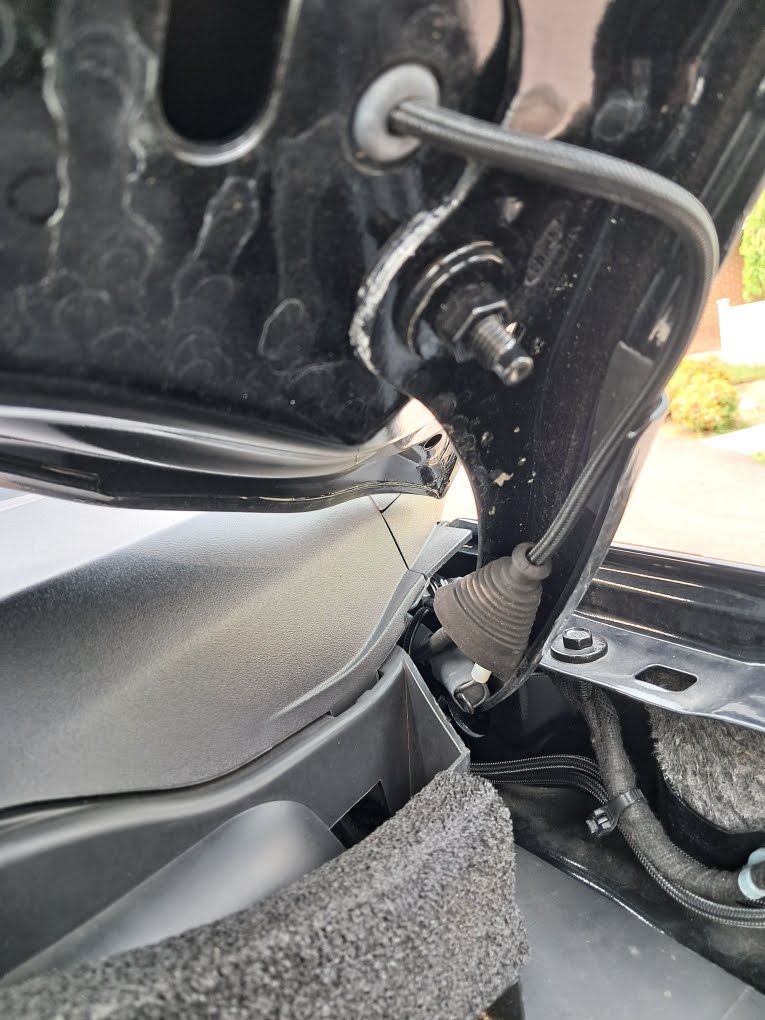
I used shrink wrap around the switch to capture the wires. Then I used 3M double sided tape to secure the assembly to the hinge at the correct angle. I put a firewall grommet that I had on hand over the wiring to slide down over the switch to cover it when in place. I pulled the grommet back so you can see the shrink wrapped switch it covers. I hope this helps.

Ford Bronco F150LEDs - Automatic Engine Bay LED Kit 2024 Bronco Engine Light Tilt Switch 01
 

BroncoDave24

Wildtrak
Well-Known Member
First Name
David
Joined
Mar 11, 2024
Threads
7
Messages
170
Reaction score
227
Location
East Tennessee
Vehicle(s)
'61 Falcon, '87 F150 XLT Lariat 5.0, '01 F350 7.3L, '24 WildTrak
Your Bronco Model
Wildtrak
How would starter current start running though the 2-way chassis? Also if the vehicle ground conducter to the battery goes bad your Bronco won't run.
Since you said basically said to trust no manufacturer that fuses the ground, that got me to thinking outside of the Bronco box...:unsure: That would include Icom, Yaesu, Kenwood, Standard, Vertex, HyTerra, Motorola, GE, etc.etc... That would also include most high power audio amp manufacturers.


If the radio chassis is bonded electrically the frame (as it should be in a high power mobile RF transmitter) AND the negative power lead is tied straight to the negative battery post ( again, as it should be), You have created a second path for the starter and every other accessory to ground to the battery through your radio's negative battery lead and the radio chassis. The Vehicle ground lead to the battery does not have to go completely bad. It can have some voltage drop in it and cause all kinds of funky issues. (Been fooling with this stuff over 40 years). I've seen steering diodes exploded off the board, repaired, working great, only to be blown off again the first time the starter is kicked in. I have seen intermittent memory clearing issues on processor controlled radios. I have seen one melted wire, luckily no fire resulted.

It's just good practice to fuse the negative lead of high power accessories IF it connects directly to the battery. There is no need if the negative power lead grounds through the vehicle frame or chassis.

Also, to be perfectly clear, in all scenarios, the positive lead MUST be fused as close to the battery as possible.
 
Last edited:

CalvinT

Badlands
Well-Known Member
First Name
Calvin
Joined
Mar 15, 2022
Threads
16
Messages
2,445
Reaction score
3,078
Location
Phoenix, AZ
Vehicle(s)
2002 Subaru WRX Wagon, 2023 Badlands (nonSAS)
Your Bronco Model
Badlands
Clubs
 
Please give me a link or model number of any radio by any manufacturer who tells you to put a fuse in the ground circuit. I want to take a look at the schematics and wiring diagrams to see what's going on.

Steering diodes can be blown if attention isn't paid to avoid the diode becoming a direct short between plus and ground. Using a fuse to protect steering diodes is bad practice to compensate for poor circuit design.

Explain exactly how current from the starter can go through the radio or any other ground if the starter ground wire is disconnected. Please explain the exact path if you've seen it happen. Don't just says it could happen. Explain exactly how it can happen.

About experience. My career started with over 86 weeks of US Navy electronics/electrical schools. I have a FCC First Class Radio Telephone License with Radar endorsement. That's the tip of the iceberg.
 

Sponsored
OP
OP
redone17

redone17

Black Diamond
Well-Known Member
First Name
Chris
Joined
Mar 6, 2021
Threads
75
Messages
4,752
Reaction score
5,184
Location
Cold Spring, NY
Vehicle(s)
2021 Bronco, 2020 Ranger
Your Bronco Model
Black Diamond
@BroncoDave24 - I think I get it. It will probably make more sense when I have the component in hand.

Did you use 12 or 14 awg wiring/inline fuse from harness to the battery. Is it 16 awg the whole run?
 

Brian_B

Big Bend
Well-Known Member
First Name
Brian
Joined
Sep 14, 2023
Threads
60
Messages
8,230
Reaction score
14,570
Location
Central CA
Vehicle(s)
'23 BB 4dr 7MT, '22 BSport OBX, '87 B-II XL
Your Bronco Model
Big Bend
Clubs
 
If the radio chassis is bonded electrically the frame (as it should be in a high power mobile RF transmitter) AND the negative power lead is tied straight to the negative battery post ( again, as it should be)
Doesn't most noise-sensitive electronics like this have a separate (-) and (Gnd)? The chassis would be bounded to Gnd, but the main power circuitry would be tied to (-), and the two would be completely independent internal on the device to help prevent noise from getting in on the main circuitry.

Kinda like in your house - your Neutral and Ground are probably bonded in your circuit breaker box, but they stay as seperate circuits inside of each appliance. And even though your equipment frames are all (usually) grounded to Gnd... you don't get electricuited when your motors turn on and go back through Neutral. Even though there is a path there in your circuit breaker box.

I mean, maybe some power electronics use (-) and (Gnd) together... and most cheap consumer level stuff will assume that. But the high end stuff I usually see (at least in the industrial realm) has a floating (-) that is separate and isolated internally from (Gnd)
 

BroncoDave24

Wildtrak
Well-Known Member
First Name
David
Joined
Mar 11, 2024
Threads
7
Messages
170
Reaction score
227
Location
East Tennessee
Vehicle(s)
'61 Falcon, '87 F150 XLT Lariat 5.0, '01 F350 7.3L, '24 WildTrak
Your Bronco Model
Wildtrak
I never said fusing the negative lead wasn't controversial! I am not trying to be argumentative. I am saying there are good, logical debate points that can be made on both sides of this issue.

Is it critical to fuse the negative, normally NO.
Is it ever recommended by any manufacturer to fuse the negative lead, YES.

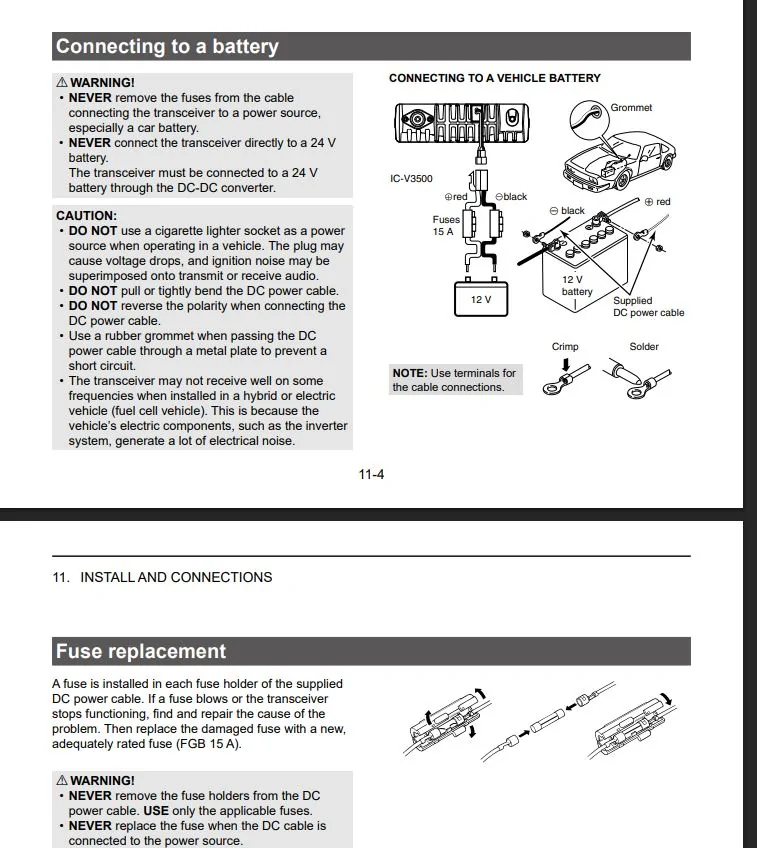
I have attached a capture of the install page from a rig I installed last week to show at least one manufacturer (Icom IC-V3500) that fuses BOTH leads to the battery. The factory wiring harness included fuses on both leads. Believe me, it is NOT uncommon. Also see Kenwood PG-20 and PG-2N, Yaesu T90258251 replacement power cables, all double fused.

Also, the negative fuse in my last post was not intended to protect the diodes. The current wasn't enough to blow the fuse. The diodes were saved by repairing the truck's negative battery lead and eliminating the small current surge that was going through the radio chassis because the factory negative from the battery to the frame/engine was compromised.

Heading to the mountains for the weekend... Cheers to all!

Ford Bronco F150LEDs - Automatic Engine Bay LED Kit Icom IC-V3500 Power Connections 01
 
Last edited:

BroncoDave24

Wildtrak
Well-Known Member
First Name
David
Joined
Mar 11, 2024
Threads
7
Messages
170
Reaction score
227
Location
East Tennessee
Vehicle(s)
'61 Falcon, '87 F150 XLT Lariat 5.0, '01 F350 7.3L, '24 WildTrak
Your Bronco Model
Wildtrak
Doesn't most noise-sensitive electronics like this have a separate (-) and (Gnd)? The chassis would be bounded to Gnd, but the main power circuitry would be tied to (-), and the two would be completely independent internal on the device to help prevent noise from getting in on the main circuitry.

Kinda like in your house - your Neutral and Ground are probably bonded in your circuit breaker box, but they stay as seperate circuits inside of each appliance. And even though your equipment frames are all (usually) grounded to Gnd... you don't get electricuited when your motors turn on and go back through Neutral. Even though there is a path there in your circuit breaker box.

I mean, maybe some power electronics use (-) and (Gnd) together... and most cheap consumer level stuff will assume that. But the high end stuff I usually see (at least in the industrial realm) has a floating (-) that is separate and isolated internally from (Gnd)
Unfortunately, Most stuff designed for negative ground has the negative power lead bonded to the chassis by design. That is the reason there can be issues.

Only stuff intended to be used in both + and - ground vehicles is isolated. A lot of the older Motorola and GE's were designed to be used in both positive and negative ground vehicles, so the chassis was isolated from the negative and the positive power leads. The same chassis could be used in 12 volt negative and positive ground, 24 volt negative and positive ground, 48 volt negative and positive grounds, even 72 volt locomotives with the correct power supply boards installed. I've worked on a lot of them. Since they are isolated, they never recommended both leads be fused.
 
Last edited:

BroncoDave24

Wildtrak
Well-Known Member
First Name
David
Joined
Mar 11, 2024
Threads
7
Messages
170
Reaction score
227
Location
East Tennessee
Vehicle(s)
'61 Falcon, '87 F150 XLT Lariat 5.0, '01 F350 7.3L, '24 WildTrak
Your Bronco Model
Wildtrak
@BroncoDave24 - I think I get it. It will probably make more sense when I have the component in hand.

Did you use 12 or 14 awg wiring/inline fuse from harness to the battery. Is it 16 awg the whole run?
See the earlier pic of the fuse holder. It is a #10 gauge fuse holder with a 5 amp fuse. That fuse then connects to the supplied LED light harness. I hope that helps!
 

Sponsored

CalvinT

Badlands
Well-Known Member
First Name
Calvin
Joined
Mar 15, 2022
Threads
16
Messages
2,445
Reaction score
3,078
Location
Phoenix, AZ
Vehicle(s)
2002 Subaru WRX Wagon, 2023 Badlands (nonSAS)
Your Bronco Model
Badlands
Clubs
 
I never said fusing the negative lead wasn't controversial! I am not trying to be argumentative. I am saying there are good, logical debate points that can be made on both sides of this issue.

Is it critical to fuse the negative, normally NO.
Is it ever recommended by any manufacturer to fuse the negative lead, YES.

I have attached a capture of the install page from a rig I installed last week to show at least one manufacturer (Icom IC-V3500) that fuses BOTH leads to the battery. The factory wiring harness included fuses on both leads. Believe me, it is NOT uncommon. Also see Kenwood PG-20 and PG-2N, Yaesu T90258251 replacement power cables, all double fused.

Also, the negative fuse in my last post was not intended to protect the diodes. The current wasn't enough to blow the fuse. The diodes were saved by repairing the truck's negative battery lead and eliminating the small current surge that was going through the radio chassis because the factory negative from the battery to the frame/engine was compromised.

Heading to the mountains for the weekend... Cheers to all!

Icom IC-V3500 Power Connections 01.JPG
Thank you for posting that link. I did some research so I could figure out why they were providing a fuse in the negative lead.

A body on frame vehicle, such as the Bronco, has two ground systems that must be bonded together. The frame and the body. There are straps or wires bonding them together so they act as one ground. Over the years there have been various ways of bonding everything together.

Here are a few:
Battery to frame to starter.
Battery to engine block to starter and also to frame.
Sometimes the engine block provides a ground for the starter, then the block is grounded to the frame. The battery negative is then connected to the frame.

Finally the body needs to be grounded to the frame.

There are other combinations, but they all serve to make sure the starter or engine ground, frame ground and body (chassis) ground are all bonded together.

I found this description for an older automobile:
Body to the engine block
Engine block to frame
Frame to negative side of battery
And a whole host of other grounds.

Over time these ground bonds can fail due to corrosion, modifications, collision damage and other factors.

What this boils down to is there are a number of different grounding/bonding systems with various implications when you start adding electrical equipment. This has huge implications for installers and equipment designers.

When a radio is installed another ground path is created. It’s from where the antenna is mounted to the body through the radio to ground point of the radio. In most vehicles the factory radio is usually grounded to the car body, either through a separate ground wire (new vehicles) or the radio chassis (older vehicles). As long as both are bonded to the car body there is no problem.

Problems arise when the radio antenna is mounted to the body, and the radio is grounded to the battery or frame. Or vice versa, antenna to a frame member and radio to chassis or battery. This isn’t a problem with a unibody such as the Bronco Sport since the chassis or body is the frame.

As BroncoDave24 pointed out, if the ground between the chassis and body or frame fails, ground current will end up flowing through the antenna braid and then the ground wire from the radio to the battery. Antenna braid isn’t designed to handle a lot of current. Even lighting loads can cause the antenna braid to overheat. In an extreme case this could even be starter current. But that would depend on the design of the vehicle grounding system.

There are two solutions to avoid problems.

Make sure vehicle ground systems are well documented (they aren’t). And make sure all installers are completely familiar with every vehicle they’re installing radios into. This isn’t practical.

Or

As Icon and many other radio manufacturers do, install a fuse in the ground lead. Then there’s no potential for an installer oversight to cause a fire.

Some installations require the radio ground to be isolated from chassis ground. Two examples are marine and aviation. This also allows the same model radio to be installed in a positive ground or negative ground system (old British cars anyone?)

Then there is the problem of steering diode failing because the radio wasn't designed for current flow in the radio chassis. There's no current flow if the antenna and radio ground are connected to the same ground, usually body (chassis).

So I stand corrected. Thanks to BroncoDave24 for pointing this out.

In 6G Broncos the same harness carries ground wires to the engine block, to the frame (left front shock tower), the starter, and the alternator. Finally there’s a wire from the negative battery post to the body. All these wires tie to a single point, the negative battery terminal. So a ground failure is unlikely but not impossible. And if other chassis/frame ground points start failing, your Bronco will probably start throwing codes. The ground system is a signal return as much as it’s a power return.
 

CalvinT

Badlands
Well-Known Member
First Name
Calvin
Joined
Mar 15, 2022
Threads
16
Messages
2,445
Reaction score
3,078
Location
Phoenix, AZ
Vehicle(s)
2002 Subaru WRX Wagon, 2023 Badlands (nonSAS)
Your Bronco Model
Badlands
Clubs
 
Doesn't most noise-sensitive electronics like this have a separate (-) and (Gnd)? The chassis would be bounded to Gnd, but the main power circuitry would be tied to (-), and the two would be completely independent internal on the device to help prevent noise from getting in on the main circuitry.

Kinda like in your house - your Neutral and Ground are probably bonded in your circuit breaker box, but they stay as seperate circuits inside of each appliance. And even though your equipment frames are all (usually) grounded to Gnd... you don't get electricuited when your motors turn on and go back through Neutral. Even though there is a path there in your circuit breaker box.

I mean, maybe some power electronics use (-) and (Gnd) together... and most cheap consumer level stuff will assume that. But the high end stuff I usually see (at least in the industrial realm) has a floating (-) that is separate and isolated internally from (Gnd)
In a building the green wire should never have current flowing in it. It's a safety ground for fault currents if there's a short to equipment chassis. There will often be a small capacitor to tie the circuitry ground to the green wire. It's there to couple noise to ground but block AC power.

The Neutral and ground (green) wire are only bonded at one point, the breaker panel, which is also connected to the building ground system (ground rods).

Noise can be a problem in building grounding systems. That's the conduit, rebar, structural. steel which are all bonded together and (usually) connected to the ground wire. Many commercial outlets will bond the third prong to the electrical box when they're installed. With rigid conduit this will give a proper safety ground. But as you pointed out, there's a potential noise problem.

In medical buildings you'll see outlets that have a green dot. These are isolated ground outlets. They do not connect to the building ground. These outlets are for medical equipment. The green wire is only tied to building round in the breaker panel. These outlets are isolated from conduit, steel, etc. This helps keep noise out of the equipment.
 
OP
OP
redone17

redone17

Black Diamond
Well-Known Member
First Name
Chris
Joined
Mar 6, 2021
Threads
75
Messages
4,752
Reaction score
5,184
Location
Cold Spring, NY
Vehicle(s)
2021 Bronco, 2020 Ranger
Your Bronco Model
Black Diamond
@BroncoDave24 - alright, it’s taken me a bit to circle back to this. Long story long, I got F150LEDs to refund me for the one kit that was installed on my 2021 (I originally bought a second kit for our Ranger as well). Since I totaled my truck and I wasn’t psyched on their switch/wiring they offered to refund me if I mailed it back to them. So I did. I kept the second kit to install it correctly on my 2025.

Pardon my electrical ignorance. I have some sort of mental block when it comes to this shit. I eventually figure it out - but, I can’t seem to grasp how this thing works. Can you explain this tilt switch wiring to me? Is it spliced inline on the positive side? Then continue to run the line from switch toward the battery with 5A fuse just before the positive terminal like you explained earlier? Did you just ground the black wire to the body near the hinge?
 

BroncoDave24

Wildtrak
Well-Known Member
First Name
David
Joined
Mar 11, 2024
Threads
7
Messages
170
Reaction score
227
Location
East Tennessee
Vehicle(s)
'61 Falcon, '87 F150 XLT Lariat 5.0, '01 F350 7.3L, '24 WildTrak
Your Bronco Model
Wildtrak
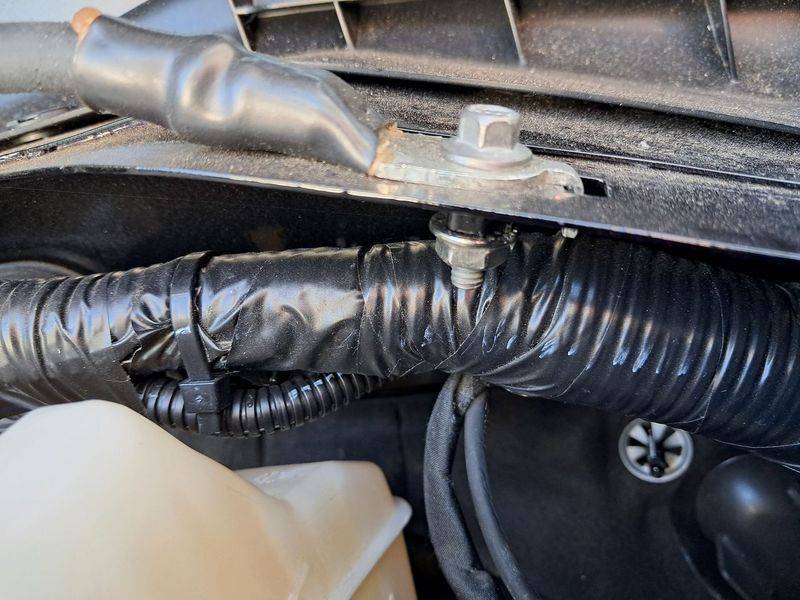
@redone17 Starting with the positive at the battery it is going through a short, heavy gauge wire to a 5 amp fuse, then on the the tilt switch, then on to the lighting harness.

The Black ground is attached to the chassis somehow. If you use a factory ground point consider doing this. Put a nut on the underside of the ground bolt and use the extra threads sticking out as a stud. Double nut it if you want a good flat surface on both sides for your ground lug to mate with. This way you aren't interfering with the factory connection at all. I think they are standard pitch metric, either M5 if 8mm or M6 if 10mm.

I hope this helps!

Ford Bronco F150LEDs - Automatic Engine Bay LED Kit 668642-3284429a974c2bbd62184e710cbf0a11
 
OP
OP
redone17

redone17

Black Diamond
Well-Known Member
First Name
Chris
Joined
Mar 6, 2021
Threads
75
Messages
4,752
Reaction score
5,184
Location
Cold Spring, NY
Vehicle(s)
2021 Bronco, 2020 Ranger
Your Bronco Model
Black Diamond
Thanks @BroncoDave24 - that's exactly how I had planned it out. Appreciate you taking the time to confirm my plan of attack. Good tip on the ground. I am using that location for a couple of lights already. I will take your advice and relocate them to the underside.
Sponsored


Top