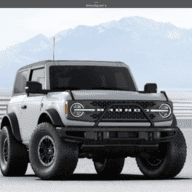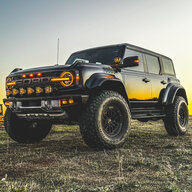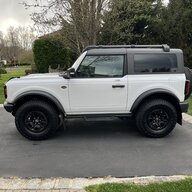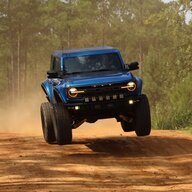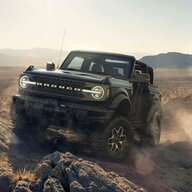
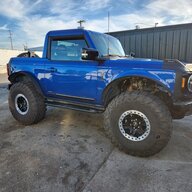
If your tires are not leaving the ground at high speeds (jumps or whoops) then you'll be just fine with the suspension! My Braptor was fine with street / highway / rock crawling /trails at moderate speed with the Godzilla and running 40's. It's the high speed whoops and jumps where the extra weight and front-to-rear ratio needs suspension tuning.
I think it's going to be more about "what did Ford not really document on the Ranger Raptor that every other human assumes would be the same as the Braptor but is not."
The transfer case is definitely different in the Ranger compared to the Braptor. In doing a bit of AI-assisted research, I learned that the Ranger Raptor has intentionally mismatched front (4.70) and rear gearing (3.73) which is managed through the Ranger Raptor's transfer case's wet clutch pack.
Here are some call-outs for the transfer case specifically:
The Ranger Raptor's ~26% front/rear speed difference is normally absorbed by the ITM transfer case’s wet clutch pack slipping intelligently in 4A mode. The factory PCM/AWD module knows the exact mismatch and modulates clutch pressure accordingly.
- Programming requirement: The replacement PCM (or control pack) must be flashed/calibrated to understand the split ratios so the AWD module still allows controlled slip in 4A without triggering binding codes or limp mode.
- In 4H/4L (locked modes), the system expects loose-surface tire slip to relieve wind-up — same as stock.
- If you keep the stock Ranger Raptor transfer case (recommended for full 4A functionality and shift-by-wire), the AWD module may need to stay or be reprogrammed to work with the new PCM.
- Unique Raptor Callout: No other common Ford platform has this split-ratio + clutch-based ITM setup in a midsize truck. Donor PCMs assume identical front/rear ratios, so custom calibration is mandatory or 4A mode (daily on-road AWD) will not work properly.
Here's the rest of the considerations from the AI summary - it's the Programming implications that are often the most time-consuming because it's a lot of trial and error:
1. Rear Suspension Geometry (Watts Linkage vs. Panhard Rod)
- Ranger Raptor: Coil-sprung solid rear axle with a Watts linkage (instead of a simple track bar). This keeps the axle perfectly centered throughout the full range of travel with zero side-to-side arc.
- Bronco Raptor: Coil-sprung solid rear axle with a traditional Panhard rod.
Why this matters for the swap:
- The Godzilla is significantly heavier and torquier than the stock 3.0L V6. The Watts linkage's geometry assumes certain roll-center behavior and lateral stiffness tuned for the lighter EcoBoost. Adding V8 weight changes ride height, spring rates, and axle movement under power — potentially introducing bind or unpredictable handling in Baja/Rock modes.
- Mechanical provisions needed: Custom rear driveline angles (driveshaft length, U-joint phasing, and slip-yoke travel) will differ from Bronco swaps. You may need adjustable Watts-link arms or reinforced bushings to maintain proper pinion angle under the extra torque/weight. Shock towers and coil-over mounting points are also Ranger-specific.
- Programming implications: The PCM, ABS/ESC module, and G.O.A.T. drive-mode calibrations are tuned for Watts-link dynamics (sharper high-speed desert behavior). A donor PCM (or custom tune) must be flashed with Ranger-specific suspension parameters, or you'll get incorrect stability control intervention, crawl-control behavior, or fault codes.
2. Wheelbase, Frame, and Driveshaft Packaging
- Ranger Raptor: Longer wheelbase (~128.7" / 3270 mm) + pickup bed layout.
- Bronco Raptor: Shorter wheelbase (~116.5" / 2959 mm) + SUV body.
Why this matters:
- Longer rear driveshaft on the Ranger changes critical speed, angle, and vibration characteristics once the heavier Godzilla + 10R80 combo is installed.
- The bed and different firewall/cowl mean exhaust routing, fuel lines, and rear crossmember placement differ from the Bronco's more open SUV layout.
Mechanical provisions needed:
- Custom-length rear driveshaft (or modified carrier bearing) — not a direct carry-over from Bronco builds.
- Engine mounts and transmission crossmember almost certainly require Ranger-specific fab or modification (frame rail spacing/height is similar but not identical due to the truck body).
- Exhaust: Easier clearance under the bed, but you'll need unique routing to clear the longer frame and leaf/coil setup without hitting the bed floor.
Programming: Minor, but the PCM must be calibrated for the longer wheelbase's speed/acceleration parameters and different weight distribution (truck vs. SUV) to keep accurate speedo, shift logic, and traction control.
3. Rear Axle Strength and Track Width
- Ranger Raptor: Smaller Dana AdvanTEK M220 rear axle (semi-floating, narrower track).
- Bronco Raptor: Larger M235 / Dana 50-class rear axle (thicker tubes, double-row bearings, wider track).
Why this matters:
- The Godzilla's massive low-end torque (especially with 37"+ tires) stresses the smaller M220 more than the Bronco's axle sees in factory form.
Mechanical provisions needed:
- Stronger axle shafts, upgraded differential cover, or aftermarket girdle recommended sooner on the Ranger. No direct Bronco parts swap here.
- Narrower overall track width means different fender clearance and steering geometry considerations when the heavier engine shifts weight forward.
Programming: None directly, but torque-vectoring and locker engagement logic in the AWD module is calibrated differently for the narrower stance.
4. Transfer Case and Shifter Integration
- Both use very similar Interactive Torque Management (ITM) 2-speed transfer cases with wet-clutch 4A mode, but early Bronco Raptors sometimes require a full transfer-case swap in Godzilla builds to match the Ranger-style unit for better shifter compatibility
- Ranger Raptor uses an electronic shift-by-wire shifter that some Bronco builders actually borrow for cleaner integration
Implications for Ranger swap:
- You can usually keep the stock Ranger transfer case (big plus), but the PCM flash must explicitly support the ITM clutch slip calibration alongside the split ratios.
- Shifter and G.O.A.T. mode selector are native to the Ranger — fewer adaptations needed here than on Bronco swaps.
5. Other Minor but Unique Programming/Integration Points
- Body Control Module (BCM) and truck-specific features: Tailgate, bed lighting, and payload/towing calibrations are Ranger-only. The new PCM must be VIN-synced and flashed with Ranger truck parameters or you'll lose functions or get warnings.
- Stability and drive-mode tuning: G.O.A.T. modes (especially Baja and Rock Crawl) are calibrated for the Ranger's narrower, Watts-tuned dynamics and higher payload focus. Bronco tunes won't transfer directly.
- Cooling and ancillaries: Different radiator package and hood clearance in the truck body may require custom AC lines, power-steering routing, or radiator support mods (Godzilla runs hotter under load than the turbo V6).
Bottom line: The Ranger Raptor Godzilla swap is mechanically very doable (shared platform helps), but the combination of Watts linkage geometry + split ratios + longer wheelbase/pickup packaging makes it more involved than a Bronco Raptor conversion. Expect extra fab work on driveshafts/mounts/exhaust and multiple rounds of FORScan/FDRS custom flashing to keep full OEM functionality (lockers, 4A mode, drive modes, gauges). Shops that have already done Bronco Raptor swaps are the best starting point — they can adapt their harnesses and tunes for the Ranger-specific items.
All-in-all - it's totally doable. It will just take longer being the first to figure out the programming!
The Ranger Raptor does not have m220 rear axle...it gets a special banjo style with a drop out section, very similar to a ford 9".
Sponsored