
Sponsored

Rear Trac Rod Relocation Bracket...Enlighten me

BigMeatsBronco

First Edition
Well-Known Member
First Name
Allan
Joined
Nov 25, 2021
Threads
52
Messages
3,376
Reaction score
10,444
Location
97301
Vehicle(s)
2021 FE 2 door
Your Bronco Model
First Edition
Clubs
 
Nice reference on how Panhard affects handling. A good read.

Some thoughts on location of Panhard bar and roll center, for those that are interested. The Oem Panhard is long and symmetrically mounted (both frame and axle mount locations are same distance from vehicle centerline).

For static condition at ride height only (a simplified case). The vehicle roll (rotations about the for-aft axis) occur about the roll axis. A line connecting the rear axle roll center and the front axle roll center.

Lateral forces acting on vehicle produce a torque about the roll axis with momentum arm as the vertical distance between applied lateral force and roll axis. Lateral forces, such as a change in lateral velocity that occurs during cornering, occur at vehicle CG. The roll moment can be defined as the vertical distance between CG an roll axis (for a given constant lateral force).

Considering rear axle only (a simplification), the lateral forces acting at CG are transferred to axle and then produce vertical and lateral (friction) forces at tire/ground contact patch. the load path for the lateral forces from body to axle occur through upper and lower links, struts, and Panhard bar. A simple assumption is that all of the suspension links have pinned ends and can only take axial loading.

For case with 4 link suspension (no Panhard), the only way to transfer lateral load from body to axle is for the links to be triangulated somewhat, having some angle in lateral direction. Based on the link angles, the intersections of their line of actions with the vertical/lateral plane through the axle dictates the roll center.

For the case with Panhard bar, the panhard dominates the lateral load transfer to the axle since it is oriented in the lateral plane. The roll center then simply has to fall along the Panhard line of action somewhere. For symmetrically mounted oem Panhard this is the intersection with the vehicle central plane (for-aft and vertical axes).

Some numbers based on CAD data for OEM SAS ride height. CG is 15.5” in vertical direction from rear axle centerline. Roll center with Panhard is about 1” vertically below axle centerline. So roll moment is then about 14” (CG above roll center).

Lifting 2” via struts, produces a 2” rise in sprung CG. Leveling panhard with a 2” axle mount bracket also raises roll center by 2”, so roll moment remains same as oem. Leveling panhard via frame mount bracket drops roll center back to oem location but increase roll moment by 2” (since CG increases by 2”). A 14% increase in roll moment (2/14), not a whole lot.

Probably the most important thing is to level panhard at ride height so to minimize lateral axle motion during suspension travel. It would be interesting to see what real world handling differences occur with either frame or axle mount height adjustments. A small increase in roll moment may be a fair sacrifice to keep roll center at axle level (tighter corner handling). 🤷‍♂️
Excellent information and easy to understand! thank you. My situation is slightly different than the normal folks as I have removed the top heavy two-door Bronco top and the Side Glass, and rear portion of the roll bar as well. While these are not super heavy items they are at nearly the top of the vehicle and by removing them all together I feel I have lowered the CG by a smidgen (if not a lot.) Additionally, eventually I plan on actually running my suspension height near OEM, or maybe 1 in above original Sasquatch ride height, the rest of my lift actually comes from the huge tires 41 in versus the 34s that come stock on Sasquatch. This does more to raise the center of gravity than the struts lift themselves as the axles and vehicle are lifted from the tire change. Because of these differences I have opted to keep the Roll center below the axle, I may play around with different mounting points and bracketry to see how it affects the handling and if I do I'll update folks with the data in the future.

Lastly, I'm wondering how the Roll center versus CG Center effects articulation? It seems to me the rear axle would articulate easier with the CG Center well above the Roll center?
Sponsored

 

87-Z28

Outer Banks
Well-Known Member
First Name
Andy
Joined
Sep 1, 2022
Threads
3
Messages
1,169
Reaction score
2,753
Location
Texas
Vehicle(s)
BMW
Your Bronco Model
Outer Banks
Clubs
 
Lastly, I'm wondering how the Roll center versus CG Center effects articulation? It seems to me the rear axle would articulate easier with the CG Center well above the Roll center?
Absolutely. Just considering rear axle in 2 dimensions. If roll is defined as the angular motion between the body and the axle, then roll stiffness will dictate roll angles. Assuming vehicle body is rigid, another story for the open top non-boxed Bronco body, but assuming this nonetheless. Also a rigid axle. Then roll stiffness is simply due to the rear springs/dampers and anti-sway bar.

Roll angle, in the static load case, can be defined as a function of roll torque (lateral cornering load times roll moment arm) and the roll stiffness. So when lowering roll center at the sacrifice of increasing roll moment, then roll angles will increases for the same roll stiffness.

The converse is also true. If roll stiffness remains constant, then roll angle (or articulation) increases as roll torque (or roll moment increases).

This is reason why dropping sway bar helps articulation, roll stiffness changes. Increasing roll moment also helps articulation. Lowering sway bar bracket on frame side should increase lateral cornering handling and also increase relative articulation. Nothing is free, so roll angles will increase for same lateral g loads. For an off road rig this seems like a reasonable compromise. Very curious how this turns out.

I suppose the aftermarket is just conservative in that they don’t want to increase roll moment so they opt to raise Panhard on axle side. 🤷‍♂️
 
Last edited:

87-Z28

Outer Banks
Well-Known Member
First Name
Andy
Joined
Sep 1, 2022
Threads
3
Messages
1,169
Reaction score
2,753
Location
Texas
Vehicle(s)
BMW
Your Bronco Model
Outer Banks
Clubs
 
Bigmeats got me curious about real numbers for the 6G platform and “roll center”. I have attached a simple analysis to illustrate some critical behaviors.

First a word about “Roll Center”. This is merely an engineering construct in order to simplify analysis. The roll center is not a single point nor does it remain fixed in space. If there are two bodies that are kinematically connected, then there exists a point where lateral loading is applied and NO roll will exist between the bodies. Not necessarily the point the vehicle rolls about.

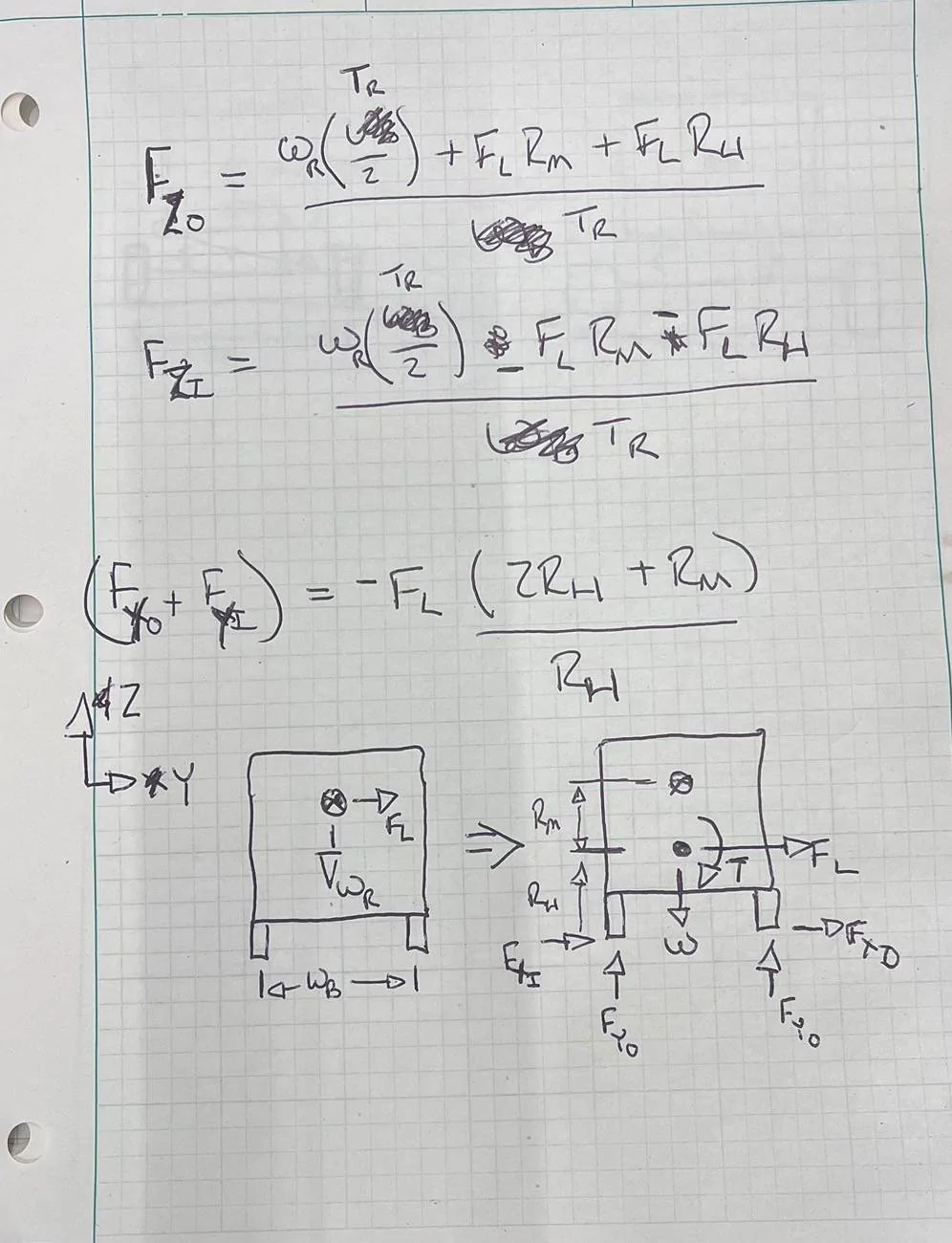
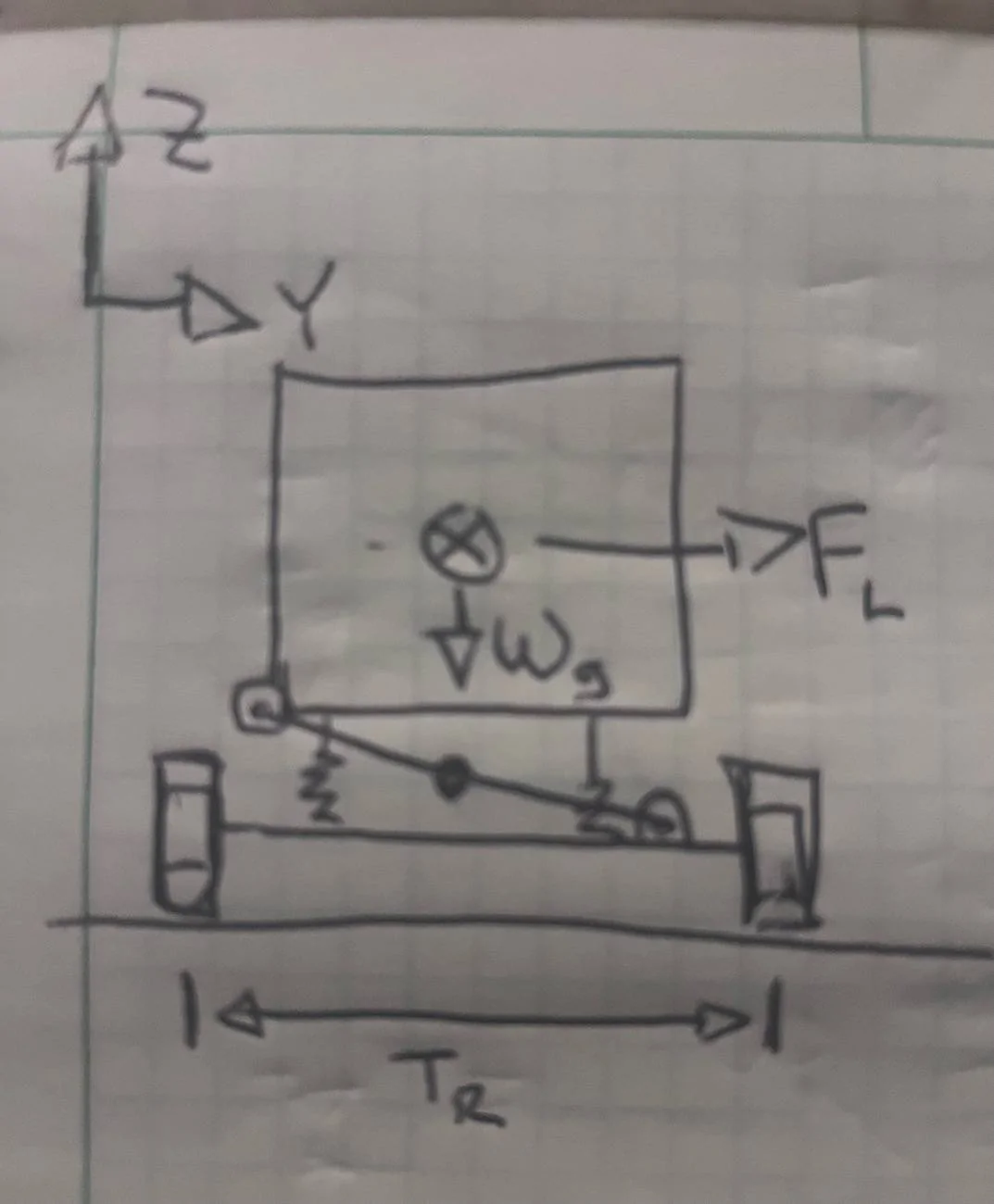
Consider a simplified model of the rear end in 2D, see first figure. this model shows the vehicle body and rear axle as the two bodies and the 5 link suspension as the kinematic connection between the bodies with the relative rotation between the body and axle as the “roll”. There are 3 degrees of freedom (motion) for this model of rear end; lateral, vertical, and rotational. This obviously ignores the front end and is not a true 3D representation but can nonetheless highlight interesting behaviors of our solid axle rear end.

The “roll center” location for this 2D model can be calculated from the line of action of the links connecting the axle and body. For this 2D case, only the lateral loading can produce a roll between the two bodies. The lateral body force at the CG during cornering is transferred to the axle via the links and into the road at the tire contact patch.

In the oem 5 link, the rear upper and lower links are very weakly triangulated. The Panhard bar is the dominant lateral load transfer between the bodies. This makes the roll center easy to calculate but more importantly completely controlled by the Panhard geometry. Hence locating the Panhard via custom mounts you can control roll center and cornering vehicle response. Very powerful.

Assuming rigid links and perfectly pinned ends (no flexible bushings). Then the symmetric oem Panhard roll center falls at the location where the Panhard intersects the central axis in our 2D model. Obviously during suspension cycling, especially for an off road vehicle, the Panhard geometry changes and thus roll center dynamically moves. It is NOT a fixed point in space.

A static analysis can be easily done neglecting dynamic response, so inertial effects, which are of course real. Fully understanding the limitations. Nonetheless some interesting cornering behaviors can be shown and are qualitatively representative.

The analysis is included in the figures and has some critical variables of interest; WR is vertical weight on rear axle, FL is later load due to cornering g’s, Tr is rear track width, Rh is roll center height from ground, Rm is roll moment (distance between CG and roll center height), Ry is lateral traction at tire/ground interface, RZo is vertical tire load at outer wheel, and RZi is vertical tire load at inner.

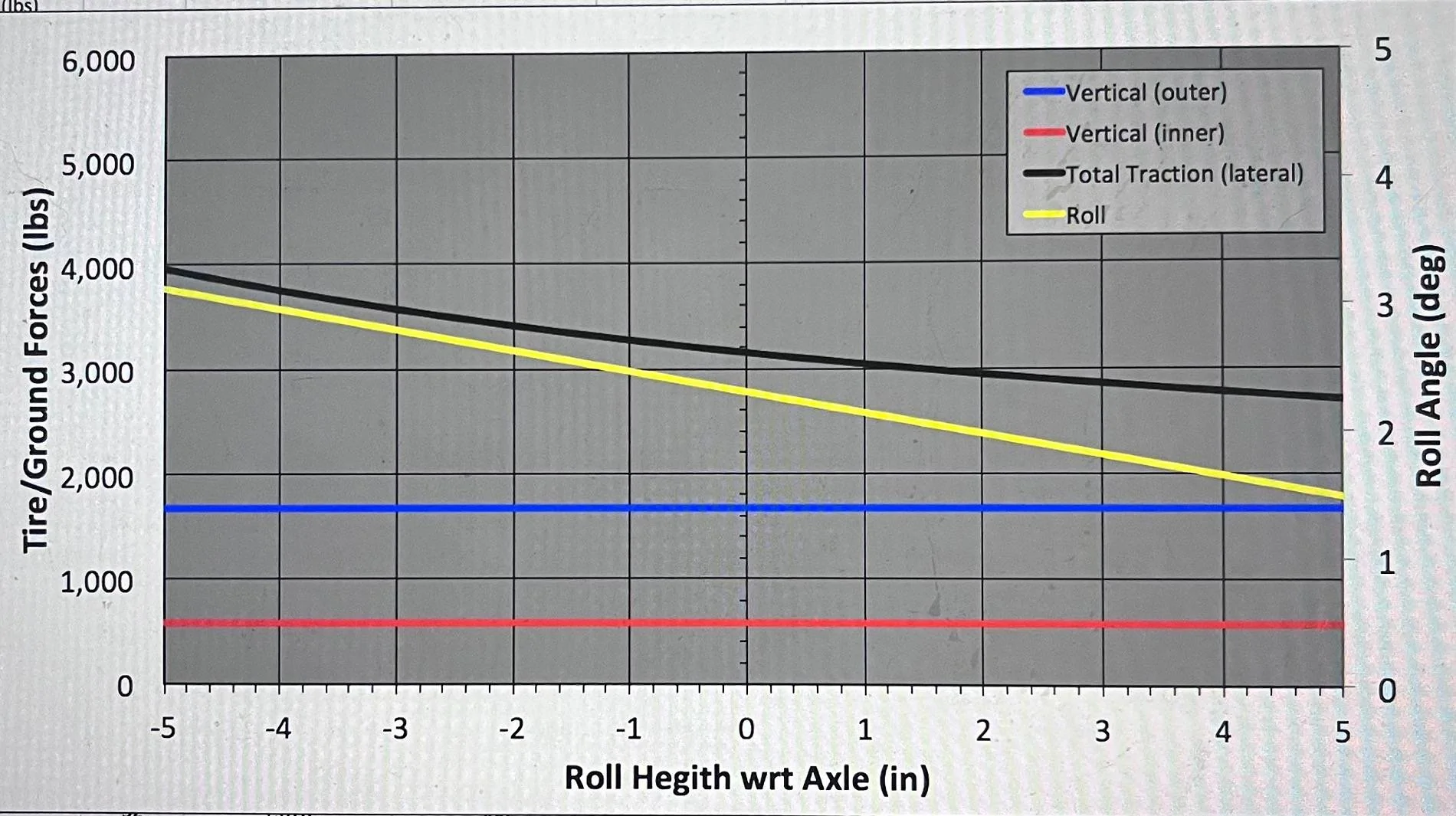
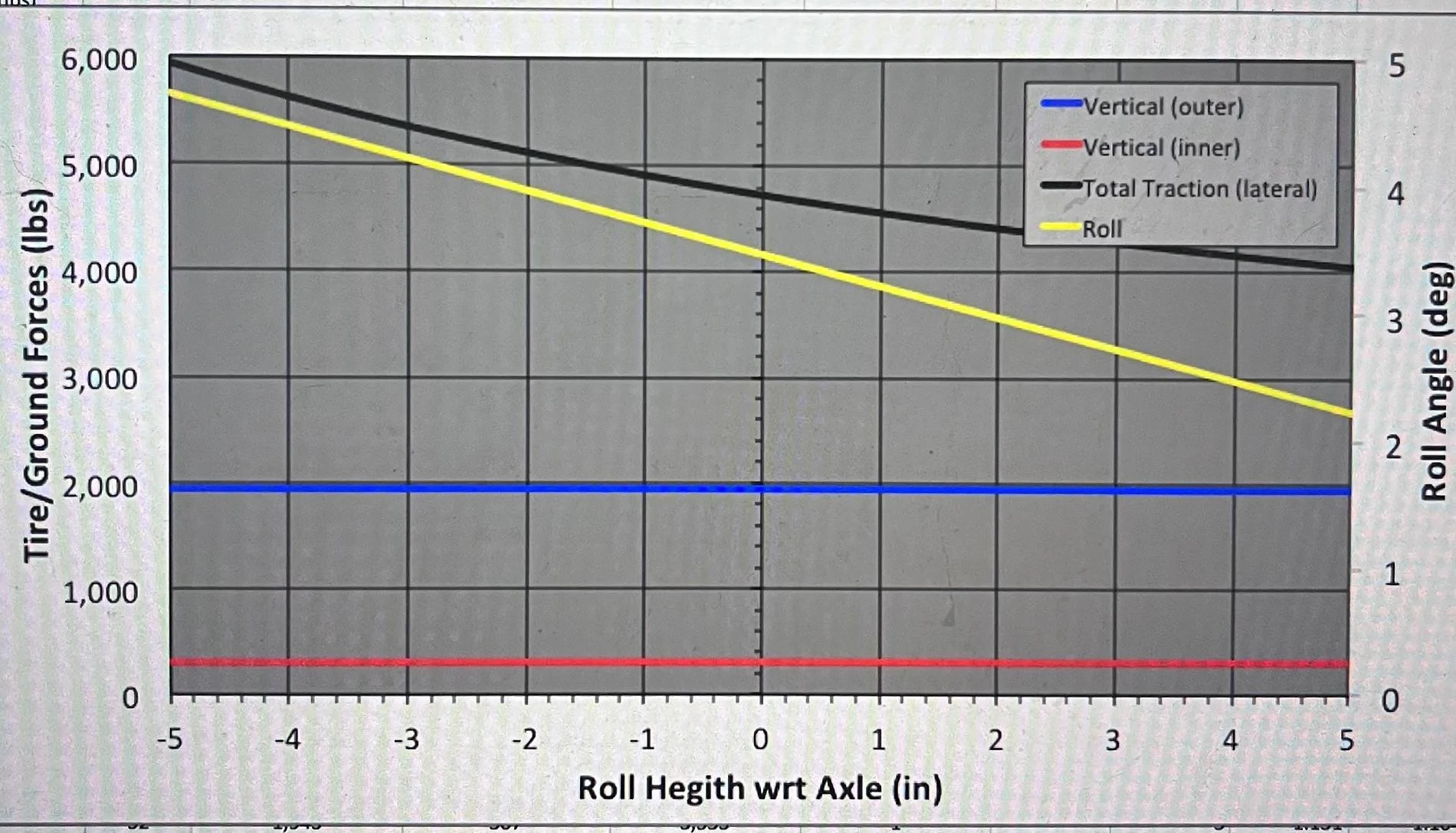
the tire forces (Ry, RZo, and RZi) are shown in 3 equations from 2nd figure. Plotting these quantities vs the roll center some interesting results can be seen, see plots. For easy reference the roll center is located wrt the axle. Also plotted is roll angle.

Now for some basic oem numbers; weight on rear axle is 2500 lbs, SAS roll moment is 15”, SAS roll height is 1” below axle and 16” wrt ground, roll stiffness is estimated (wo sway bar) from 250 lbs/in springs.

First plot of results is for 0.5 lateral cornering g’s and second is for 0.75 g’s. All plots assume roll height varies as we relocate Panhard bar but CG remains constant for SAS (31” from ground) so roll moment increases as Panhard moves lower

Notice 0.5 g’s produces greater vertical tire load on outer tire than inner, ie, vehicle wants to tip. But vertical loads don’t change with roll center height. However tire traction loads increase as roll center decreases. This produces better corner handling, as long as tire friction can keep them on the road. That is why reducing roll center improves corner handling. Also notice that there is no free lunch, body roll increases as roll center decreases since roll moment increases (CG doesn’t move). Perhaps a fair compromise for an off road rig. At 0.75 g’s the traction forces increase even more.

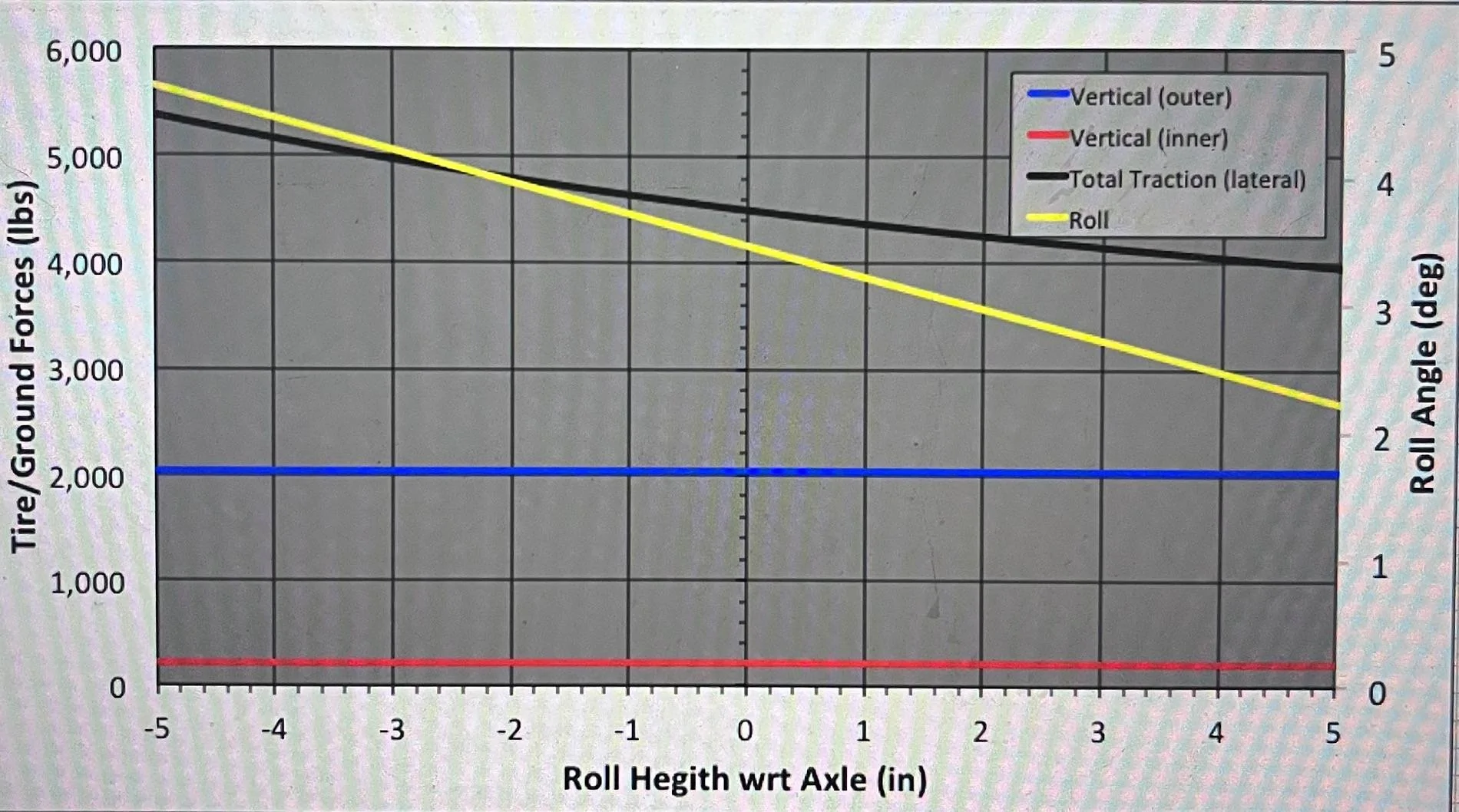
I also made a plot for Bigmeats and his 40s with near SAS CG wrt axle (0.75 g’s). He has kept his CG down while getting clearance from the big meats. So this really helps his corner handling. Maybe he is already on 42s or 50s 🤷‍♂️, I can’t keep up. Anyway his tire traction is LESS than SAS since he has lifted the CG from his big tires, that is why he is fighting to keep it as low as possible. So another tool in his arsenal is to try and reduce the roll center height back to near oem by dropping the frame mount for the Panhard bar which helps get back some tire traction forces.

TLDR for most but interesting to me. If nothing else, ignore math and equations., but think about roll moment and roll height. Then traction forces and body roll in degrees from plots can clearly show how roll center affects these.

Ford Bronco Rear Trac Rod Relocation Bracket...Enlighten me IMG_7336


Ford Bronco Rear Trac Rod Relocation Bracket...Enlighten me IMG_7335


Ford Bronco Rear Trac Rod Relocation Bracket...Enlighten me IMG_7329


Ford Bronco Rear Trac Rod Relocation Bracket...Enlighten me IMG_7330


Ford Bronco Rear Trac Rod Relocation Bracket...Enlighten me IMG_7331
 

telenerd

Badlands
Well-Known Member
Joined
Jul 26, 2021
Threads
90
Messages
2,032
Reaction score
4,138
Location
Laramie
Vehicle(s)
Subaru
Your Bronco Model
Badlands
Clubs
 
Good write up @87-Z28

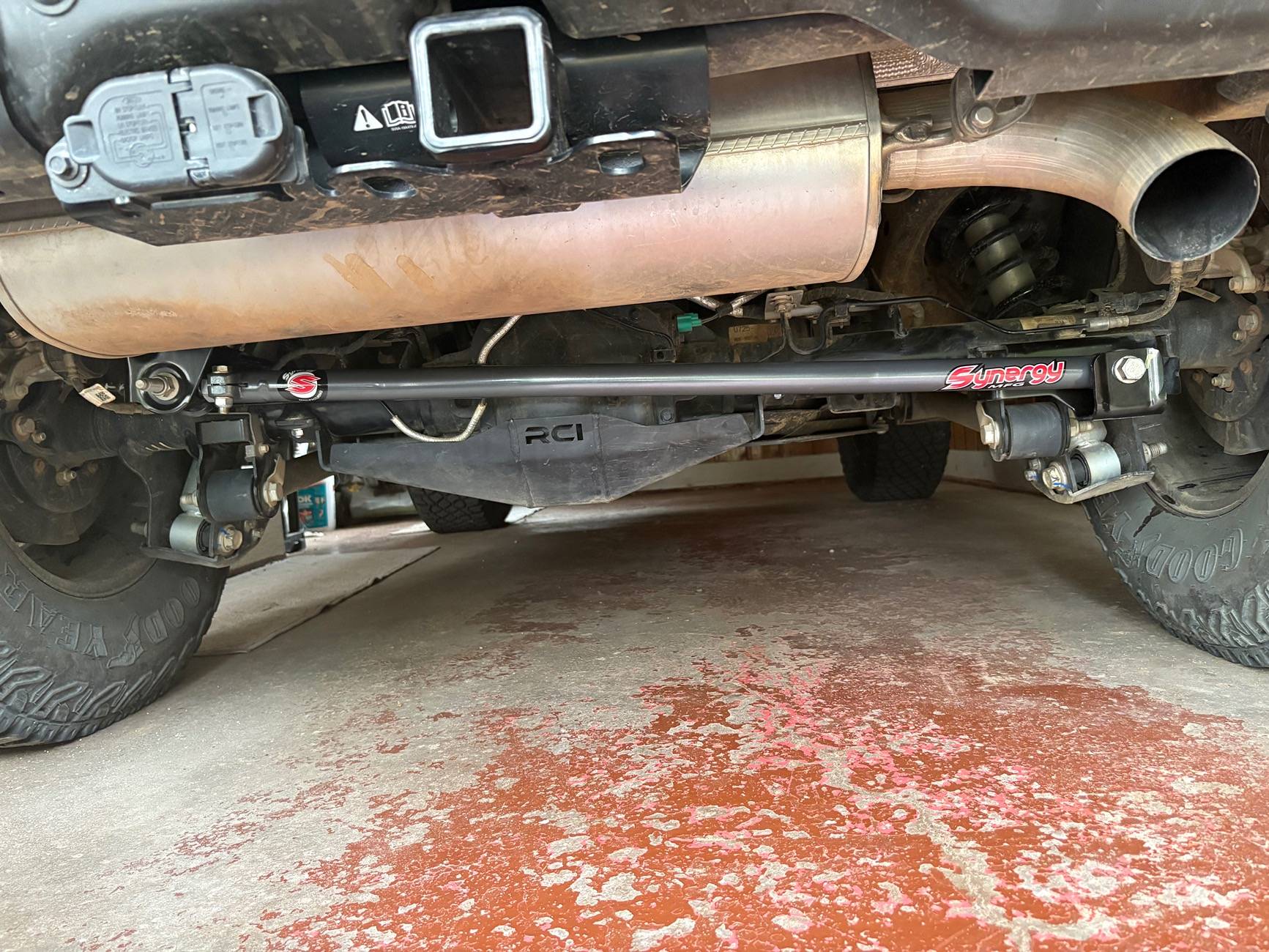
Would you be able to explain what strength of the pan hard bar and flexible bushing does with ride quality? After my lift I installed a Synergy Trackbar, the bar is massive and is made out of steel and has special durometer flex joints. I didnt add a relocation bracket, but the Bronco feels different driving around town and on the highway. I will be taking it Offroad in another week to really test things but overall bumps feel more muted and the vehicle feels stiffer but not stiff just more compliant. Cornering at speeds the rear just feels planted and when hitting bumps I am not getting any jarring feelings or hops.

Can you explain why just a track bar would make such a big difference? I’m thinking it’s mostly has to do with stiffness of materials and bushings used on the new bar and can help centering the axel. Trackbars probably not all created equal. I’d imagine a billet track bar with heim joints or Jonny joints would ride differently then a steel track bar with a poly or rubber flex joint.

PS if you haven’t already make sure to fill out my Bronco6g Forum survey. 😂

https://www.bronco6g.com/forum/threads/bronco6g-forum-addiction.116270/

Ford Bronco Rear Trac Rod Relocation Bracket...Enlighten me IMG_2213
 

BigMeatsBronco

First Edition
Well-Known Member
First Name
Allan
Joined
Nov 25, 2021
Threads
52
Messages
3,376
Reaction score
10,444
Location
97301
Vehicle(s)
2021 FE 2 door
Your Bronco Model
First Edition
Clubs
 
I suppose the aftermarket is just conservative in that they don’t want to increase roll moment so they opt to raise Panhard on axle side. 🤷‍♂️

Im guessing the aftermarkets #1 goal is to bring to market quickly and sell as many as possible...Like many other things, they dont take the time to do the math or engineering to build things correctly in most cases...

In this case, one company creates a band aid for the lifted bronco, and ALL others follow blindly w/o even questioning the design benefits and/or flaws.

Anyways, thanks for the detailed explanation, it helps me and I'm sure others understand that there's more to the story than just buying this bracket that moves the mounting point up 2" inches and calling it a day.
 

87-Z28

Outer Banks
Well-Known Member
First Name
Andy
Joined
Sep 1, 2022
Threads
3
Messages
1,169
Reaction score
2,753
Location
Texas
Vehicle(s)
BMW
Your Bronco Model
Outer Banks
Clubs
 
Good write up @87-Z28

Would you be able to explain what strength of the pan hard bar and flexible bushing does with ride quality? After my lift I installed a Synergy Trackbar, the bar is massive and is made out of steel and has special durometer flex joints. I didnt add a relocation bracket, but the Bronco feels different driving around town and on the highway. I will be taking it Offroad in another week to really test things but overall bumps feel more muted and the vehicle feels stiffer but not stiff just more compliant. Cornering at speeds the rear just feels planted and when hitting bumps I am not getting any jarring feelings or hops.

Can you explain why just a track bar would make such a big difference? I’m thinking it’s mostly has to do with stiffness of materials and bushings used on the new bar and can help centering the axel. Trackbars probably not all created equal. I’d imagine a billet track bar with heim joints or Jonny joints would ride differently then a steel track bar with a poly or rubber flex joint.

PS if you haven’t already make sure to fill out my Bronco6g Forum survey. 😂

https://www.bronco6g.com/forum/threads/bronco6g-forum-addiction.116270/

IMG_2213.jpeg
the Panhard bar is designed to be a “rigid” link. It can only carry axial loads along its line of action (from mount to mount). The size of the oem bar is plenty stiff along its axis.

many of the bars have a slight bend at the diff for extra clearance. This weakens the bar by causing a stress concentration at the bend under axial load. So general practice would be to increase bar diameter to decrease stress at concentration and maintain stiffness. Once again I would think the oem bar is plenty strong and stiff.

this becomes a fairly simple design trade off, ie, make bar as small as possible to minimize weight and reduce its volume for clearance issues.

the effective stiffness of the Panhard needs to include the bar, the end conditions, and the mounts. These are all springs in series which are completely dominated by the weakest spring.

The Panhard is plenty stiff so doesn’t contribute to effective stiffness. Hopefully the mounts are plenty stiff and also don’t contribute. The mount can be a challenge though. The oem mount has a small offset so not much bending to react. However if it were offset 10” from axle then bending loads would be difficult to deal with and mount stiffness would be an issue. Some real design considerations are needed for the mount. All of the aftermarket bar leveling mounts increase bending stresses.

so ultimately the stiffness is dominated by the bar end conditions. One of the design goals is to rigidly locate the rear axle laterally. No lateral motion at all is desirable. So then a steel on steel pinned connection with very tight tolerances would be desirable.

Another design goal is ride quality. Dynamic loads across a steel on steel connection will have large spikes. Deformations are required to absorb energy in the form of strain energy. Local deformations can be introduced at the rod ends with a flexible bushing material. This will absorb energy but also add flexibility, reduce stiffness, which is in contradiction to the first design goal of rigidly locating the axle.

So the compromise is in the bushing material. Be as “rigid” as possible and still absorb “sufficient” energy. Both rigid and sufficient need to be quantified with numbers so chosen designs can be evaluated and the “best” compromise can be chosen. This most definitely requires knowledge of the use case for the design. Hard core off roading, racing, daily driver, …

a direct swap, bar for bar, I can’t imagine the bar makes any difference but the bushing materials or lack there of most likely do.
Sponsored

 
Last edited:


Top