
Sponsored

Tbrownski

Black Diamond
Well-Known Member
First Name
Taylor
Joined
Mar 16, 2023
Threads
4
Messages
45
Reaction score
34
Location
Reno nv
Vehicle(s)
2023 Bronco, 2019 F350
Your Bronco Model
Black Diamond
I confirmed, almost no natural return to center on steering wheel. Still an interesting concept. Not for me though.
My Baja kits has basically zero return to center. You get used to it but when I drive a stock geometry bronco I sure miss that easy steering.
Sponsored

 
OP
OP
Lobo Off-Road

Lobo Off-Road

Wildtrak
Well-Known Member
Squatch Sponsor (Level 3)
First Name
Chris
Joined
Mar 18, 2022
Threads
22
Messages
445
Reaction score
938
Location
Hemet, CA
Website
lobooffroad.com
Vehicle(s)
All of them
Your Bronco Model
Wildtrak
Starting from the top, Ill answer as many questions as I can. I am not able to check in everyday etc as im working on the business. One thing I do want to state, as I do not believe the community on this forum is aware of, is that I have been in involved in the off road racing community for two decades, and have had the opportunity to work with some of the best teams and innovators in the business. I have another company that builds and preps off road race cars, in addition to building a entire production line of race quality utv parts. I am not saying that to boast or puff my chest, but rather make it clear that, this is not a armor company making suspension components, but rather someone bringing the racing knowledge and background to the bronco community.

@AttackGuy64 I am working on a couple different options for the rear-end, ( links, bolt in wider rear-end, and a triangulated 4 link conversion with a larger rear end), I do recommend upgrading to a wider rear-end, to create a better balance of the vehicle. however it is not mandated. If someone wanted to run wheel spacers as a alternative option, they could. As most other front end kits are going that route.

For the members questioning the integrity of the kit, the kit has been in development and analyzed for almost a year. The outer ball joints are 1 ton ball joints. The ball joint is a preferred fit for its location and the objective of this first kit. The lateral load that is applied. The ball joint is easily serviceable, has more contact patch and will last much longer than a uniball in this situation. Upgrades options will be available in the future but is not necessary.

For the members asking if its street legal, its as street legal as any other kit on the market.

For the members stating that its double the failure point, its all about perspective. The load is distributed to each link, dividing the load across the four outer ball joints vs focusing on one.

For the comments on CV plunge, longer the arms, greater the radius of the suspension is pivoting on. Greater the radius, straighter the line and less plunge.

For the comments referring to the width, This is the narrowest we were able to make the kit, without the arms crashing into the coil bucket. Yes this tech is on UTVS and maintain stock width, but you also have to remember that the shortest arm length on a UTV is 20” The upper links on the bronco are roughly 12.5” at the +4” mark.

One of the large factors that taken into consideration, while building this kit was using a wheel with minimal offset. We were able to utilize the FACTORY wheel, with much room to spare. Most other kits require a large offset wheel, So yes they may claim to be a narrower suspension package but require a lager offset wheel, making the kit even wider than ours. By having less of a offset wheel, less load is put on wheel bearing, wheel studs etc. In addition to having less load on the bearing, we are able to provide cleaner suspension geometry with longer arms over shorter arms.

Addressing the assumption of the kit essentially would be “ flopping around” if the tie rod was not connected. That is not the case whatsoever. Convention A arms have a intersection point that just so happens to be where the uniball or ball join is located. This system has a virtual intersection point like a triangulated 4 link. Therefore, allowing the suspension to pivot around the intersection of the upper and lower links.
 

TeocaliMG

Badlands
Well-Known Member
Base Sponsor (Level 1)
Joined
Jun 3, 2019
Threads
24
Messages
999
Reaction score
3,287
Location
Plymouth Michigan
Vehicle(s)
2021 Bronco Badlands non-sas 4 door manual
Your Bronco Model
Badlands
Clubs
 
Addressing the assumption of the kit essentially would be “ flopping around” if the tie rod was not connected. That is not the case whatsoever. Convention A arms have a intersection point that just so happens to be where the uniball or ball join is located. This system has a virtual intersection point like a triangulated 4 link. Therefore, allowing the suspension to pivot around the intersection of the upper and lower links.
Thanks for the response, I respect It. I think this portion of the response is directed towards me.

I dont think that this would be "flopping around" with a loss of tie rod, but given that a virtual pivot still is kinematically different from a "real" pivot, there is a very real concern about how constrained the motion is with a loss of tie rod.

I think you guys could demonstrate this and build a lot of confidence in the product. For example, if a normal bronco loses a tie rod, the knuckle can only steer so far (well within design limits). If your suspension loses a tie rod, how much free motion or turning can be achieved by the knuckle before binding? Does this exceed key things like the CV angle? Also, what is the mechanical limit that causes binding, and how robust is that itself to overtravel (ball joint cam out for example).

Given your experience and proven track record, I assume all of these points can be addressed. I find this system (and really anything suspension related) fascinating, and would love to know these details.
 

swooshdave

Badlands
Well-Known Member
Joined
Dec 15, 2020
Threads
105
Messages
4,866
Reaction score
9,173
Location
Portland, Oregon
Vehicle(s)
Mustang
Your Bronco Model
Badlands
Clubs
 
For the members asking if its street legal, its as street legal as any other kit on the market.
I wasn't asking if it was street legal (considering some of the things I've seen on the street...) but more if the lack of steering feel affects how it handles on the street? Or is it like it is on the dirt, you just get use to it?
 

Dusty

Base
Well-Known Member
Joined
Feb 29, 2016
Threads
37
Messages
1,234
Reaction score
6,484
Location
Mentone, CA
Vehicle(s)
70, 71 & '21 Broncos
Your Bronco Model
Base
Clubs
 
I wasn't asking if it was street legal (considering some of the things I've seen on the street...) but more if the lack of steering feel affects how it handles on the street? Or is it like it is on the dirt, you just get use to it?
Here's a 3rd party perspective on that. I too was concerned about the return-to-center thing, and how it would affect the "feel" of driving it, especially on the street. The first time I drove it there was a few miles of in-town streets until we got to some dirt to really wring it out. After the first few minutes it just became something you didn't even think about. It's not like you have to consciously push the wheel back to center as you come out of a turn. Your hands just automatically steer it back, and after a few minutes you're not even thinking about it any more. It might sound a bit cliché to simply say "you get used to it" but that's literally what happens, and it happens very quickly.
 

Sponsored

87-Z28

Outer Banks
Well-Known Member
First Name
Andy
Joined
Sep 1, 2022
Threads
3
Messages
1,211
Reaction score
2,910
Location
Texas
Vehicle(s)
BMW
Your Bronco Model
Outer Banks
Clubs
 
For the comments on CV plunge, longer the arms, greater the radius of the suspension is pivoting on. Greater the radius, straighter the line and less plunge.
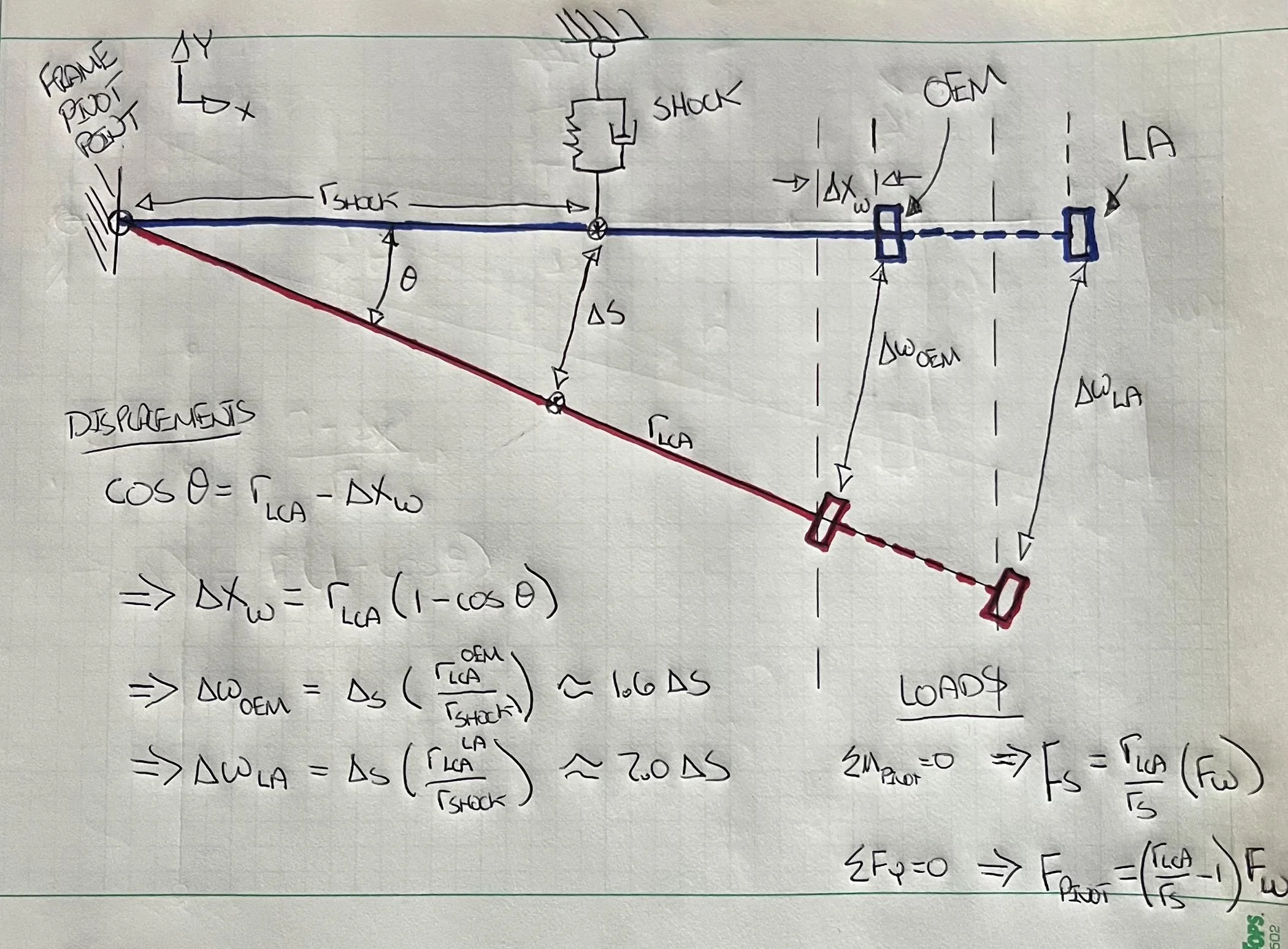
Not questioning the design or your analysis. Just pointing out some basic kinematics. Here is a very basic load and displacement analysis for long arm LCAs in the camber plane. Figure shows general kinematics.

some results in camber plane.

Wheel in/out motion (plunge) increases with increased LCA length for same LCA angle. this will effect CV plunge: dX_wheel = rLCA (1-cos theta). Note CV axle is not at same kinematic pivot location as LCA. This represents wheel plunge only.

wheel up/down motion (travel) increases with increased LCA length for same LCA angle. dy_wheel = dy_shock ( rLCA/rShock). About a 1.6 factor for OEM and 2.0 for long arm (+4”).

loads for both shocks and pivot point increase as LCA length increases for same LCA angle and load at the wheel. Fshock = Fwheel ( rLCA/rShock ). Fpivot = Fwheel [ ( rLCA/rShock) - 1 ]

some basic consequences of longer LCA using OEM hard points: for same shock motion wheel travel goes up, but loads and wheel plunge also go up.

Ford Bronco LOBO OFF-ROAD STAGE X FRONT SUSPENSION KIT D7547D37-929A-48F8-8FE2-1C18900D2DF8
 
OP
OP
Lobo Off-Road

Lobo Off-Road

Wildtrak
Well-Known Member
Squatch Sponsor (Level 3)
First Name
Chris
Joined
Mar 18, 2022
Threads
22
Messages
445
Reaction score
938
Location
Hemet, CA
Website
lobooffroad.com
Vehicle(s)
All of them
Your Bronco Model
Wildtrak
Thanks for the response, I respect It. I think this portion of the response is directed towards me.

I dont think that this would be "flopping around" with a loss of tie rod, but given that a virtual pivot still is kinematically different from a "real" pivot, there is a very real concern about how constrained the motion is with a loss of tie rod.

I think you guys could demonstrate this and build a lot of confidence in the product. For example, if a normal bronco loses a tie rod, the knuckle can only steer so far (well within design limits). If your suspension loses a tie rod, how much free motion or turning can be achieved by the knuckle before binding? Does this exceed key things like the CV angle? Also, what is the mechanical limit that causes binding, and how robust is that itself to overtravel (ball joint cam out for example).

Given your experience and proven track record, I assume all of these points can be addressed. I find this system (and really anything suspension related) fascinating, and would love to know these details.
I agree on the videos, and my team and I are working on educational videos, as I believe thats one of the best ways to get the message across with out confusion.
One thing I should have stated to help with this, is there is stubs on the spindle that limit the turning motion, by touching the lower links. Similar to the OE spindle and lower A arm.

For CV plunge, through the suspension travel we have 1/16 of plunge (less than stock).
Turning plunge is 1/4" ( slightly more more than stock)
 

DTounget

Wildtrak
New Member
First Name
DAVE
Joined
Mar 14, 2024
Threads
0
Messages
3
Reaction score
1
Location
TEMECULA, CA
Vehicle(s)
2008 TOYOTA TUNDRA, 2021 BRONCO
Your Bronco Model
Wildtrak
Thanks for the response, I respect It. I think this portion of the response is directed towards me.

I dont think that this would be "flopping around" with a loss of tie rod, but given that a virtual pivot still is kinematically different from a "real" pivot, there is a very real concern about how constrained the motion is with a loss of tie rod.

I think you guys could demonstrate this and build a lot of confidence in the product. For example, if a normal bronco loses a tie rod, the knuckle can only steer so far (well within design limits). If your suspension loses a tie rod, how much free motion or turning can be achieved by the knuckle before binding? Does this exceed key things like the CV angle? Also, what is the mechanical limit that causes binding, and how robust is that itself to overtravel (ball joint cam out for example).

Given your experience and proven track record, I assume all of these points can be addressed. I find this system (and really anything suspension related) fascinating, and would love to know these details.
If a tie rod is lost in a conventional system, the upright will flop because of the caster and the need to lift or fall of the wheel depending on the direction you're trying to go.

In the virtual pivot system if a tie rod is lost the wheel will remain in the neutral position, straight or just off straight depending on where the alignment cams are. Without getting into the weeds of the why and how, the spring pressure into the trunnion will stabilize it and keep them where they are. It obviously isn't drivable but it's not as dramatic when a tie rod fails.

With this Lobo suspension however one of the main features is the huge reduction in the tie rod loading, that is one of the main reasons for designing a system like this. The tie rod only needs to rotate the tire regardless of the obstacle the tire is negotiating. It's almost like asking, if the sun explodes tomorrow, what will you want to do before the earth is wiped out, it could happen but statistically impossible.

Also, if the tie rod didn't exit the upright would just turn until the spacers timed out one way and the caliper hitting the link going the other way. The outer 8 ball cv can handle more angle than this kit will every mechanically do.
 

Snacktime

Black Diamond
Well-Known Member
First Name
Nate
Joined
Jul 14, 2020
Threads
72
Messages
3,925
Reaction score
9,824
Location
Sac-a-tomatoes
Vehicle(s)
Bronco, F150
Your Bronco Model
Black Diamond
Clubs
 
I think you need to post about the joints. The claim that the forces are reduced by having the load spread across more contact points is miss leading. Depending on how the force is applied it can be directly transferred to a point.

You buy long travel kits based on joints, same as a 4 link. Your selling a scaled up product, what connects each moving part is what is going to define the reliability.
 

DTounget

Wildtrak
New Member
First Name
DAVE
Joined
Mar 14, 2024
Threads
0
Messages
3
Reaction score
1
Location
TEMECULA, CA
Vehicle(s)
2008 TOYOTA TUNDRA, 2021 BRONCO
Your Bronco Model
Wildtrak
Not questioning the design or your analysis. Just pointing out some basic kinematics. Here is a very basic load and displacement analysis for long arm LCAs in the camber plane. Figure shows general kinematics.

some results in camber plane.

Wheel in/out motion (plunge) increases with increased LCA length for same LCA angle. this will effect CV plunge: dX_wheel = rLCA (1-cos theta). Note CV axle is not at same kinematic pivot location as LCA. This represents wheel plunge only.

wheel up/down motion (travel) increases with increased LCA length for same LCA angle. dy_wheel = dy_shock ( rLCA/rShock). About a 1.6 factor for OEM and 2.0 for long arm (+4”).

loads for both shocks and pivot point increase as LCA length increases for same LCA angle and load at the wheel. Fshock = Fwheel ( rLCA/rShock ). Fpivot = Fwheel [ ( rLCA/rShock) - 1 ]

some basic consequences of longer LCA using OEM hard points: for same shock motion wheel travel goes up, but loads and wheel plunge also go up.

D7547D37-929A-48F8-8FE2-1C18900D2DF8.jpeg
Ford Bronco LOBO OFF-ROAD STAGE X FRONT SUSPENSION KIT 1711039495489-ci

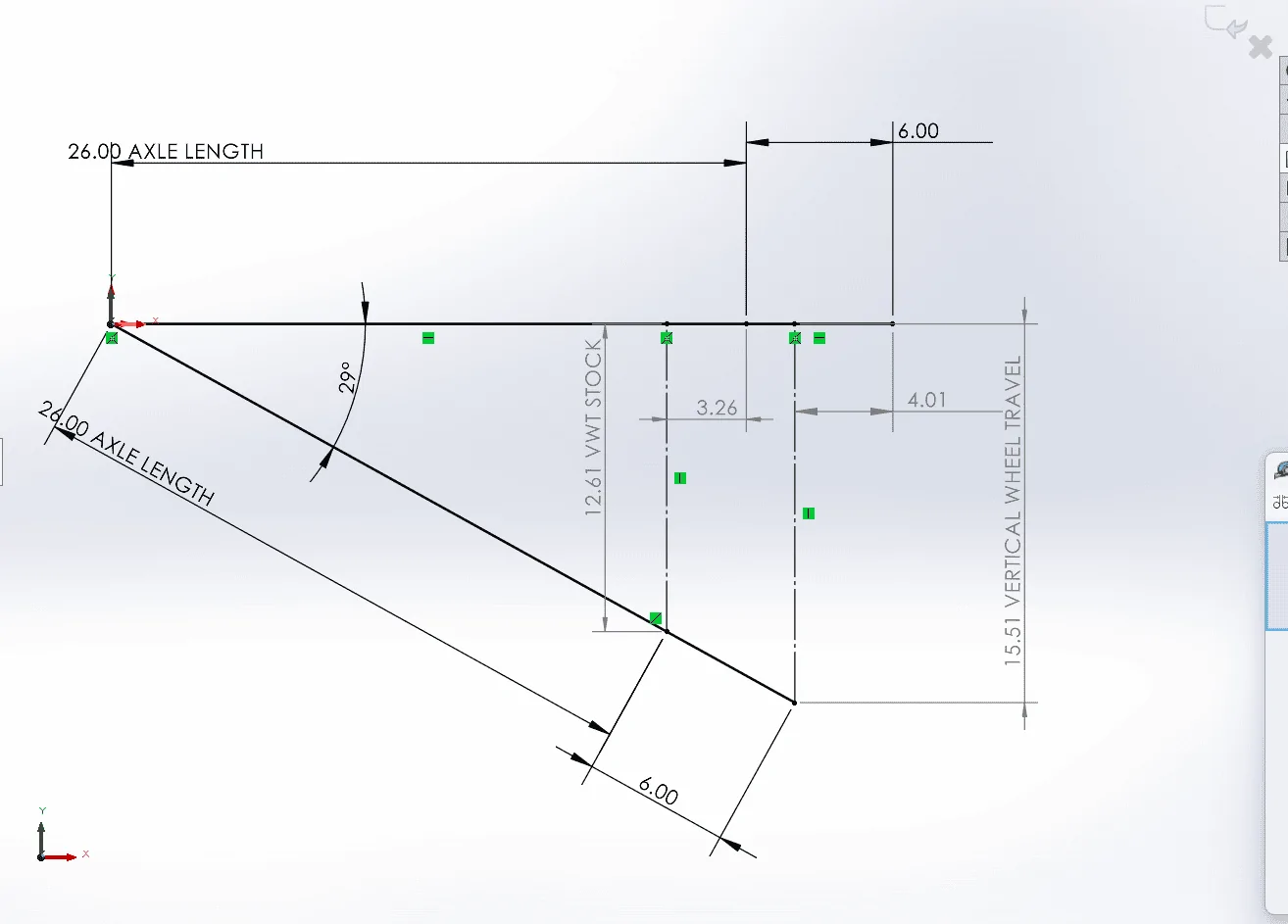
Here is what you drew but with some numbers attached. What you're saying, yes is correct if camber curve is ignored and an I beam is used, but your plunge frame of reference though isn't applicable to how a Short/Long arm system works, or even a trailing arm system. What you're alluding to is the essentially the scrub of the wheel CL to the ground or trackwidth change. So yes, for the same angle you get more vertical displacement but also at the cost of an increase in horizontal displacement (no free lunch)

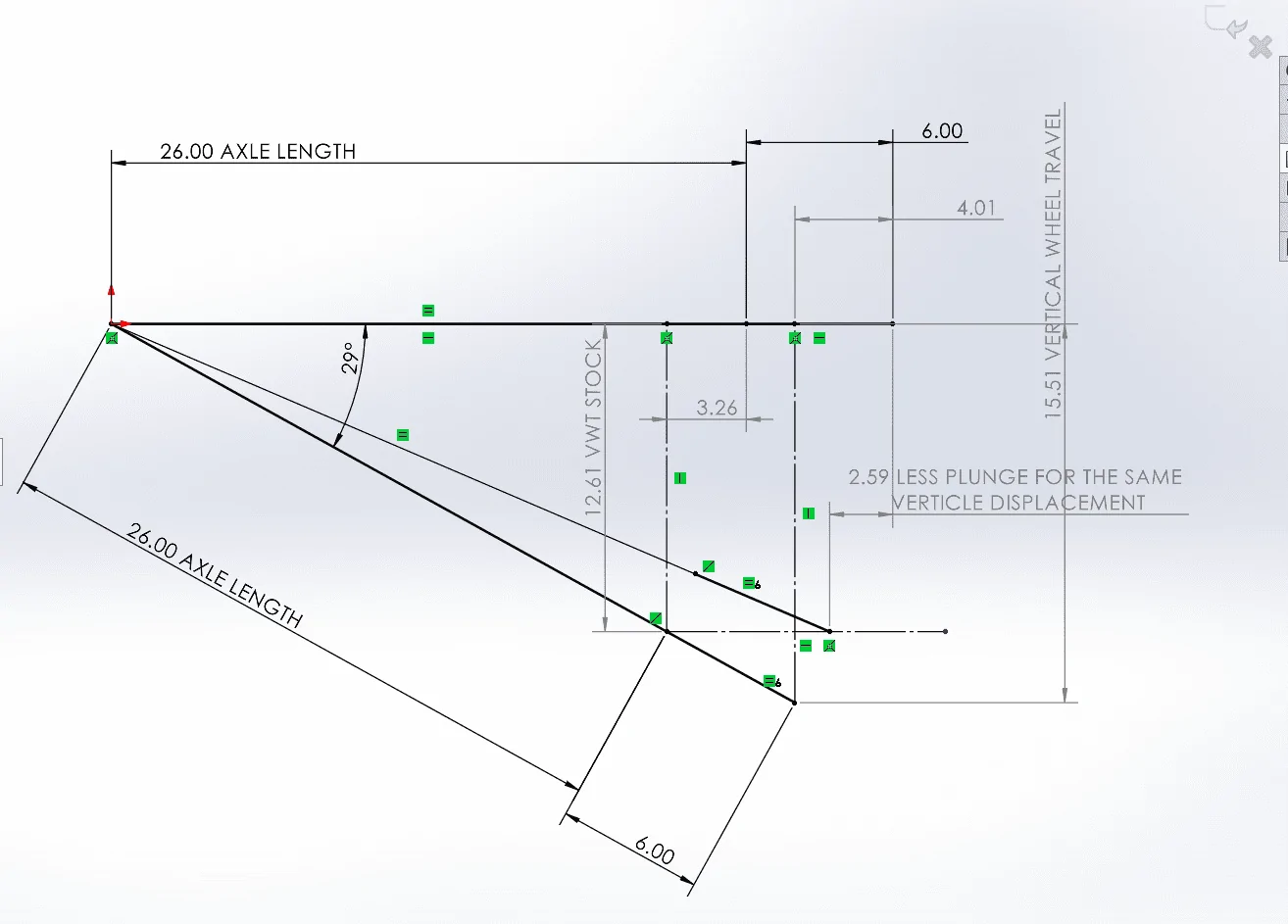
Now if you analyzed it for how much horizontal displacement is achieved for the equivalent vertical displacement, the longer arm actually plunges less, as seen here.
Ford Bronco LOBO OFF-ROAD STAGE X FRONT SUSPENSION KIT 1711040365042-3y


All of this thought isn't what happens to an axle in most SLA systems, the UCA defining the camber curve can be done in a way that the axle will plunge almost zero. All the kits we have designed have less than .1" of plunge in a straight-ahead steering position. Also since the upright is part of the system it allows us to modify the camber curve to reduce the scrub of the suspension as well.

As far as the increase in loading on the factory mounts, yes just like you would grab a long ratchet to remove a stubborn fastener the longer the control arms naturally have more leverage on the hard points. For note however the loading is distributed differently than a traditional a arm setup so no one bolt sees as much loading as it would in a traditional setup.
 

Sponsored

87-Z28

Outer Banks
Well-Known Member
First Name
Andy
Joined
Sep 1, 2022
Threads
3
Messages
1,211
Reaction score
2,910
Location
Texas
Vehicle(s)
BMW
Your Bronco Model
Outer Banks
Clubs
 
as I said in my post.

Not questioning the design or your analysis. Just pointing out some basic kinematics.
I think the design is intriguing. Nothing negative in my post.

1711039495489-ci.png

Here is what you drew but with some numbers attached.
that is not what I drew up. I was not speaking about the axle just the LCA kinematics as a rigid link, which it is. As I mentioned the CV plunge is more complex and requires full 3D analysis and location of CV axle pivots as well as lengths

Note CV axle is not at same kinematic pivot location as LCA. This represents wheel plunge only.
I provided a FBD that accurately describes LCA kinematics about OEM hard points based on shock motion. Nothing to do with axle. Diagram represents accurate scale for oem lengths ( shock radius and LCA/knuckle joint radius). It is scaled drawing and radii are accurate and describe both motion ratio and load amplification. It also shows a hypothetical 4” longer LCA and it’s affects on kinematics.

Net forces and displacements are accurate for LCA motion induced by shocks about OEM hard points. Same shock displacement produces same LCA angle (rigid link). Wheel plunge is simply defined as X direction motion of LCA/knuckle joint. See caveat about CV plunge


Wheel in/out motion (plunge) increases with increased LCA length for same LCA angle. this will effect CV plunge: dX_wheel = rLCA (1-cos theta). Note CV axle is not at same kinematic pivot location as LCA. This represents wheel plunge only.

wheel up/down motion (travel) increases with increased LCA length for same LCA angle. dy_wheel = dy_shock ( rLCA/rShock). About a 1.6 factor for OEM and 2.0 for long arm (+4”).

loads for both shocks and pivot point increase as LCA length increases for same LCA angle and load at the wheel. Fshock = Fwheel ( rLCA/rShock ). Fpivot = Fwheel [ ( rLCA/rShock) - 1 ]
Also conclusions are accurate and valid. No free lunch


some basic consequences of longer LCA using OEM hard points: for same shock motion wheel travel goes up, but loads and wheel plunge also go up.

You have introduced many complexities that I acknowledge but are not required to accurately conduct a loads/displacement analysis for the simple LCA rigid link. I was not analyzing the entire multi link suspension. Just pointing out the consequences on load/displacement for increasing LCA radius.
 

87-Z28

Outer Banks
Well-Known Member
First Name
Andy
Joined
Sep 1, 2022
Threads
3
Messages
1,211
Reaction score
2,910
Location
Texas
Vehicle(s)
BMW
Your Bronco Model
Outer Banks
Clubs
 
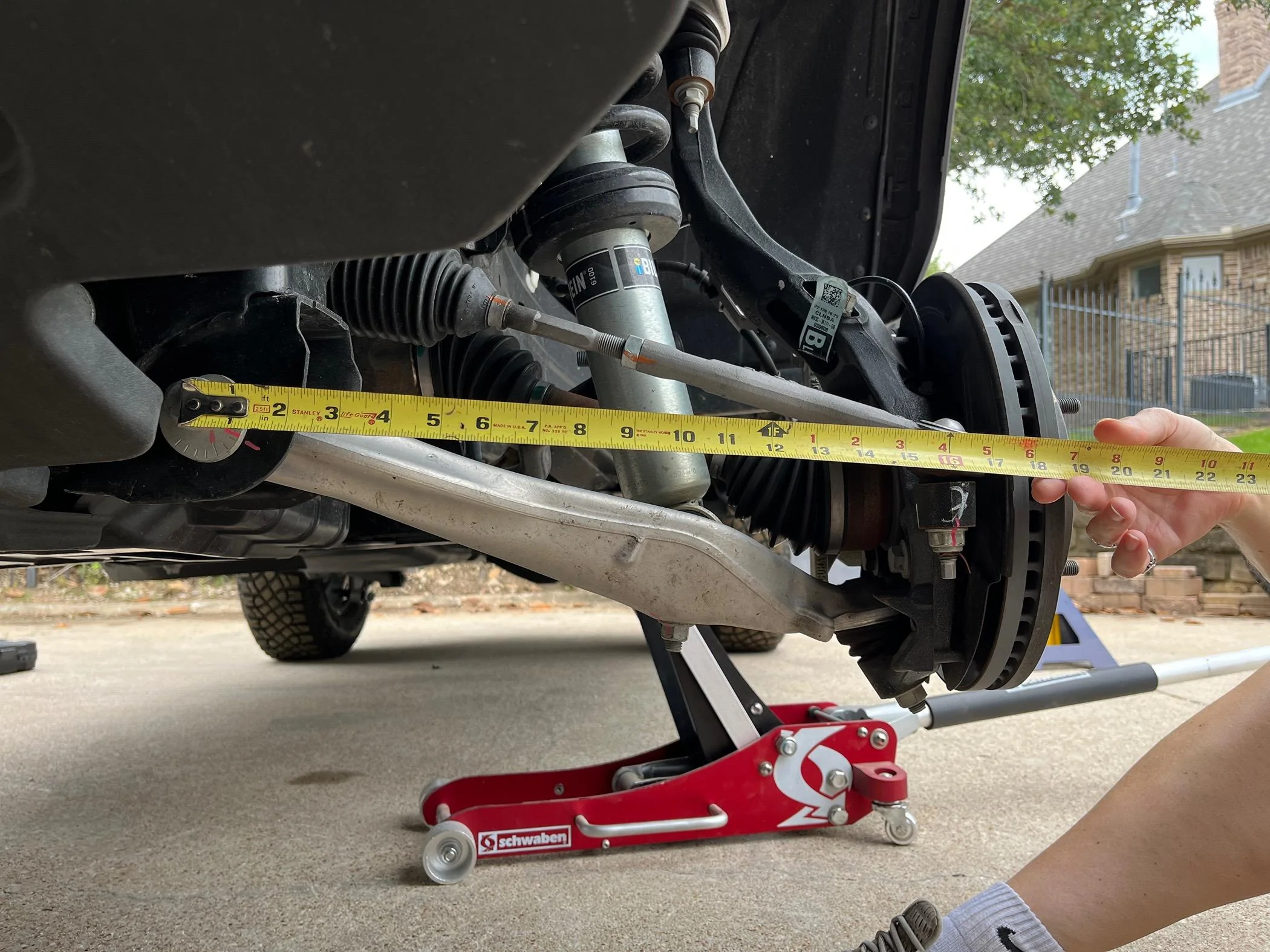
Some real numbers as an example for LCA kinematics. See photo.

for OEM LCA: rShock ~10”, rLCA ~16”, motion ratio is ~1.6 = rLCA/rShock

for long arm LCA w/ 4” increased radius and OEM hard points: rShock remains ~10”, rLCA -20”, motion ratio -2.0

Results of long arm LCA:

1) increased wheel travel of 25-30% for same shock displacement. Calculated from: dy_wheel = dy_shock ( rLCA/rShock).

2) increased shock loads of 25-30% for same wheel loading. Calculated from: Fshock = Fwheel ( rLCA/rShock ).

3) increased LCA pivot loads of 60% for same wheel loading. Calculated from: Fpivot = Fwheel [ ( rLCA/rShock) - 1 ]

Only point of my original post is that; Long arm LCA has great benefits (increased wheel travel) but also results in increased loads that need to be addressed. Especially when using bolt on OEM hard points.

Ford Bronco LOBO OFF-ROAD STAGE X FRONT SUSPENSION KIT F024AFA2-27DD-4D79-BF6B-AEBCEED9E884
 

BAUS67

Base
Well-Known Member
First Name
redneck
Joined
Jan 3, 2020
Threads
25
Messages
5,435
Reaction score
17,209
Location
Central PA
Vehicle(s)
88 5.0 LX, 08 F-150 Stepside, 22 Expl Timberline
Your Bronco Model
Base
Clubs
 
I happen to think about this the other day. I had not heard anything new about this. I ventured to the web site and it's not there, tried to search and found nothing. Did I miss something???? Did something not work out and decided to scrap the idea???? Just curious as to what happened here, I don't mean for this post to sound negative just wondered what happened because have not seen anything lately about it. Thought this was a big thing with SXSs and used in Ultra4 racing???? :unsure:
 
Last edited:
OP
OP
Lobo Off-Road

Lobo Off-Road

Wildtrak
Well-Known Member
Squatch Sponsor (Level 3)
First Name
Chris
Joined
Mar 18, 2022
Threads
22
Messages
445
Reaction score
938
Location
Hemet, CA
Website
lobooffroad.com
Vehicle(s)
All of them
Your Bronco Model
Wildtrak
I happen to think about this the other day. I had not heard anything new about this. I ventured to the web site and it's not there, tried to search and found nothing. Did I miss something???? Did something not work out and decided to scrape the idea???? Just curious as to what happened here, I don't mean for this post to sound negative just wondered what happened because have not seen anything lately about it. Thought this was a big thing with SXSs and used in Ultra4 racing???? :unsure:
We are revising a couple things that I wanted to fix before releasing it. One of the things is the cost. We are looking into doing a cast upright to lower cost, however, that is a large upfront cost on our end, that I do have a concern it paying for itself. We are working on simplifying the the kit ( NOT SACRAFICING QUALITY OR PERFORMANCE) but rather, looking at lowering labor cost/ weld time, in order to make the price point of the kit more attainable.
 

BAUS67

Base
Well-Known Member
First Name
redneck
Joined
Jan 3, 2020
Threads
25
Messages
5,435
Reaction score
17,209
Location
Central PA
Vehicle(s)
88 5.0 LX, 08 F-150 Stepside, 22 Expl Timberline
Your Bronco Model
Base
Clubs
 
We are revising a couple things that I wanted to fix before releasing it. One of the things is the cost. We are looking into doing a cast upright to lower cost, however, that is a large upfront cost on our end, that I do have a concern it paying for itself. We are working on simplifying the the kit ( NOT SACRAFICING QUALITY OR PERFORMANCE) but rather, looking at lowering labor cost/ weld time, in order to make the price point of the kit more attainable.

Awesome. Thanks for the reply, I'll stay tuned in. 😁
Sponsored


Top