

Sponsored

Adding a distribution block to positive side - Pics and Part links appreciated

JediMcMuffin

Badlands
Well-Known Member
First Name
Tommy
Joined
Jun 15, 2021
Threads
47
Messages
2,389
Reaction score
4,430
Location
San Diego
Vehicle(s)
2021 Bronco Badlands
Your Bronco Model
Badlands
Clubs
 
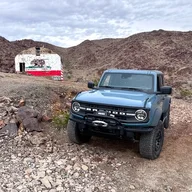
Ya'll are much smarter than me. All I know is that the accessory terminals on my positive connection have really begun to get crowded. That SDHQ solution didn't sit well with me either.

I'm running:
EcoFlow Smart Alternator Charger (third largest cable)
Ham Radio (rather small cable, really)
Warn Winch (largest cable)
ARB Twin Compressor (second largest cable(s))

Very few of these run concurrently. The radio realistically draws very little except when transmitting. I just don't love how it looks in the slightest. My negatives are pretty distributed throughout the engine bay, so thats less of an issue.
Sponsored
 
OP
OP
Shrek27

Shrek27

Black Diamond
Well-Known Member
Joined
Apr 14, 2023
Threads
1
Messages
382
Reaction score
475
Location
Fullerton CA
Vehicle(s)
Bronco
Your Bronco Model
Black Diamond
Clubs
 
That's a nice looking product! But it's impossible to give an exact answer because they don't tell you what the bus bar is made of. It looks like it's plated, so it's not aluminum or stainless which is good.

They say the studs are M4x0.7. That limits each circuit to about 10 amps. The connecting cables look to be about that diameter which is around 10-12 AWG which would go with four circuits each carrying 10 amps.

The bus bar is either brass or steel, probably steel and the plating is probably nickel which is good for low currents and corrosion protection. I think the bus bar is steel because the studs look like they PEM style press-in studs which are made for steel, stainless and aluminum. Again I'm sure the bar isn't stainless or aluminum because it's plated. Brass isn't strong enough for press-in studs.

If you own one of these use a magnet on the bus bar. I think one will stick.

I really like how they've mounted it. I may steal their idea if I need to fabricate a bus bar for extra connections, or just buy theirs.

I'd make the ground connection differently. At 2:50 they put their ground lug under the factory ground lug. I'd reverse the order and leave the factory ground lug against the chassis with the Borne lug next to the bolt head. The factory ground is probably carrying more current.

From what I see I think it's a nice product if you want to wire accessories that draw less than 10 amps each.
https://www.amazon.com/dp/B0BCJV424...XWMWVE6ZI&ref_=list_c_wl_lv_ov_lig_dp_it&th=1

These look like the block they use, but listing has higher 300A rating.

I also like this location for low amp needs. I have access to sheet metal and a bender so may just make a bracket and use something like this. With some prefab cable looks like this can be done for around $100 if you have some DIY in ya. Unsure if I'll follow their install and use that fuse box terminal. Good tip on the grounding lug!

I'll run the winch and Bluetti Charger 1 alternator charger straight to the battery on the open posts.

This has been very helpful, thanks to all who've added to the discussion. :idea: :clap:(y)
 
OP
OP
Shrek27

Shrek27

Black Diamond
Well-Known Member
Joined
Apr 14, 2023
Threads
1
Messages
382
Reaction score
475
Location
Fullerton CA
Vehicle(s)
Bronco
Your Bronco Model
Black Diamond
Clubs
 
Ya'll are much smarter than me. All I know is that the accessory terminals on my positive connection have really begun to get crowded. That SDHQ solution didn't sit well with me either.

I'm running:
EcoFlow Smart Alternator Charger (third largest cable)
Ham Radio (rather small cable, really)
Warn Winch (largest cable)
ARB Twin Compressor (second largest cable(s))

Very few of these run concurrently. The radio realistically draws very little except when transmitting. I just don't love how it looks in the slightest. My negatives are pretty distributed throughout the engine bay, so thats less of an issue.
Couldn't agree more! I knew there was plenty of expertise and experience to go around here and come up with a plan.
 

CalvinT

Badlands
Well-Known Member
First Name
Calvin
Joined
Mar 15, 2022
Threads
16
Messages
2,442
Reaction score
3,071
Location
Phoenix, AZ
Vehicle(s)
2002 Subaru WRX Wagon, 2023 Badlands (nonSAS)
Your Bronco Model
Badlands
Clubs
 
https://www.amazon.com/dp/B0BCJV424...XWMWVE6ZI&ref_=list_c_wl_lv_ov_lig_dp_it&th=1

These look like the block they use, but listing has higher 300A rating.

I also like this location for low amp needs. I have access to sheet metal and a bender so may just make a bracket and use something like this. With some prefab cable looks like this can be done for around $100 if you have some DIY in ya. Unsure if I'll follow their install and use that fuse box terminal. Good tip on the grounding lug!

I'll run the winch and Bluetti Charger 1 alternator charger straight to the battery on the open posts.

This has been very helpful, thanks to all who've added to the discussion. :idea: :clap:(y)
Those have M10 studs, which if they're copper should be good for up to 150A each. They're probably rating each stud at 100A which give a total rating for the bus bar of 300A. Good old Amazon!

The Black one would be good for a ground bus. But as centja1 pointed out, there's no provision for fuses for the positive or red bus.
 
Last edited:

Sponsored

Doc TOC

Badlands
Well-Known Member
First Name
John
Joined
Apr 4, 2023
Threads
1
Messages
301
Reaction score
750
Location
Los Angeles
Vehicle(s)
Expedition Max, Fusion Hybrid, BMW 5 Series, HD Road King
Your Bronco Model
Badlands
WOW! I had to duck there is so much flying around here.

@SierraBronco - thanks for the shout out. Glad @CalvinT stepped up while I was off galavanting.

I am not telling anyone what to buy. I don't know what your setup is. It would be irresponsible to recommend something based on a minor bit of information. Just move on if that is what you are looking for.

People: Stop talking voltage. It's all 12V. And it remains fairly constant while the engine is running the alternator. Measuring a voltage is misleading. Nobody cares it's a 2 foot tide, it's the surge that kills you.

AMPERAGE and RESISTANCE is the primary focus in automotive and marine wiring applications.
It changes at every junction, material type, gauge/thickness, contact surface, circuit length, and so on. THAT is what you should be thinking about.

For an off-road application, ALWAYS 1st look to what they do in the marine (seawater) environment. That is way more abusive than most off-road experiences. Sea dogs have been testing materials 100s of years before the auto came around. Ionic (galvinizing, oxidizing, chelating) reactions have existed since the earth formed and water showed up.

For anything over 20A, nickel-plated copper buses are the go-to. Nickel-plated aluminum in race boats; but, they are regularly torqued and changed out, as @CalvinT points out. (BTW, nice write up.)

Here is how the people who manage power systems look at bus bars:
1. Resistance
2. Conductivity surface area and density (see below)
3. Corrosion susceptibility
4. Thermal expansion
5. Material mass
6. Adjoining circuit length

Recall (or learn it) that electrons travel over the outer surface of a material faster than through it. Using a generality, which means there are lots of exceptions and "it depends", most of the voltage movement is over the top 10% outer surface layer of a conductive material. Electrons flow until they hit resistance. Then they follow the path of least resistance (every hear that before?) and go further down into the material matrix. Then vibration from the diversion creates heat, which causes more electrons to vibrate, and more heat. Then bonds fall apart. And presto! A short happens. And sometimes fires erupt.

Corrosion is the younger step-sibling of resistance. It takes time for it to grow up as ugly as resistance. Lots of ways to make a material corrode. Oxygen is #1 in all its ionic forms, which are everywhere. Even O2 in the presence of micro sparks turns ionic. Water is its ionic helper by providing surface adhesion and distribution. And electrical current provides disruptive electrons that break chemical bonds, opening the door for an ionic oxygen. All inorganics oxidize because it is a more stable material state, some easier than others. Some materials have really strong bonds and/or chemical structures that make it harder. But they all get there eventually. Ergo, the smelting industry to do a reset.

Thermal expansion is happening from continuous temperature changes all the time in a vehicle. Ambient temperatures, engine heat, wind (environmental or motion induced), the sun, you get the picture. So, at your junctions, where resistance is the biggest issue, creating gaps from dissimilar materials, with different expansion rates, is an issue. Gaps create 3 problems. Arcing, oxidation exposure, and material deformation. All the micro occurrences add up to macro issues. Then resistance shows up again. Materials heat up, more voltage arcing, and then stuff fails.

The more materials involved in a junction, guess what happens. Faster the resistance builds up. A lead post, with an unplated aluminum bar, with stainless screws and nuts, steel washers, copper wire, plastic spacers - what could possibly go wrong?!?

Material mass matters more when the amperage draw is large or fluctuates. Winching is a familiar example for most. The sudden draw, short flow, then stoppage taxes the lowest surface area points in a circuit. This is where size and thickness matters. If there is not adequate surface area, then material conductive density matters. Where are those electrons going to go? Into the material seeking an open valence bond. No place to go. Then it's electron party time, good vibrations happen, and things heat up.

All I am going to say about circuits is, it is a round trip. Your circuit, generally :wink:, is the length to your device TIMES 2. Electrons have to go back to the battery in order for work to occur. So when you read the gauge rating charts, that is for the full length of the circuit, not the half distance to your amp, winch, frig, whatever. If you are doing a front battery to rear gate twin air pump, that is a 50 foot circuit, not a 25 (assuming you route around a lot of stuff ond don't run your wires though the passenger cabin air or over the roof).



So what does all this ranting mean? (And thanks for reading this far.)

Don't get gimmicked into risking your electrical on stuff not thoroughly tested for your situation. If a vendor cannot provide 3rd party testing of their device for your setup scenario, then assume they are full of shit. That is DOD level thinking. Let them prove it to you.

If you don't know what your are doing (honestly admitting so), don't come here to get advice. 99% of us yokels either are clueless too, or haven't experienced your scenario. The other 1% are busy off-roading or educating themselves. Go get advice from someone who does this as a living. Someone who has training, knows what they are talking about, and has to be right, or goes hungry because they aren't. And only a fool saves a dollar only to add more risk to their (and their family's) life.

ALWAYS look to see what they do in the marine industry. A lot of those companies have met DOD, Navy, competitive racing, and yachting high standards for durability, corrosion resistance, vibration control, and reliability. Nobody wants to get stranded out on the water. It can be brutal and deadly when you screw up. They have a very low tolerance for dumb shits. Unfortunately, that ain't so in automotive. It seems to spawn them.
 
Last edited:

SierraBronco

Wildtrak
Well-Known Member
Joined
Mar 27, 2024
Threads
40
Messages
5,108
Reaction score
13,743
Location
USA
Vehicle(s)
2022 Wildtrak, 2024 Wildtrak, 2024 Wildtrak
Your Bronco Model
Wildtrak
Wow, Doc Toc bringing it today. Nice post
@CalvinT and @Doc TOC dropping ridiculously useful and very informative information as to why a 6061 block would be a bad idea. Second response - "I like it but it's kinda pricey"

"I ain't readin' all that. Way too many words in one post."
 
OP
OP
Shrek27

Shrek27

Black Diamond
Well-Known Member
Joined
Apr 14, 2023
Threads
1
Messages
382
Reaction score
475
Location
Fullerton CA
Vehicle(s)
Bronco
Your Bronco Model
Black Diamond
Clubs
 
WOW! I had to duck there is so much flying around here.

@SierraBronco - thanks for the shout out. Glad @CalvinT stepped up while I was off galavanting.

I am not telling anyone what to buy. I don't know what your setup is. It would be irresponsible to recommend something based on a minor bit of information. Just move on if that is what you are looking for.

People: Stop talking voltage. It's all 12V. And it remains fairly constant while the engine is running the alternator. Measuring a voltage is misleading. Nobody cares it's a 2 foot tide, it's the surge that kills you.

AMPERAGE and RESISTANCE is the primary focus in automotive and marine wiring applications.
It changes at every junction, material type, gauge/thickness, contact surface, circuit length, and so on. THAT is what you should be thinking about.

For an off-road application, ALWAYS 1st look to what they do in the marine (seawater) environment. That is way more abusive than most off-road experiences. Sea dogs have been testing materials 100s of years before the auto came around. Ionic (galvinizing, oxidizing, chelating) reactions have existed since the earth formed and water showed up.

For anything over 20A, nickel-plated copper buses are the go-to. Nickel-plated aluminum in race boats; but, they are regularly torqued and changed out, as @CalvinT points out. (BTW, nice write up.)

Here is how the people who manage power systems look at bus bars:
1. Resistance
2. Conductivity surface area and density (see below)
3. Corrosion susceptibility
4. Thermal expansion
5. Material mass
6. Adjoining circuit length

Recall (or learn it) that electrons travel over the outer surface of a material faster than through it. Using a generality, which means there are lots of exceptions and "it depends", most of the voltage movement is over the top 10% outer surface layer of a conductive material. Electrons flow until they hit resistance. Then they follow the path of least resistance (every hear that before?) and go further down into the material matrix. Then vibration from the diversion creates heat, which causes more electrons to vibrate, and more heat. Then bonds fall apart. And presto! A short happens. And sometimes fires erupt.

Corrosion is the younger step-sibling of resistance. It takes time for it to grow up as ugly as resistance. Lots of ways to make a material corrode. Oxygen is #1 in all its ionic forms, which are everywhere. Even O2 in the presence of micro sparks turns ionic. Water is its ionic helper by providing surface adhesion and distribution. And electrical current provides disruptive electrons that break chemical bonds, opening the door for an ionic oxygen. All inorganics oxidize because it is a more stable material state, some easier than others. Some materials have really strong bonds and/or chemical structures that make it harder. But they all get there eventually. Ergo, the smelting industry to do a reset.

Thermal expansion is happening from continuous temperature changes all the time in a vehicle. Ambient temperatures, engine heat, wind (environmental or motion induced), the sun, you get the picture. So, at your junctions, where resistance is the biggest issue, creating gaps from dissimilar materials, with different expansion rates, is an issue. Gaps create 3 problems. Arcing, oxidation exposure, and material deformation. All the micro occurrences add up to macro issues. Then resistance shows up again. Materials heat up, more voltage arcing, and then stuff fails.

The more materials involved in a junction, guess what happens. Faster the resistance builds up. A lead post, with an unplated aluminum bar, with stainless screws and nuts, steel washers, copper wire, plastic spacers - what could possibly go wrong?!?

Material mass matters more when the amperage draw is large or fluctuates. Winching is a familiar example for most. The sudden draw, short flow, then stoppage taxes the lowest surface area points in a circuit. This is where size and thickness matters. If there is not adequate surface area, then material conductive density matters. Where are those electrons going to go? Into the material seeking an open valence bond. No place to go. Then it's electron party time, good vibrations happen, and things heat up.

All I am going to say about circuits is, it is a round trip. Your circuit, generally :wink:, is the length to your device TIMES 2. Electrons have to go back to the battery in order for work to occur. So when you read the gauge rating charts, that is for the full length of the circuit, not the half distance to your amp, winch, frig, whatever. If you are doing a front battery to rear gate twin air pump, that is a 50 foot circuit, not a 25 (assuming you route around a lot of stuff ond don't run your wires though the passenger cabin air or over the roof).

So what does all this ranting mean? (And thanks for reading this far.)

Don't get gimmicked into risking your electrical on stuff not thoroughly tested for your situation. If a vendor cannot provide 3rd party testing of their device for your setup scenario, then assume they are full of shit. That is DOD level thinking. Let them prove it to you.

If you don't know what your are doing (honestly admitting so), don't come here to get advice. 99% of us yokels either are clueless too, or haven't experienced your scenario. The other 1% are busy off-roading or educating themselves. Go get advice from someone who does this as a living. Someone who has training, knows what they are talking about, and has to be right, or goes hungry because they aren't. And only a fool saves a dollar only to add more risk to their (and their family's) life.

ALWAYS look to see what they do in the marine industry. A lot of those companies have met DOD, Navy, competitive racing, and yachting high standards for durability, corrosion resistance, vibration control, and reliability. Nobody wants to get stranded out on the water. It can be brutal and deadly when you screw up. They have a very low tolerance for dumb shits. Unfortunately, that ain't so in automotive. It seems to spawn them.
Thanks for the detailed response. I've gotten alot from this thread. Mainly came to conclusion that I need to just repair the OEM terminal that I boogered up first, see what I need after that, and start again, which I will do with some new perspective.

For anyone too busy to read his post, here are my takeaways.
Avoid gimmicks ✅
Demand proven performance ✅
Seek expert advice when dealing with complex or high-load electrical setups ✅
 

mvilla

Badlands
Well-Known Member
First Name
Mike
Joined
Sep 19, 2023
Threads
23
Messages
237
Reaction score
317
Location
San Francisco
Vehicle(s)
4-door Badlands Bronco w/ Sasquatch package
Your Bronco Model
Badlands
https://www.amazon.com/dp/B0BCJV424...XWMWVE6ZI&ref_=list_c_wl_lv_ov_lig_dp_it&th=1

These look like the block they use, but listing has higher 300A rating.

I also like this location for low amp needs. I have access to sheet metal and a bender so may just make a bracket and use something like this. With some prefab cable looks like this can be done for around $100 if you have some DIY in ya. Unsure if I'll follow their install and use that fuse box terminal. Good tip on the grounding lug!

I'll run the winch and Bluetti Charger 1 alternator charger straight to the battery on the open posts.

This has been very helpful, thanks to all who've added to the discussion. :idea: :clap:(y)
https://www.amazon.com/dp/B0BCJV424...XWMWVE6ZI&ref_=list_c_wl_lv_ov_lig_dp_it&th=1

These look like the block they use, but listing has higher 300A rating.

I also like this location for low amp needs. I have access to sheet metal and a bender so may just make a bracket and use something like this. With some prefab cable looks like this can be done for around $100 if you have some DIY in ya. Unsure if I'll follow their install and use that fuse box terminal. Good tip on the grounding lug!

I'll run the winch and Bluetti Charger 1 alternator charger straight to the battery on the open posts.

This has been very helpful, thanks to all who've added to the discussion. :idea: :clap:(y)
Interested to see what you come up with. I was thinking of riveting a couple L brackets to the top of the quarter panel and attaching some aluminum sheet vertically. If you have some other ideas, please let me know!
 

Sponsored

CalvinT

Badlands
Well-Known Member
First Name
Calvin
Joined
Mar 15, 2022
Threads
16
Messages
2,442
Reaction score
3,071
Location
Phoenix, AZ
Vehicle(s)
2002 Subaru WRX Wagon, 2023 Badlands (nonSAS)
Your Bronco Model
Badlands
Clubs
 
Just a little extra info for those who like to experiment.

If you're curious about the electrical compatibility of two metals make a battery with them.

Put a saline solution in a non conducting container. Then insert the two metals, but make sure they don't touch. Those are your electrodes. Connect a digital voltmeter to the electrodes. The greater the voltage, the less the incompatibility. For example if you use aluminum and copper you'll get around 2.3V. With lead and copper you'll get around 0.5 volts.

With aluminum or stainless steel you may have to scratch them to break the passivating layer before immersing them in the saline.

While writing this I realized I made an error in my previous post. I said the difference with lead and aluminum was 0.5-0.6V. The correct voltage is 1.5-1.6V.
 
Last edited:

Karl_in_Chicago

Badlands
Well-Known Member
First Name
Karl
Joined
Jul 19, 2020
Threads
6
Messages
2,264
Reaction score
4,783
Location
Chicago
Vehicle(s)
Badlands
Your Bronco Model
Badlands
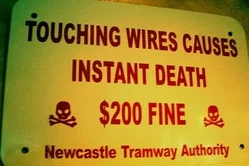
In a previous life I owned a home on Chicago's NW side very close to a Chicago CTA "L" station but where the trains ran at ground level instead of eLevated. Like any urban railway there were warning signs, barriers, yadda yadda but one night some REALLY drunk guy made his way past the barriers and walked down the tracks . . . and whizzed on the 3rd rail. He's no longer with us; not sure how he fared in that year's Darwin Award competition. 🙄
 

CalvinT

Badlands
Well-Known Member
First Name
Calvin
Joined
Mar 15, 2022
Threads
16
Messages
2,442
Reaction score
3,071
Location
Phoenix, AZ
Vehicle(s)
2002 Subaru WRX Wagon, 2023 Badlands (nonSAS)
Your Bronco Model
Badlands
Clubs
 
Real sign in Australia. They're strict down there.
Ford Bronco Adding a distribution block to positive side - Pics and Part links appreciated 200finedeath
Sponsored


Top