
Sponsored

Tailgate "Reinforcement"

OP
OP
Denis85

Denis85

Outer Banks
Well-Known Member
First Name
Chris
Joined
Apr 20, 2025
Threads
25
Messages
346
Reaction score
313
Location
New York
Vehicle(s)
2025 Bronco
Your Bronco Model
Outer Banks
Clubs
 

DarthLincoln

Badlands
Well-Known Member
First Name
Chuck
Joined
Feb 11, 2022
Threads
2
Messages
927
Reaction score
2,304
Location
Northern California - Contra Costa County
Vehicle(s)
1999 BMW M coupe, 2023 Ford Bronco Badlands 2dr
Your Bronco Model
Badlands
Clubs
 
Hopefully not to pedantic, but such reinforcement plates do not lower loads, they actually increase them. What they do accomplish is to increase stiffness and decrease stress in some areas.

The load is the input and the stress (and deflection) are the response.
Actually what @Oldhippie said was correct. He said:

the Hammer type plates do take some load off the aluminum tailgate
This is true.

In the stock configuration, the aluminum tailgate is the only thing attached to the hinges. So the full load of the spare-tire and spare-tire-carrier are on the aluminum tailgate.

In the modified configuration, both the aluminum tailgate and the steel reinforcement plate are attached to the hinges. The spare-tire-carrier is bolted to both the reinforcement plate and the aluminum tailgate which transfer their loads to the hinges. So the weight of the spare-tire and the spare-tire-carrier is distributed partly to the reinforcement plate and partly to the aluminum tailgate. Thus the loads on the aluminum tailgate are reduced. This is what he said.

You are correct that the reinforcement plate does not lower the total loads in the tailgate SYSTEM (instead they are increased by the weight of the reinforcement plate), but the system is not what @Oldhippie was talking about.
 

swamp2

Raptor
Well-Known Member
Joined
Dec 19, 2022
Threads
156
Messages
4,041
Reaction score
4,188
Location
San Diego
Vehicle(s)
911 Carrera S / 4Runner TRD Pro
Your Bronco Model
Raptor
Actually what @OldhippieIn the stock configuration, the aluminum tailgate is the only thing attached to the hinges. So the full load of the spare-tire and spare-tire-carrier are on the aluminum tailgate.
Well, not quite, the gate & spare mounting system and the spare itself all pass loads into both the gate, hinges and the latch, depending largely on an open or closed state.

In the modified configuration, both the aluminum tailgate and the steel reinforcement plate are attached to the hinges. The spare-tire-carrier is bolted to both the reinforcement plate and the aluminum tailgate which transfer their loads to the hinges. So the weight of the spare-tire and the spare-tire-carrier is distributed partly to the reinforcement plate and partly to the aluminum tailgate. Thus the loads on the aluminum tailgate are reduced. This is what he said.
In both cases the spare "routes" loads into both the aluminum gate and to the hinges.

A better way to think about this is that the added stiffness of an aftermarket reinforcement changes global deflections and stresses.

Whether or not these systems actually reduce loads in one area and increase them in others depends on many factors including; details of the mounting, fit and friction between components and fasteners, if the bolts are torqued with or without the spare attached and greatly on the dynamic loading. It's not so simple.

What is certain again is that a very stiff added plate, attached to the hinges or not, will reduce deflections in the relatively compliant gate.
 

DarthLincoln

Badlands
Well-Known Member
First Name
Chuck
Joined
Feb 11, 2022
Threads
2
Messages
927
Reaction score
2,304
Location
Northern California - Contra Costa County
Vehicle(s)
1999 BMW M coupe, 2023 Ford Bronco Badlands 2dr
Your Bronco Model
Badlands
Clubs
 
Well, not quite,
Yes “quite”. What i said was correct - don’t try to change what I said like you did in your first reply to @Oldhippie. I said “the full load of the spare-tire and spare-tire-carrier are on the aluminum tailgate”. Whether the aluminum tailgate then transfers loads to just the hinges when open, or to the hinges and the latch when closed is irrelevant to what i said - the spare-tire-carrier only attaches to the tailgate in the stock configuration, so the full load of the spare-tire and the carrier are transferred to the aluminum tailgate.

In both cases the spare "routes" loads into both the aluminum gate and to the hinges.
The spare-tire does NOT ”route“ loads to the hinges. The aluminum tailgate and carrier are between the spare-tire and the hinges in the load path.
If you want to be pedantic. The weight of the spare-tire is transferred to the carrier at the wheel/carrier interface. The load of their combined weight is transferred to the aluminum tailgate at the carrier/tailgate interface. The aluminum tailgate alone then transfers the load including its own weight to the hinges (and to the latch if closed).

Adding a reinforcement plate that attaches to both the carrier and the hinges provides a second load path between the carrier and the hinges and thus reduces the load going into the aluminum tailgate. That was the original point being made correctly before you started your pedantic digression. “the Hammer type plates do take some load off the aluminum tailgate”. That statement was correct.
 

swamp2

Raptor
Well-Known Member
Joined
Dec 19, 2022
Threads
156
Messages
4,041
Reaction score
4,188
Location
San Diego
Vehicle(s)
911 Carrera S / 4Runner TRD Pro
Your Bronco Model
Raptor
@DarthLincoln , yes absolutely "not quite" the Hammer type plates simply do not "take some load off the aluminum tailgate", instead, as I've described previously/repeatedly, they add stiffness (and mass) to the gate, decrease stress and deflections in the gate and redistribute stress in both the gate itself and hinges (and striker area).

The key thing they do to the gate itself is lower deflections and reduce stress. They just do not remove loads.

Let's try it this way. Removing a/some load could be done and that could be accomplished by running a much lighter spare! That is removing (reducing) a load!

Technically, it all depends on where you terminate your body of interest. The load from the spare, gate and anything else on the gate are transferred into the gate and into the hinges. If you isolate the gate for analysis then the hinges and stricker exert reaction forces and torques on the gate! Or you can also consider those perfectly rigid and as a boundary condition which certainly is an approximation. That's because the sheet metal body beyond the hinges and striker on the body are far from perfectly rigid and also deflect.

My use of spare along with "routes" had quotes since it's not quite precise. The weight and dynamic weight of the spare is the major load causing most of the system stresses. It's load is "routed from" the spare (technical at it's center of gravity) through its mounting points, to the gate, gate reinforcements (if present), to the hinges and striker, and on into the body on both sides of the gate. So the spare is the nexus or beginning of the critical load path and the "route". Hopefully that helps.

If you (both) want to continue considering reducing stress and deflection as "taking the load off" that will remain imprecise and colloquial at best.
 

Sponsored

DarthLincoln

Badlands
Well-Known Member
First Name
Chuck
Joined
Feb 11, 2022
Threads
2
Messages
927
Reaction score
2,304
Location
Northern California - Contra Costa County
Vehicle(s)
1999 BMW M coupe, 2023 Ford Bronco Badlands 2dr
Your Bronco Model
Badlands
Clubs
 
This discussion is going in circles. Both the aluminum tailgate structure and the reinforcement plate attach to the “load” (spare tire + carrier) and both attach to the ”base” (the hinges). So there are 2 independent structures supporting the load and transferring to the base.

(a) If there is no reinforcement plate, then 100% of the load is on the tailgate structure.
(b) If a reinforcement plate is added that also attaches to the load and to the hinges, then the tailgate structure is no longer supporting 100% of the load. Some % of the load is now supported by the reinforcement plate directly to the hinges. The hinges still see 100% of the load (part from the tailgate structure and part from the reinforcement plate) + the added load of the reinforcement plate.

I leave it at that.
 

crenca

Big Bend
Well-Known Member
First Name
Chris
Joined
Nov 4, 2024
Threads
24
Messages
1,382
Reaction score
2,234
Location
Southern New Mexico
Vehicle(s)
2016 Sequoia, 2012 Tundra, 2024 Sasquatched 2.3L 7M 4Door Bronco
Your Bronco Model
Big Bend
I am more concerned about the dynamic loads of a heavier wheel/tire and how those loads are distributed through the tailgate to the supports (hinges and latch). Adequate reinforcement helps to reduce displacement and local stress within the tailgate. This reduces the risk for plastic deformations within the tailgate, the primary failure mechanism. A true buckling stability concern (Euler buckling) is not likely.
Can you (or anyone else) tell if the 'plate' in the FP kit extends to the tire carrier (aka "the cone") itself...just eyeballing I am not sure, though I recognize it still may structurely reinforce the (load bearing) tailgate itself

https://www.bronco6g.com/forum/thre...or-broncos-here-at-lethal-performance.108707/

If a reinforcement plate is added that also attaches to the load and to the hinges, then the tailgate structure is no longer supporting 100% of the load. Some % of the load is now supported by the reinforcement plate directly to the hinges. The hinges still see 100% of the load (part from the tailgate structure and part from the reinforcement plate) + the added load of the reinforcement plate.
From a physics/structural point of view, I don't think it works that way. In other words the reinforcement itself together with the tailgate forms (maybe "synergizes" is the better word) a new structure that itself bears 100% of the load - it is one (new) thing, at least it is if it is competently designed and put together (thus @swamp2 caveat's about fasteners, torque spec, even rather the 'new thing' is screwed together with the relevant load (spare tire) on it or not).

While it may make intuitive sense (after all we took one thing and put it together with another thing), physically (structurally) there is no "division" of load that can be usefully described in percentages.
 

DarthLincoln

Badlands
Well-Known Member
First Name
Chuck
Joined
Feb 11, 2022
Threads
2
Messages
927
Reaction score
2,304
Location
Northern California - Contra Costa County
Vehicle(s)
1999 BMW M coupe, 2023 Ford Bronco Badlands 2dr
Your Bronco Model
Badlands
Clubs
 
From a physics/structural point of view, I don't think it works that way. In other words the reinforcement itself together with the tailgate forms (maybe "synergizes" is the better word) a new structure that itself bears 100% of the load - it is one (new) thing, at least it is if it is competently designed and put together (thus @swamp2 caveat's about fasteners, torque spec, even rather the 'new thing' is screwed together with the relevant load (spare tire) on it or not).

While it may make intuitive sense (after all we took one thing and put it together with another thing), physically (structurally) there is no "division" of load that can be usefully described in percentages.
Yeah I basically agree with that. It is a new structure as both the aluminum tailgate and the reinforcement plate are attaching to the same locations at the load and the hinges with the same bolts, only millimeters apart and under clamp load. I also agree you can‘t define or predict a % of load on either of the 2 parts. With weight transfer and friction and hole location/size tolerances the loading cannot be defined, and since these are not rigid bodies but will deflect, that load path shifts between the two. Only in a perfectly ideal concept of say 2 identical cantilevered beams attached close together on the same wall with a load perfectly balanced on the end of both beams as rigid bodies could you say something like 50% of the load is on one beam and 50% is on the other.
 

Pops

Badlands
Well-Known Member
Joined
May 17, 2025
Threads
3
Messages
237
Reaction score
601
Location
North of Seattle
Vehicle(s)
2025 2-door, Sas, Mid Pkg.
Your Bronco Model
Badlands
I am pretty sure we need several layers of management, engineering leads, and a few union reps to help with these discussions.
:shock::whistle:
Let's not forget a "guided" process of asking the *Five Whys.

-- from experience in the engineering world.

*one important meeting I attended, regarding why a poor design was causing troubles, had experts guiding the groups to the final answer: the assembly mechanics weren't getting enough sleep.
And management bought into this!!
:headbang:
 

87-Z28

Outer Banks
Well-Known Member
First Name
Andy
Joined
Sep 1, 2022
Threads
3
Messages
1,171
Reaction score
2,754
Location
Texas
Vehicle(s)
BMW
Your Bronco Model
Outer Banks
Clubs
 
Can you (or anyone else) tell if the 'plate' in the FP kit extends to the tire carrier (aka "the cone") itself...just eyeballing I am not sure, though I recognize it still may structurely reinforce the (load bearing) tailgate itself

https://www.bronco6g.com/forum/thre...or-broncos-here-at-lethal-performance.108707/


From a physics/structural point of view, I don't think it works that way. In other words the reinforcement itself together with the tailgate forms (maybe "synergizes" is the better word) a new structure that itself bears 100% of the load - it is one (new) thing, at least it is if it is competently designed and put together (thus @swamp2 caveat's about fasteners, torque spec, even rather the 'new thing' is screwed together with the relevant load (spare tire) on it or not).

While it may make intuitive sense (after all we took one thing and put it together with another thing), physically (structurally) there is no "division" of load that can be usefully described in percentages.
I just got the one from Barnes, since it was cheap and will provide some support. I am not convinced any of the others are that much better. So no reason to spend much in my opinion. there probably are real differences between the various designs but very difficult to evaluate without a proper stress analysis.
 

Sponsored

BlueBronco

Raptor
Well-Known Member
Joined
Jul 14, 2020
Threads
18
Messages
4,666
Reaction score
16,098
Location
DFW
Vehicle(s)
'16 F150-KR - '23 BR - '23 OBX
Your Bronco Model
Raptor
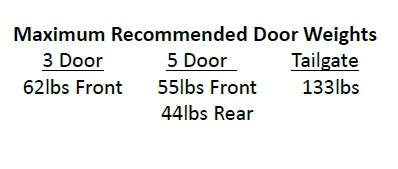
Also, the stock tailgate and hinges is capable of supporting 133lbs. I have a 37 hanging of the back of my un-reinforced tailgate without those rubber tailgate / tire bumper thingy's and haven't had any issues.

Ford Bronco Tailgate "Reinforcement" 1767132996840-91
 

indio22

Base
Well-Known Member
Joined
Aug 25, 2019
Threads
17
Messages
5,311
Reaction score
11,100
Location
Chicagoland, USA
Vehicle(s)
'72 Rover, '85 CJ7, '98 TJ, '14 BRZ, '23 Bronco
Your Bronco Model
Base
I am pretty sure we need several layers of management, engineering leads, and a few union reps to help with these discussions.
:shock::whistle:
Let's not forget a "guided" process of asking the *Five Whys.

-- from experience in the engineering world.

*one important meeting I attended, regarding why a poor design was causing troubles, had experts guiding the groups to the final answer: the assembly mechanics weren't getting enough sleep.
And management bought into this!!
:headbang:
Just don't call a Bronco engine a motor... apparently that's a faux pas in certain engineering circles.
 

Brian_B

Big Bend
Well-Known Member
First Name
Brian
Joined
Sep 14, 2023
Threads
60
Messages
8,233
Reaction score
14,571
Location
Central CA
Vehicle(s)
'23 BB 4dr 7MT, '22 BSport OBX, '87 B-II XL
Your Bronco Model
Big Bend
Clubs
 
Also, the stock tailgate and hinges is capable of supporting 133lbs. I have a 37 hanging of the back of my un-reinforced tailgate without those rubber tailgate / tire bumper thingy's and haven't had any issues.

1767132996840-91.webp
My tailgate got bent doing this with a 35” so … I hope it works out for you.
Sponsored


Top